
Level 10: 3D modelling and printing
Level 10 masters digital fabrication. Students design in Onshape and print their own products on a Creality Ender 3 V3 SE.


Level 10 at a glance
- Grade
- Grade 10 · High school
- Technology
- 3D modelling and printing
- Tools
- Onshape CAD and 3D printing
- Kit
- 3D Printing Kit, one per group of four
- Projects
- 15 projects and a Capstone
- Weekly time
- One 45 or 90 minute session
- Pre and post challenge
- Design a Reusable Utensil Holder
- Sustainability theme
- Health and Biological Systems
- Careers named
- Genetic Engineer, Cell Biologist, Bioengineer
 Level 10 book demo
See Level 10 in action
A short walk through the Level 10 workbook and the 3D Printing Kit, from the SKOOL21 channel.
More videos on the SKOOL21 channel →Projects from the 3D Printing Kit


Students can
- Model a part in Onshape
- Print and test a designed product
- Improve a design after testing
Summarised from the SKOOL21 Level Exit Outcomes.
How they work
- Define
- Design
- Share
- Reflect

Fifteen projects and a Capstone.
Full exit outcomes and Sustainable Development Goals for Level 10
Engineering & Design
- Design a part independently in Onshape CAD software and 3D-print it to solve a sustainability-linked problem (the "Design a Reusable Utensil Holder" pre/post challenge).
- Apply the full Engineering Design Process (NGSS HS-ETS1) through self-selected digital design and fabrication, without this level's alternative to a fixed team-role structure.
- Plan a solution visibly in CAD, producing a saved design artifact, before fabrication.
- Participate in structured "Share and Improve" peer critique rounds on an individual design rather than team-based building.
Science
- Apply high-school engineering design standards to a digitally fabricated solution (NGSS HS-ETS1).
- Investigate heredity or molecules-to-organisms content connected to a design problem (NGSS LS1/LS3).
- Explore a human-activity/Earth-systems theme such as responsible consumption (NGSS ESS3).
- Investigate IGCSE Biology 0610 content such as cell structure, DNA, or organ systems — the dominant science strand at this level, often via a physical model built alongside the CAD design.
Mathematics
- Apply IGCSE Core/Extended Number and Mensuration concepts to size a 3D-printed part accurately, such as fitting it in a school bag (Cambridge IGCSE Mensuration/Number).
- Use geometry, trigonometry, or transformations/vectors concepts to model a 3D shape in CAD (Cambridge IGCSE Geometry, Trigonometry, Transformations & Vectors).
- Apply high-school algebra, functions, or geometry concepts embedded in a CAD-based design task (Common Core HS Algebra, Functions, Geometry).
- Interpret statistics or probability from testing multiple print iterations (Cambridge IGCSE Statistics/Probability; Common Core HS Statistics & Probability).
Computing & Coding
- Model a physical part in Onshape, a professional-grade CAD platform, using precise dimensions and parametric design tools.
- Prepare and execute a 3D-print job on a Creality Ender-class printer from a completed CAD file — a full digital design-to-physical-object workflow.
Give and receive structured peer feedback through multi-round “Share and Improve” critique, working without a fixed team-role structure.
Recognize real health & life-science careers peaking again around 3D-printed biology models, such as Genetic Engineer, Cell Biologist, or Bioengineer.
Identify the Sustainable Development Goal connected to their build, themed around Health & Biological Systems.
From the SKOOL21 Level Exit Outcomes. Standards named are NGSS, Common Core and Cambridge strands.
- 2 Zero Hunger
- 3 Good Health and Well-being
- 4 Quality Education
- 6 Clean Water and Sanitation
- 7 Affordable and Clean Energy
- 8 Decent Work and Economic Growth
- 9 Industry, Innovation and Infrastructure
- 12 Responsible Consumption and Production
- 14 Life Below Water
Source: SKOOL21 Five Pillars Framework. Compare all levels
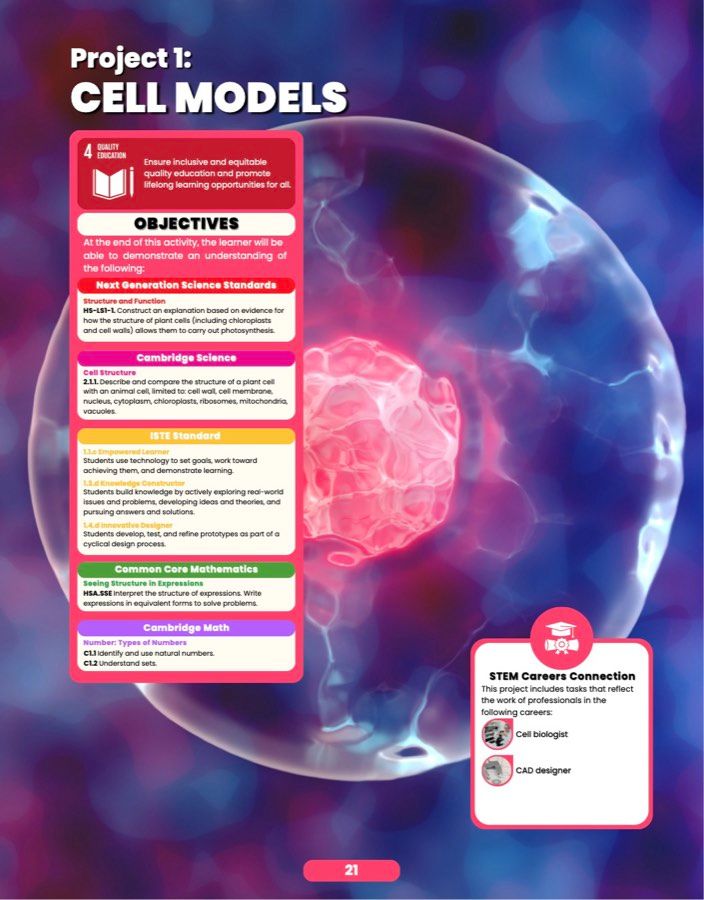
Project 1: Cell Models
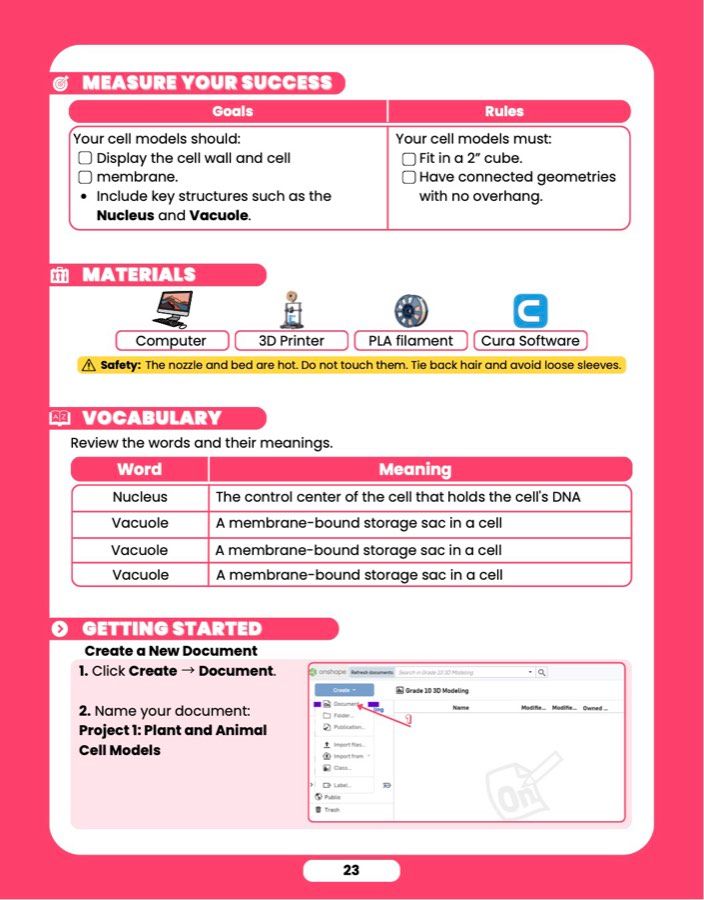
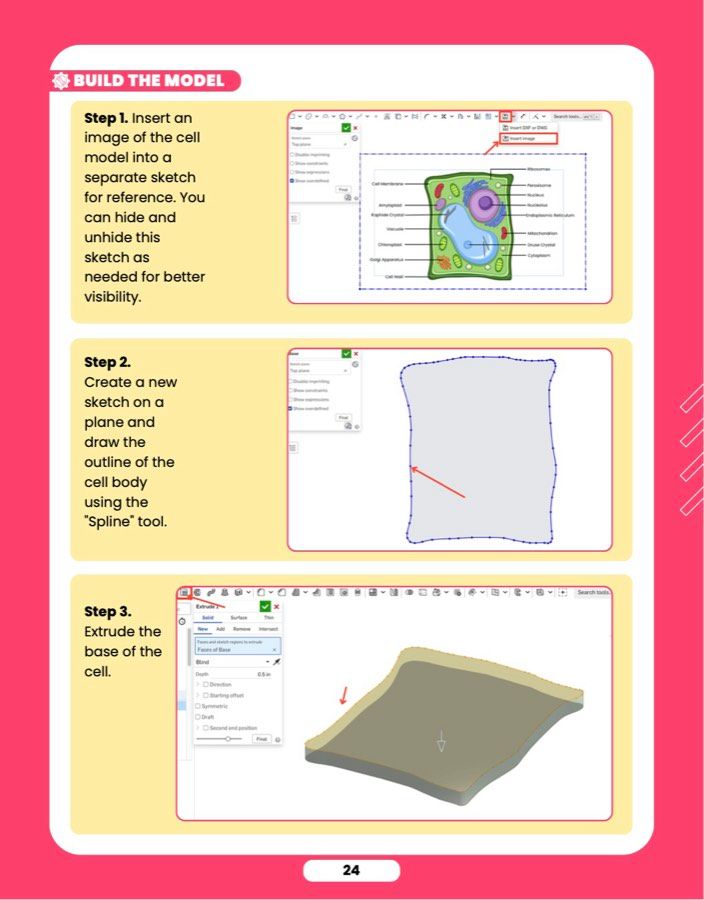
The first project of the level, as it appears in the guidebook. The full workbook is in the reader below where published.
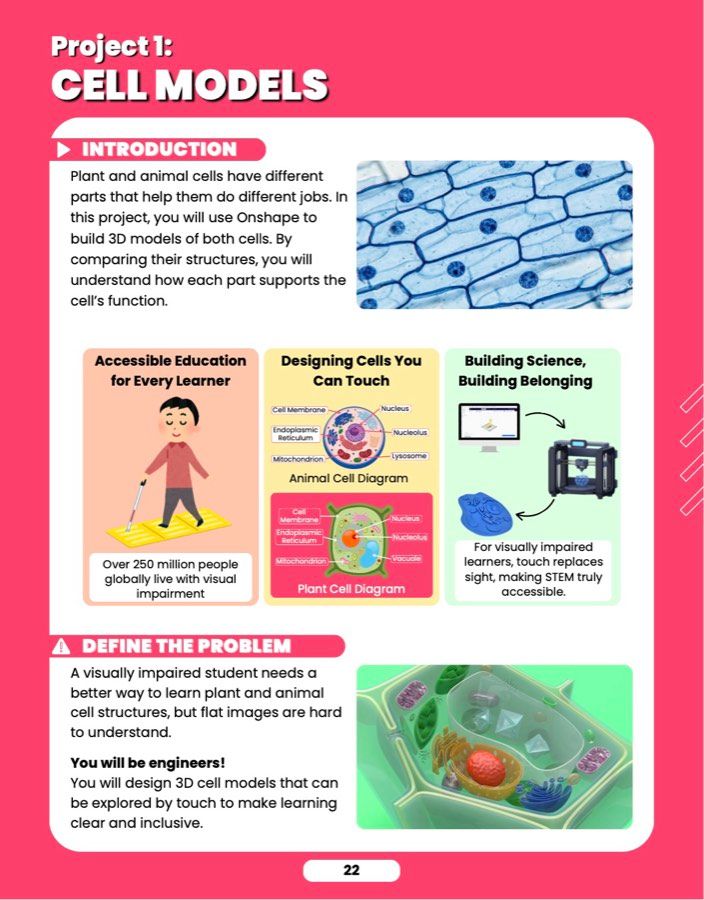
A visually impaired student needs a better way to learn plant and animal cell structures, but flat images are hard to understand. You will design 3D cell models that can be explored by touch to make learning clear and inclusive.The problem, as printed in the workbook.
- Goal named
- SDG 4 · Quality Education
- Careers named
- Cell Biologist, CAD Designer
- Standards cited
- NGSS HS-LS1-1; Cambridge IGCSE Biology 2.1.1; Common Core HSA.SSE; Cambridge IGCSE Mathematics C1.1, C1.2
Standards cited in Level 10, project by project
One row per project, quoted as the guidebook cites them. An empty cell means no citation for that project.
- PS3
- LS1
- LS2
- LS3
- ESS3
- ETS1
- Biology (IGCSE 0610 / A-Level topics)
- Physics (IGCSE 0625 / A-Level topics)
- Level 10 codes with no clear IGCSE subject match (excluded above)
- Number (IGCSE 0580 topic 1)
- Algebra and Graphs (IGCSE 0580 topic 2)
- Coordinate Geometry (IGCSE 0580 topic 3)
- Geometry (IGCSE 0580 topic 4)
- Mensuration (IGCSE 0580 topic 5)
- Level 10 capstone code not classifiable (excluded above)
| Project | SDG | NGSS | Cambridge Science | Cambridge Maths | Common Core Maths | Careers named |
|---|---|---|---|---|---|---|
| 1 Cell Models | (4) Quality Education | HS-LS1-1 | 2.1.1 | C1.1 / C1.2 | HSA-SSE | Cell Biologist, CAD Designer |
| 2 Heart Model Keychain | (3) Good Health and Well-Being | HS-LS1-2 | 9.1 | C1.6 | HSA-SSE | Medical Professional, Bioengineer |
| 3 Digestive System Puzzle | (3) Good Health and Well-Being | HS-LS1-2 | 7.2.1 / 7.3.1 | C4.6 | HSG-SRT-C | Doctor, Nurse |
| 4 Lung Model | (3) Good Health and Well-Being | HS-ETS1-2 | 11.1.2 | C2.10 | HSF-LE-A | Medical Instructor, Nurse |
| 5 Centrifuge | (3) Good Health and Well-Being | HS-ETS1-3 | 9.4.1 / 9.4.3 | C1.5 / C5.4 | MP4 | Doctor, Nurse |
| 6 DNA Model | (3) Good Health and Well-Being | HS-LS3-1 | 17.1.1 | C1.1 | MP2 | Genetic Tester, Genetic Engineer |
| 7 Punnett Square Simulator | (2) Zero Hunger | HS-LS3-3 | 17.4.11 | C2.7 | HSS-ID-A | Biologist, Agriculturist |
| 8 Food Chain Model | (14) Life Below Water | LS2.B | 19.2.3 | C1.11 | MP8 | Ecologist, Marine Biologist |
| 9 Water Collector | (6) Clean Water and Sanitation | HS-ETS1-2 | 4.2 | C1.11 | MP2 | Environmental Engineer, Civil Engineer |
| 10 Carbon Cycle Compost Bin | (12) Responsible Consumption and Production | HS-ETS1-3 | 19.3.1 | C1.6 | MP2 | Product Designer, Environmental Engineer |
| 11 Wind Anemometer | (7) Affordable and Clean Energy | HS-ESS3-4 | 2.2 | C5.2 | HSS-ID-A | Mechanical Engineer, Civil Engineer |
| 12 Habitat Rehabilitation | (12) Responsible Consumption and Production | ETS1.B | 20.2.2 | C3.1 | HSG-MG.A | Biologist, Environmental Engineer |
| 13 Sound Amplifier | (7) Affordable and Clean Energy | HS-ETS1-3 | 3.4.7 | E1.11 / E5.3 | HSG-MG.A.3 | Acoustic Engineer, Product Designer |
| 14 Levers | (9) Industry, Innovation and Infrastructure | HS-PS3-3 | 1.7.2 | C1.6 | HSA-SSE.A | Mechanical Engineer, Mechanic |
| 15 Multi-Stage Rockets | (8) Decent Work and Economic Growth | HS-ETS1-2 | 1.2 | E1.12.3 | HSG-GMD.B.4 | Aerospace Engineer, Astronaut |
| Capstone MicroClean | — | — | — | Depends on the project | Depends on the project | — |
Source: SKOOL21 Level A to 12 curriculum crosswalk (2026), compiled from the teacher guides and student books. Where the two differ, the student book prevails.
What you order
| Item | Title | ISBN or SKU |
|---|---|---|
| Student workbook | STEM Innovator’s Workbook, Level 10 | 978-981-17494-0-7 |
| Teacher guidebook | Guidebook, Level 10 | 978-981-17737-4-7 |
| Learning kit | 3D Printing Kit | STEMSIHKitG10 |
Assessment built in
Four checkpoints a year use a seven-criterion rubric, and every other project gets a 30 second workbook check.
How assessment works →Standards mapped
The guidebook maps each project to NGSS, Cambridge and Common Core standards where they apply.
See the table for this level →