
Level A: Mechanical construction
Pre-K learners build with gears, wheels and rods, taking their first steps in design thinking through touch and play.

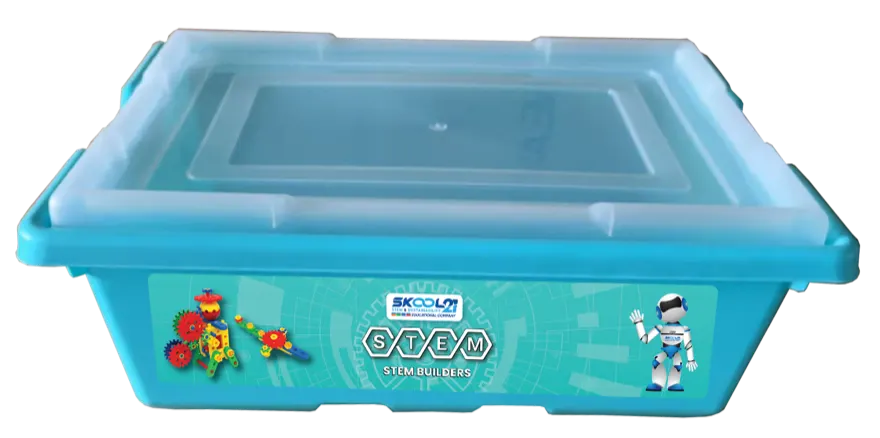
Level A at a glance
- Grade
- Pre-Kindergarten · Foundation
- Technology
- Mechanical construction
- Tools
- Pre-code, hands-on building
- Kit
- STEM Builders Kit, one per group of four
- Projects
- 15 projects and a Capstone
- Weekly time
- One 45 or 90 minute session
- Pre and post challenge
- Build the Tallest Tower
 Level A book demo
See Level A in action
A short walk through the Level A workbook and the STEM Builders Kit, from the SKOOL21 channel.
More videos on the SKOOL21 channel →Projects from the STEM Builders Kit


Students can
- Follow guided, step by step instructions to build simple mechanical structures
- Build a free-standing structure to a set height and count the pieces used
- Test by hand whether a build does its simple job
Summarised from the SKOOL21 Level Exit Outcomes.
How they work
- Plan
- Do
- Improve
- Review

Fifteen projects and a Capstone.
Full exit outcomes for Level A
Engineering & Design
- Follow guided, step-by-step instructions to build simple mechanical structures (levers, wheels, connecting rods) using kit blocks, rods, and pegs.
- Build a free-standing structure that stands independently to a specified height, tallying how many pieces were used (the "Build the Tallest Tower" pre/post challenge).
- Test, through direct hands-on trial, whether a built object performs its simple intended function (stands, balances, moves).
- Use comparison vocabulary (taller/shorter, more/fewer, stronger/weaker) to describe and refine a build with teacher guidance.
Science
- Observe and describe simple physical properties of building materials (shape, size, stability) through hands-on exploration.
- Notice and describe a simple cause-and-effect relationship encountered during guided building (e.g., a wider base makes a structure more stable).
- Use early scientific observation vocabulary introduced through the build itself (balance, strong/weak, up/down).
Mathematics
- Recognize and record numbers 1–10 while counting build pieces (Cambridge Primary Number).
- Name and sort 2D and 3D shapes found among kit pieces (Cambridge Primary Shape/Geometry).
- Compare length and mass of built objects through direct comparison — taller/shorter, heavier/lighter (Cambridge Primary Measure).
- Represent and interpret simple data, such as a tally of pieces used to build a structure (Cambridge Primary Data; Thinking & Working Mathematically).
Computing & Coding
- Follow and repeat a simple ordered sequence of physical building steps — an early, non-digital precursor to sequential/algorithmic thinking.
- Physically manipulate mechanical components (rods, pegs, wheels) as a foundation for the automation and coding content introduced from Level 1 on.
Collaborate in an informal, teacher-guided small group to build, test, and share a solution — the first step toward the formal team roles introduced at Level 1.
Not yet introduced — SKOOL21 begins explicitly naming real STEM careers from Level 1 on.
Not present by design — Level A’s guidebook intentionally aligns only to Cambridge Math at this age (confirmed design decision, not a gap).
From the SKOOL21 Level Exit Outcomes. Standards named are NGSS, Common Core and Cambridge strands.
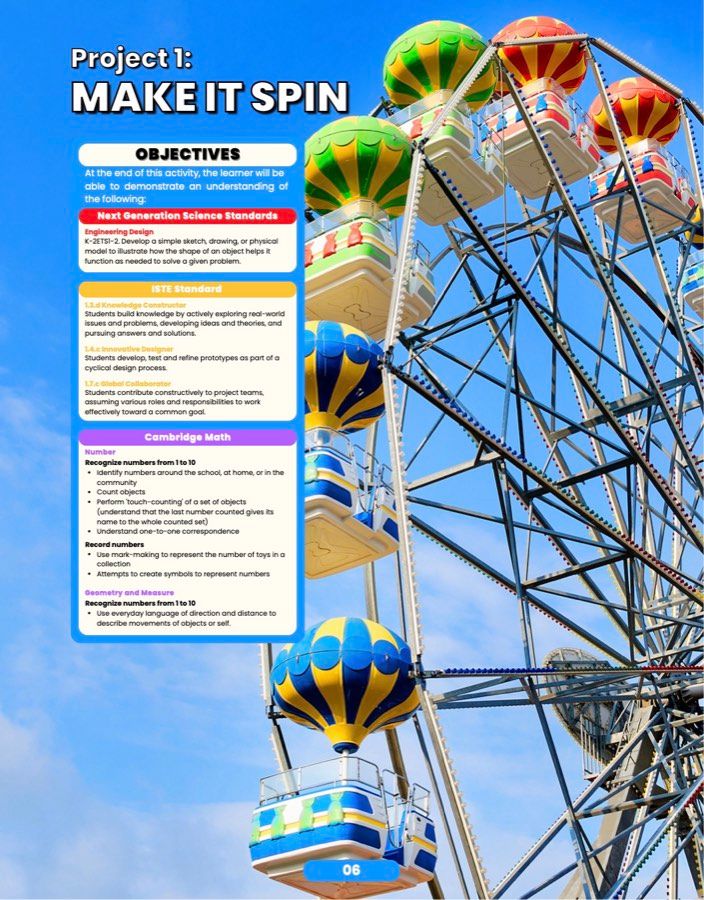
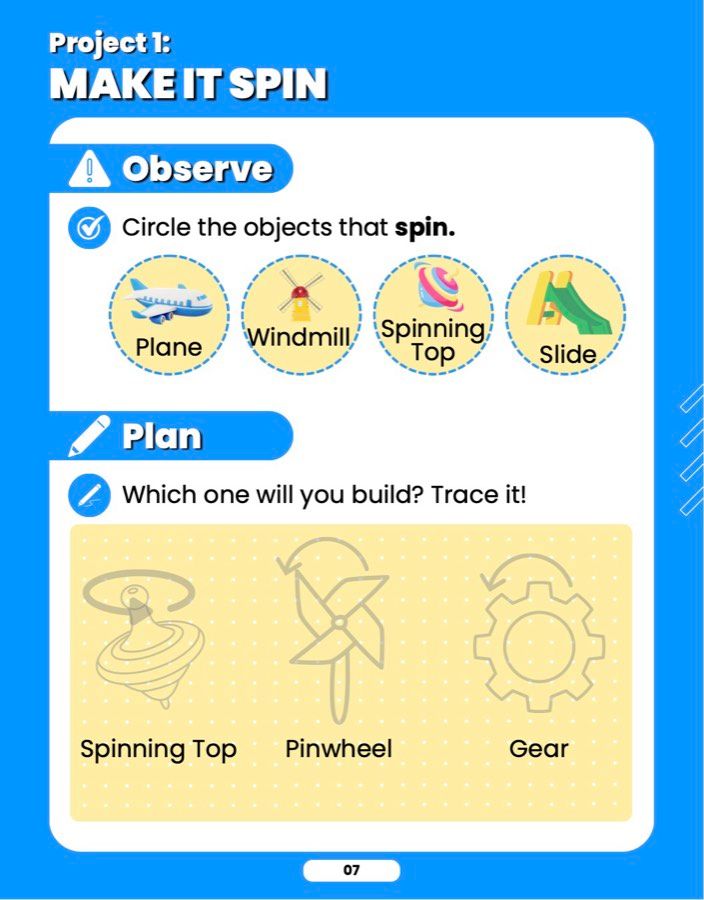
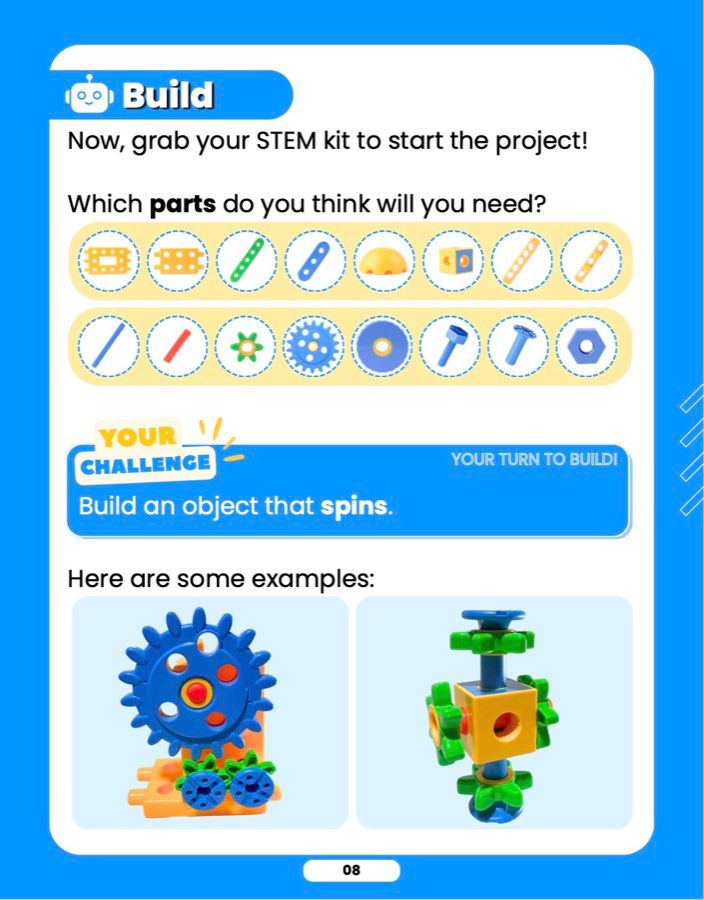
Project 1: Make It Spin
The first project of the level, as it appears in the guidebook. The full workbook is in the reader below where published.
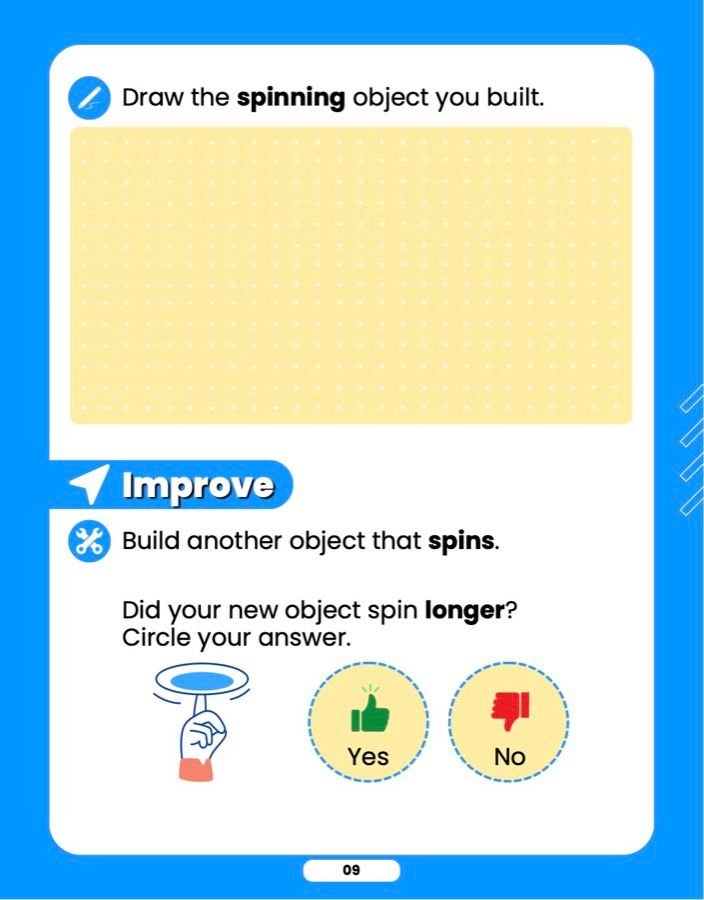
Children circle the objects that spin, then choose a spinning top, a pinwheel or a gear to trace and build.
- Standards cited
- NGSS K-2-ETS1-2; Cambridge Early Years Mathematics: number, geometry and measure
Standards cited in Level A, project by project
One row per project, quoted as the guidebook cites them. An empty cell means no citation for that project.
| Project | Cambridge Maths |
|---|---|
| 1 Make it Spin | Recognise numbers 1–10Record numbersThinking and Working Mathematically |
| 2 Make it Roll | Recognise numbers 1–10Record numbersName/sort 2D shapesDirection & distance languageTWM |
| 3 Make it Tall | Name/sort 3D shapesCompare length/massRepresent & interpret dataTWM |
| 4 Make it Ten | Recognise numbers 1–10Name/sort 3D shapesRepresent & interpret dataTWM |
| 5 Make a Pattern | Recognise numbers 1–10Repeating colour patterns w/ beads or countersTWM |
| 6 Make a Shelter | Name/sort 2D shapesCompare length/massRepresent & interpret dataTWM |
| 7 Make a Game | Recognise numbers 1–10Record numbersRepresent & interpret dataTWM |
| 8 Make a Toy | Name/sort 2D shapesDirection & distance languageRepresent & interpret dataTWM |
| 9 Make a Machine | Recognise numbers 1–10TWM |
| 10 Make a Model | Compare length/massRepresent & interpret dataTWM |
| 11 Make a Wrecking Ball | Name/sort 3D shapesRepresent & interpret dataTWM |
| 12 Make a City | Recognise numbers 1–10Name/sort 2D shapesCompare length/massRepresent & interpret dataTWM |
| 13 Make a Robot | Recognise numbers 1–10TWM |
| 14 Make a Vehicle | Direction & distance languageCompare length/massRepresent & interpret dataTWM |
| 15 Make a Playground | Recognise numbers 1–10Name/sort 2D shapesRepresent & interpret dataTWM |
| Capstone Build a Gym Machine | Recognise numbers 1–10TWM |
Level A cites Cambridge Early Years mathematics descriptors rather than numbered codes. By design, the Pre-K guidebook does not cite SDGs, NGSS, Cambridge Science, ISTE or careers. Source: SKOOL21 Level A to 12 curriculum crosswalk (2026), compiled from the teacher guides and student books. Where the two differ, the student book prevails.
Read Level A online
The full workbook, and the teacher guide where published, in a page-turning reader.

STEM Innovator’s Workbook, Level A
Opens a page-turning reader from Issuu. Issuu may set its own cookies once it loads.
Teacher Guide, Level A
Opens a page-turning reader from Issuu. Issuu may set its own cookies once it loads.
What you order
| Item | Title | ISBN or SKU |
|---|---|---|
| Student workbook | STEM Innovator’s Workbook, Level A | 978-981-17521-4-8 |
| Teacher guidebook | Guidebook, Level A | 978-981-17736-3-1 |
| Learning kit | STEM Builders Kit | STEMSIHKitPreK |
Assessment built in
Four checkpoints a year use a seven-criterion rubric, and every other project gets a 30 second workbook check.
How assessment works →Standards mapped
The guidebook maps each project to NGSS, Cambridge and Common Core standards where they apply.
See the table for this level →