
Level 6: Circuits, sensors and data
Level 6 moves from robotics to specialised circuitry. Humidity and motion sensors and advanced MakeCode programming build technical and data literacy.

Level 6 at a glance
- Grade
- Grade 6 · Middle school
- Technology
- Circuits, sensors and data
- Tools
- Advanced MakeCode
- Kit
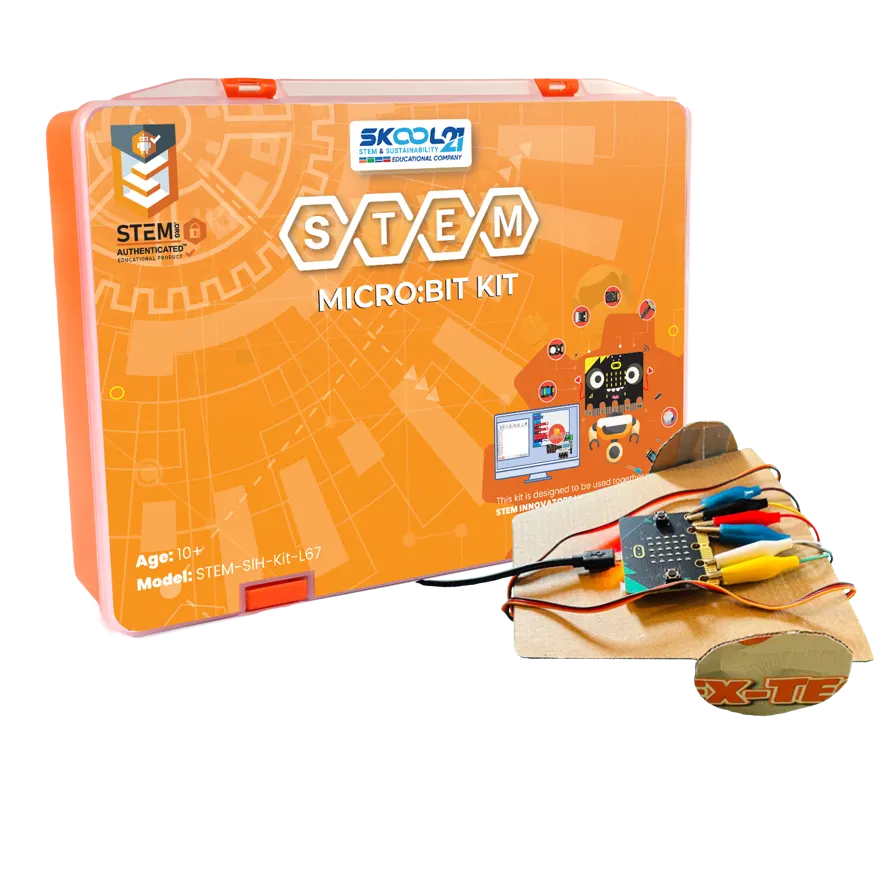
- STEM Micro:bit Kit, one per group of four
- Projects
- 15 projects and a Capstone
- Weekly time
- One 45 or 90 minute session
- Pre and post challenge
- Build a Fall Alert
- Sustainability theme
- Health, Consumption and Energy
- Careers named
- Cardiologist, Obstetrician, Public Health Expert
 Level 6 book demo
See Level 6 in action
A short walk through the Level 6 workbook and the STEM Micro:bit Kit, from the SKOOL21 channel.
More videos on the SKOOL21 channel →Projects from the STEM Micro:bit Kit


Students can
- Wire and program specialised sensors
- Program in advanced MakeCode
- Read and use sensor data to make a decision
Summarised from the SKOOL21 Level Exit Outcomes.
How they work
- Define
- Design
- Share
- Reflect

Fifteen projects and a Capstone.
Full exit outcomes and Sustainable Development Goals for Level 6
Engineering & Design
- Build a device using the micro:bit's accelerometer and specialized sensors that detects a sudden fall or drop and sounds an alarm (the "Build a Fall Alert" pre/post challenge).
- Apply advanced circuit-building skills with specialized sensors (humidity, motion, ultrasonic) to a safety- or ecosystem-themed problem.
- Test a safety-themed device against a real trigger condition and confirm it responds correctly.
- Define criteria and constraints and iterate on a solution to a stated real-world problem (NGSS MS-ETS1).
Science
- Investigate ecosystems for the first time in the programme through a safety, security, or ecosystem-themed problem (NGSS LS2).
- Explore an Earth's-Place-in-the-Universe topic connected to a project (NGSS ESS1).
- Investigate motion and forces relevant to detecting a fall or sudden movement (NGSS PS2).
- Investigate a biology topic as the leading content strand, with this level reaching slightly ahead of grade-typical content (Cambridge Science Stage 6–7 — Biology).
Mathematics
- Apply ratio and proportional reasoning, such as the threshold sensitivity of an accelerometer (Common Core Ratios & Proportional Relationships).
- Use number and probability/statistics concepts to interpret repeated sensor-test results (Cambridge Statistics incl. Probability; Common Core Statistics & Probability).
- Apply expressions/equations or number-system concepts to define a numeric alarm threshold (Common Core The Number System; Expressions & Equations).
Computing & Coding
- Write advanced MakeCode programs on a micro:bit that read specialized sensors (accelerometer, ultrasonic, humidity, motion) and trigger outputs.
- Combine multiple sensor inputs into a single program using more complex conditional logic and circuit wiring.
- Debug and refine code so a safety-themed device responds correctly and consistently to a real trigger condition.
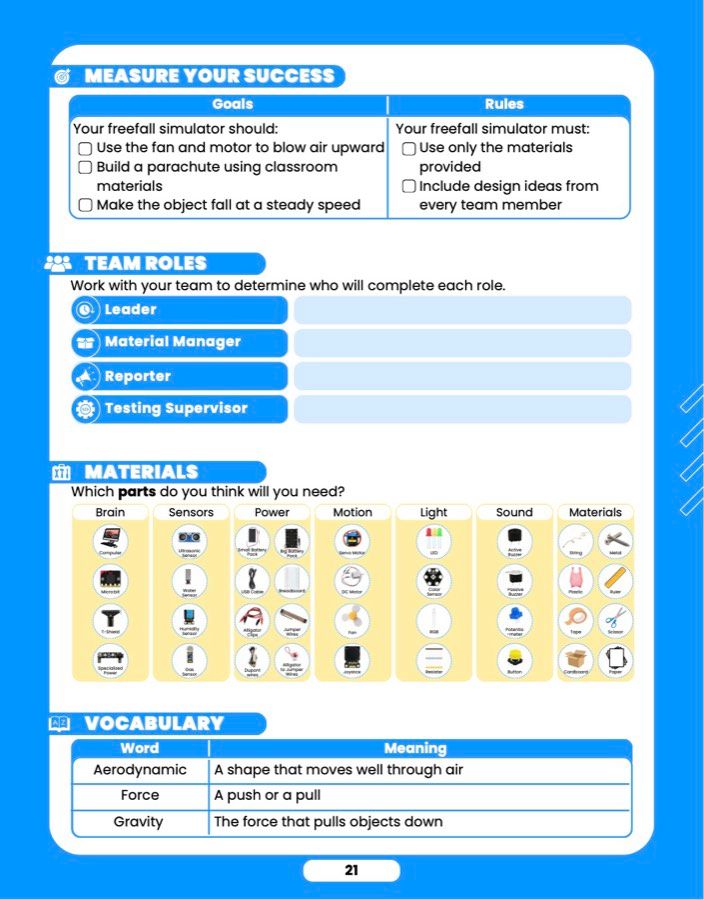
Take on and fulfill a defined team role — Leader, Material Manager, Reporter, or Testing Supervisor — while collaborating, communicating, and resolving conflict within a build team.
Recognize real health & life-science careers, named more often here than engineering ones for the first time, such as Cardiologist or Public Health Expert.
Identify the Sustainable Development Goal connected to their build, themed around Health, Consumption & Energy.
From the SKOOL21 Level Exit Outcomes. Standards named are NGSS, Common Core and Cambridge strands.
- 2 Zero Hunger
- 3 Good Health and Well-being
- 4 Quality Education
- 7 Affordable and Clean Energy
- 9 Industry, Innovation and Infrastructure
- 11 Sustainable Cities and Communities
- 12 Responsible Consumption and Production
- 13 Climate Action
- 15 Life on Land
- 16 Peace, Justice and Strong Institutions
Source: SKOOL21 Five Pillars Framework. Compare all levels
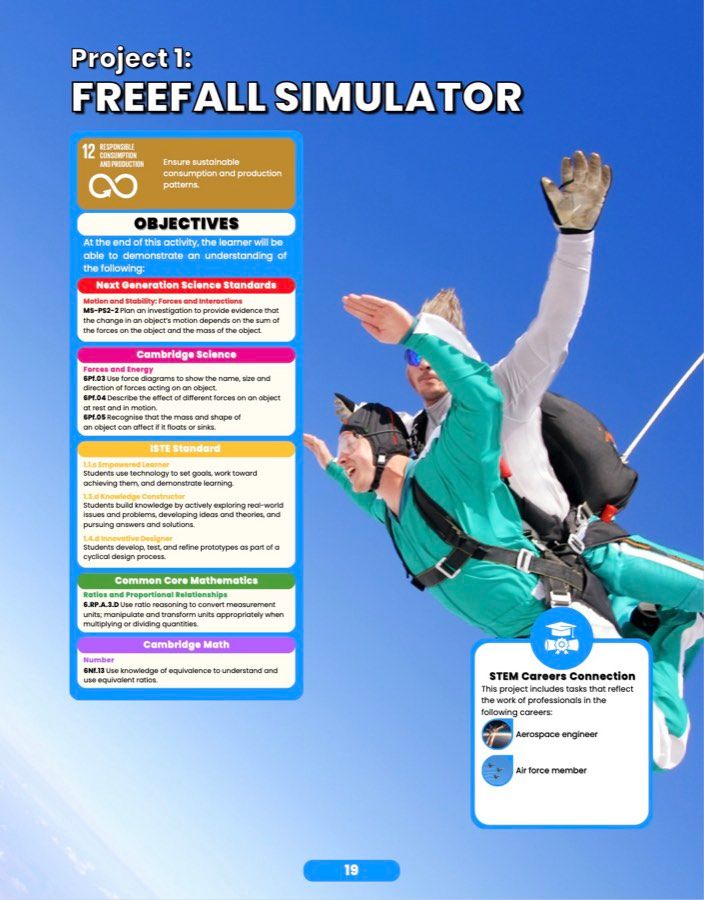
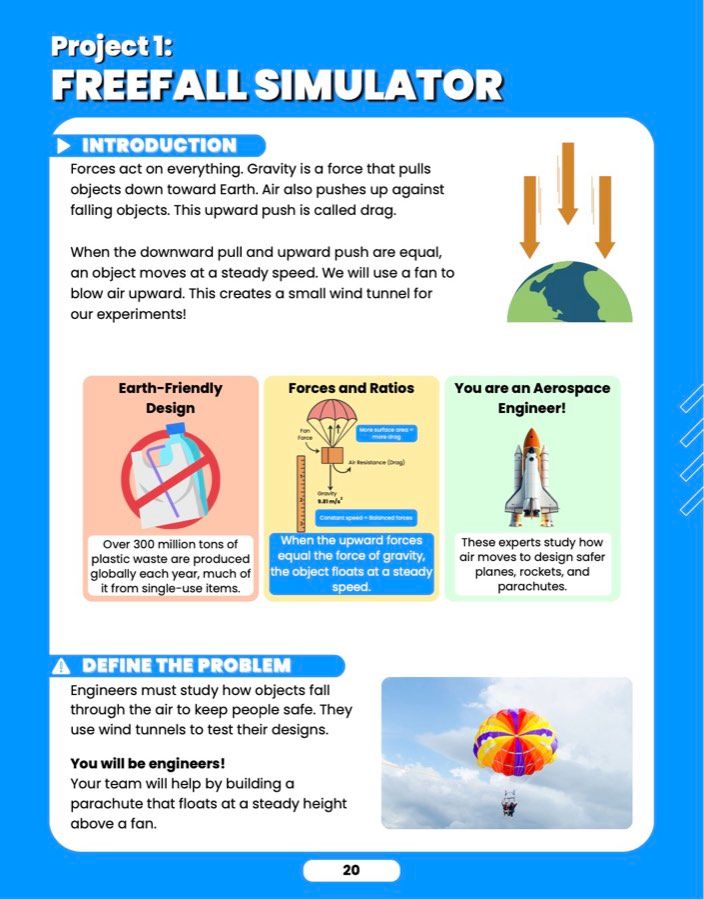
Project 1: Freefall Simulator
The first project of the level, as it appears in the guidebook. The full workbook is in the reader below where published.
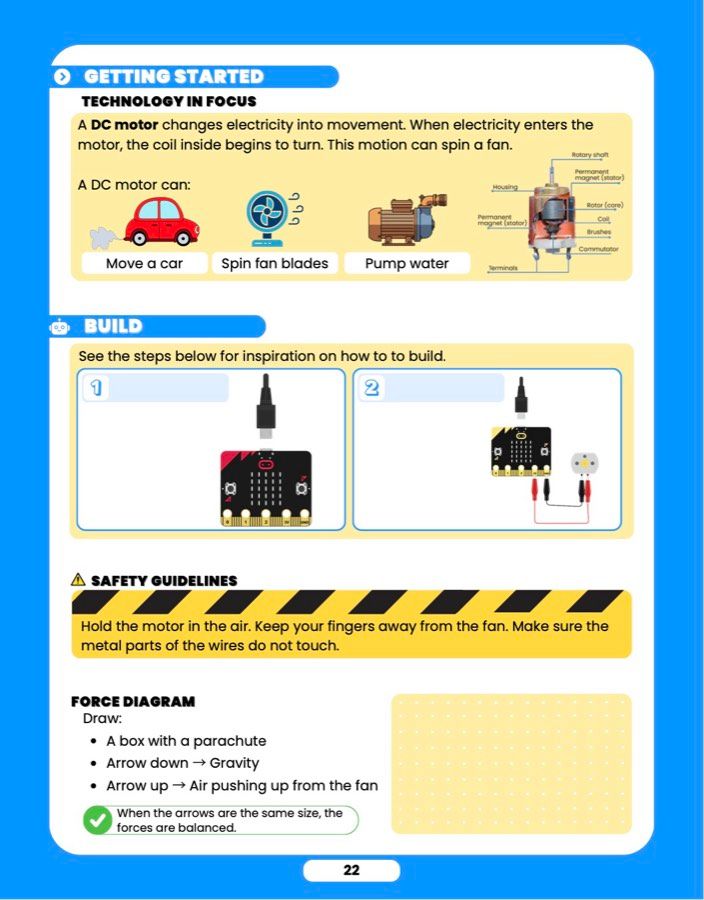
Engineers must study how objects fall through the air to keep people safe. They use wind tunnels to test their designs. Your team will help by building a parachute that floats at a steady height above a fan.The problem, as printed in the workbook.
- Goal named
- SDG 12 · Responsible Consumption and Production
- Careers named
- Aerospace Engineer, Air Force Member
- Standards cited
- NGSS MS-PS2-2; Cambridge Science 6Pf.03, 6Pf.04, 6Pf.05; Common Core 6.RP.A.3.D; Cambridge Mathematics 6Nf.13
Standards cited in Level 6, project by project
One row per project, quoted as the guidebook cites them. An empty cell means no citation for that project.
- PS2
- PS3
- LS1
- LS2
- ESS1
- ESS3
- ETS1
- TWSc
- TWSa
- Bp
- Bs
- Be
- Pf
- Ps
- ESp
- ESs
- SIC
- Nc
- Ni
- Nf
- Ss
- Sp
| Project | SDG | NGSS | Cambridge Science | Cambridge Maths | Common Core Maths | ISTE | Careers named |
|---|---|---|---|---|---|---|---|
| 1 Free Fall Simulator | Responsible Consumption and Production | MS-PS2-2 | 6Pf.036Pf.046Pf.05 | 6Nf.13 | 6.RP.A.3.D | 1.3.d1.4.a | Aerospace Engineer, Air Force Member |
| 2 Water Level Detector | Sustainable Cities and Communities | MS-LS2-5 | 6TWSa.05 | 6Nc.02 | 6.EE.B.7 | 1.3.d | Marine Biologist, Ecologist |
| 3 Ultrasonic Scanner | Good Health and Well-Being | MS-ETS1-2 | 6Bs.03 | 6Nc.03 | 6.EE.A.2 | 1.3.d1.4.a | Obstetrician, Fertility Specialist |
| 4 Circulatory System Model | Good Health and Well-Being | MS-ETS1-2 | 6Bs.01 | 6Nf.13 | 6.RP.A.1 | 1.3.d1.4.c | Cardiologist, Electrical Engineer |
| 5 Predator-Prey Graph Simulator | Life on Land | MS-LS2-1 | 6Be.05 | 6Ni.04 | 6.NS.B.3 | 1.3.d1.4.a | Ecologist, Data Analyst |
| 6 Bee Blower | Climate Action | MS-LS2-5 | 6Bp.02 | 6Nf.076Nf.12 | 6.RP.A.3.C | 1.4.a | Beekeeper, Botanist |
| 7 Posture Alarm | Good Health and Well-Being | MS-ETS1-2 | 6Ps.01 | 6Ni.02 | 6.EE.B.8 | 1.3.d | Physical Therapist, Biomedical Engineer |
| 8 Friction Car | Affordable and Clean Energy | PS2.A | 6Ps.03 | 6Ss.04 | 6.SP.B.56.SP.B.5.A | 1.3.d1.4.a | Automotive Engineer, Materials Scientist |
| 9 Toxic Checker | Zero Hunger | MS-LS2-3 | 6Be.02 | 6Ss.02 | 6.G.A.1 | 1.3.d1.4.a | Wildlife Biologist, Public Health Expert |
| 10 Pollution Monitor | Industry, Innovation and Infrastructure | MS-ESS3-3 | 6Es.02 | 6Nf.03 | 6.G.A.2 | 1.3.d | Environmental Engineer, Air Quality Control Officer |
| 11 Weight Prediction | Responsible Consumption and Production | MS-ESS1-2 | 6Ps.01 | 6Nf.03 | 6.EE.B.6 | 1.7.c | Aeronautical Engineer |
| 12 Microorganism Monitor | Affordable and Clean Energy | MS-LS1-5 | 7Bs.017Be.01 | 6Nf.08 | 6.EE.A.2 | 1.3.d | Chemical Engineer, Public Health Professional |
| 13 Thermal Servo | Quality Education | MS-PS3-3 | 6Pf.04 | 6Ss.04 | 6.SP.B.4 | 1.3.d | Mechanical Engineer, Environmental Engineer |
| 14 Global Impact | Industry, Innovation and Infrastructure | MS-ESS3-3 | 7SIC.05 | 6Sp.01 | 7.SP.C.5 | 1.7.c | Cybersecurity Professional, Emergency Responder |
| 15 Eclipse Light Tracker | Quality Education | MS-ESS1-1 | 7ESs.04 | 6Nf.13 | 6.RP.A.3.B6.RP.A.3.D | 1.3.d | Astronomer, Earth Scientist |
| Capstone Safety and Security | Peace, Justice and Strong Institutions | MS-ETS1-1 | 6TWSc.03 | — | — | 1.3.d | — |
Source: SKOOL21 Level A to 12 curriculum crosswalk (2026), compiled from the teacher guides and student books. Where the two differ, the student book prevails.
What you order
| Item | Title | ISBN or SKU |
|---|---|---|
| Student workbook | STEM Innovator’s Workbook, Level 6 | 978-981-17494-4-5 |
| Teacher guidebook | Guidebook, Level 6 | 978-981-17737-0-9 |
| Learning kit | STEM Micro:bit Kit | STEMSIHKitG67 |
Levels 6 and 7 share the STEM Micro:bit Kit.
Assessment built in
Four checkpoints a year use a seven-criterion rubric, and every other project gets a 30 second workbook check.
How assessment works →Standards mapped
The guidebook maps each project to NGSS, Cambridge and Common Core standards where they apply.
See the table for this level →