
Level 1: Powered mechanics and automation
Level 1 introduces powered mechanics and automation, with motors, input sensors and output devices, and the full design process.

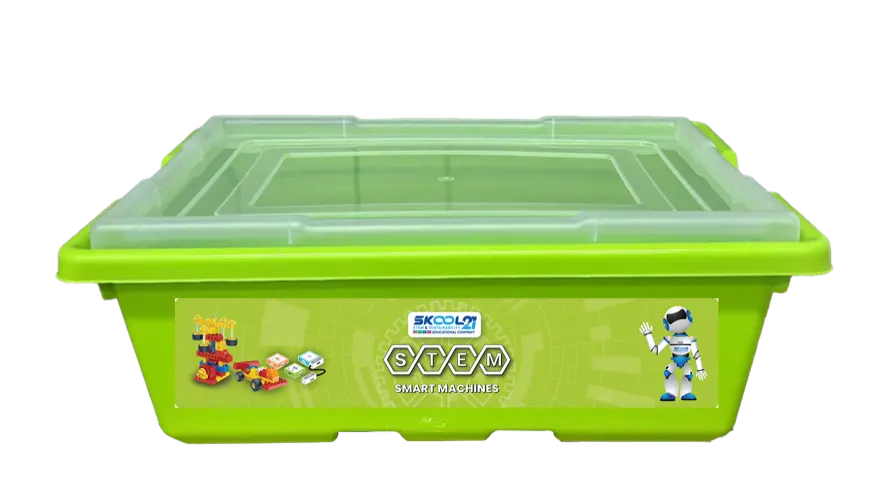
Level 1 at a glance
- Grade
- Grade 1 · Primary
- Technology
- Powered mechanics and automation
- Tools
- Coded action blocks
- Kit
- Smart Machines Kit, one per group of four
- Projects
- 15 projects and a Capstone
- Weekly time
- One 45 or 90 minute session
- Pre and post challenge
- Design a Rain Catcher
- Sustainability theme
- Clean Water and Sanitation
- Careers named
- Wind Farm Developer, City Planner, Civil Engineer
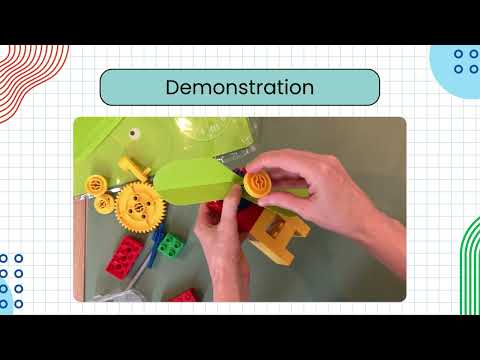 Level 1 book demo
See Level 1 in action
A short walk through the Level 1 workbook and the Smart Machines Kit, from the SKOOL21 channel.
More videos on the SKOOL21 channel →Projects from the Smart Machines Kit


Students can
- Build a machine powered by a motor
- Use a sensor as an input and an output device as a result
- Work through Define, Design, Share and Reflect with a partner
Summarised from the SKOOL21 Level Exit Outcomes.
How they work
- Define
- Design
- Share
- Reflect

Fifteen projects and a Capstone.
Full exit outcomes and Sustainable Development Goals for Level 1
Engineering & Design
- Define a design problem using stated criteria and constraints for the first time — e.g., a container that must hold water and be easy to empty (the "Design a Rain Catcher" pre/post challenge).
- Build a solution from the Smart Machines Kit's coded blocks, motors, and sensors that meets the stated criteria.
- Test a built solution against its criteria and identify one needed improvement.
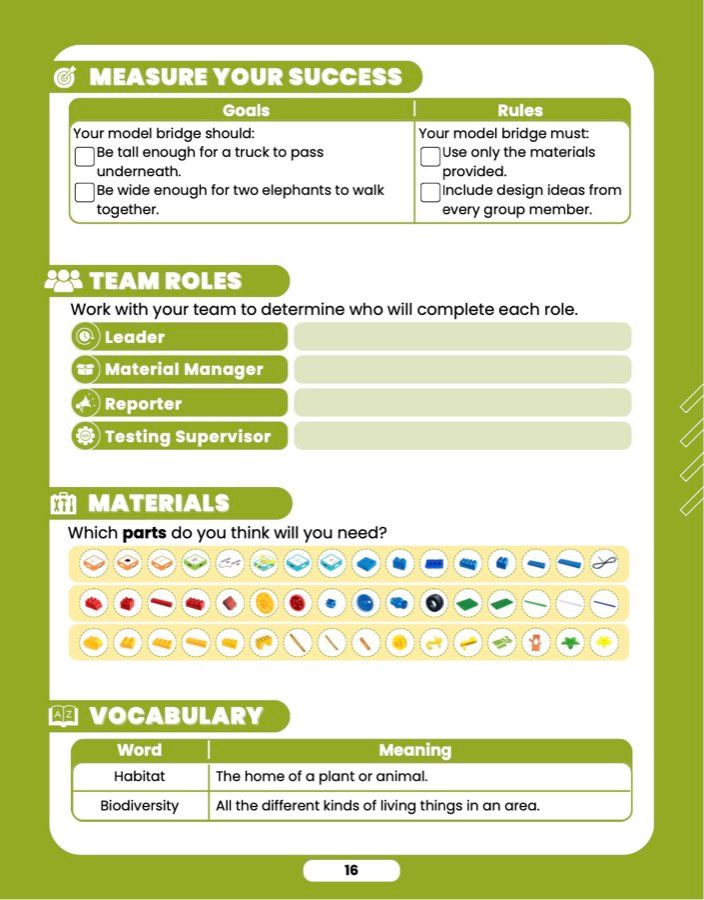
- Work within the level's first defined 4-role team structure (Leader, Material Manager, Reporter, Testing Supervisor) to complete a build.
Science
- Describe a basic earth process relevant to a build, such as where rainwater comes from and how it can be collected and reused (NGSS Earth's Place in the Universe; Cambridge Science Earth & Space).
- Connect a build to an introductory physical-science (waves) or life-science (heredity) idea encountered this year (NGSS PS4 Waves; LS1/LS3 Heredity).
- Apply Thinking & Working Scientifically skills — observing, predicting, testing — while building and testing a device (Cambridge Science Stage 1, continuing).
- Connect a build to a real-world scenario as an example of science in context (Cambridge Science — Science in Context).
Mathematics
- Count, compare, and combine quantities of parts used in a build (Cambridge Primary Number; Common Core Operations & Algebraic Thinking, Number & Operations in Base Ten).
- Identify and use simple 2D/3D shapes and spatial relationships in a design (Cambridge Primary Geometry; Common Core Geometry).
- Collect and represent simple data from testing, such as how much water a container holds (Cambridge Primary Statistics; Common Core Measurement & Data).
Computing & Coding
- Use simple coded action blocks to sequence and trigger motor and sensor behavior on a physical device — a tangible introduction to programmed control ahead of visual/text coding.
- Apply basic if-this-then-that logic in a physical build (e.g., a trigger causes a motor to move).
Take on and fulfill a defined team role — Leader, Material Manager, Reporter, or Testing Supervisor — while collaborating, communicating, and resolving conflict within a build team.
Name a career connected to a completed design (e.g., Environmental Engineer).
Name a sustainability goal connected to a completed design (Clean Water and Sanitation).
From the SKOOL21 Level Exit Outcomes. Standards named are NGSS, Common Core and Cambridge strands.
- 7 Affordable and Clean Energy
- 8 Decent Work and Economic Growth
- 9 Industry, Innovation and Infrastructure
- 11 Sustainable Cities and Communities
- 13 Climate Action
- 15 Life on Land
Source: SKOOL21 Five Pillars Framework. Compare all levels
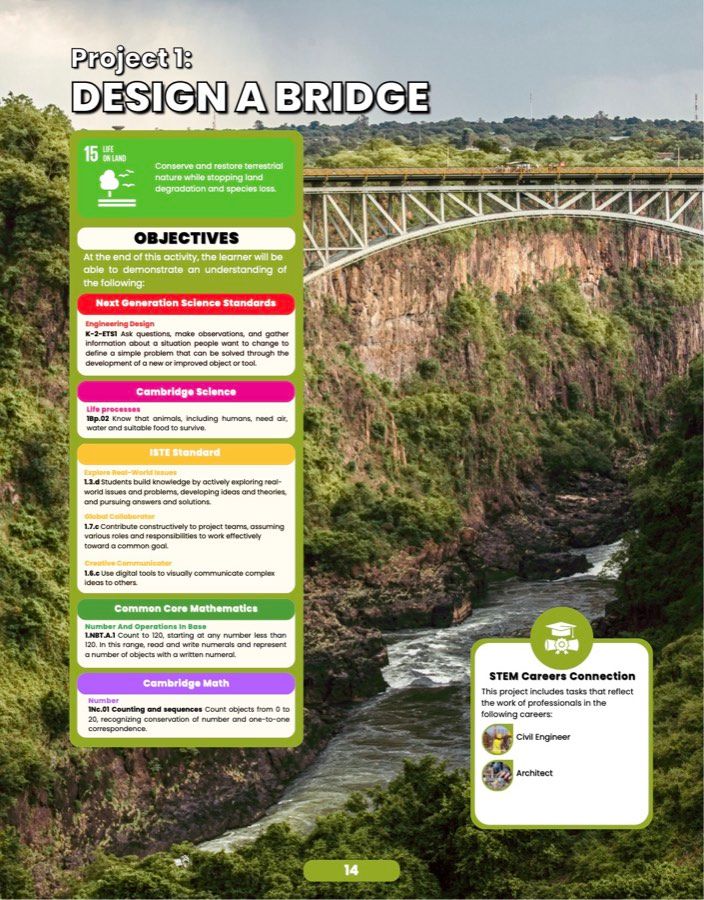
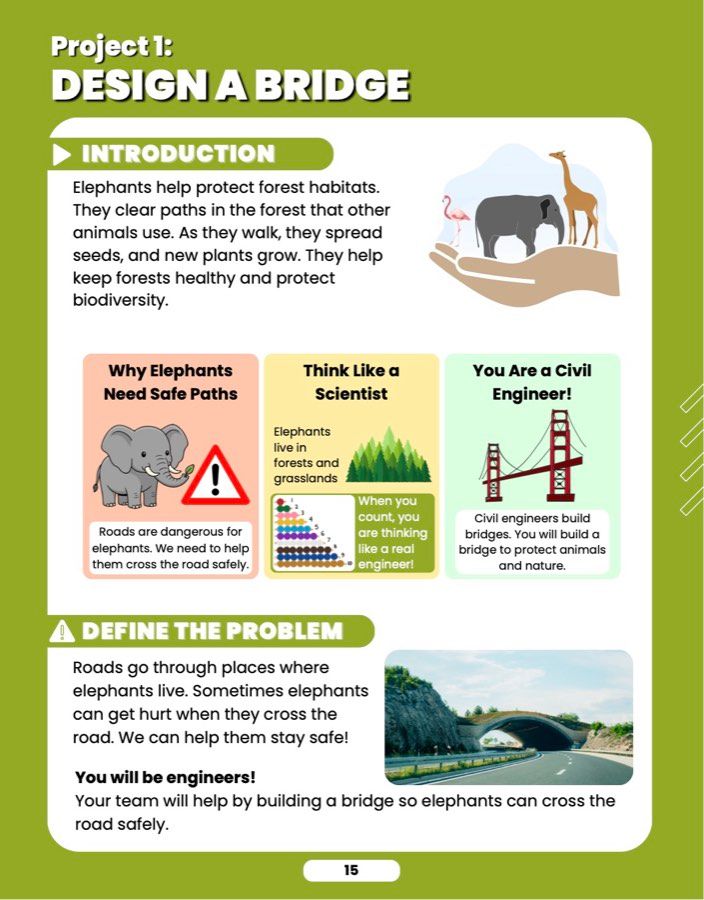
Project 1: Design a Bridge
The first project of the level, as it appears in the guidebook. The full workbook is in the reader below where published.
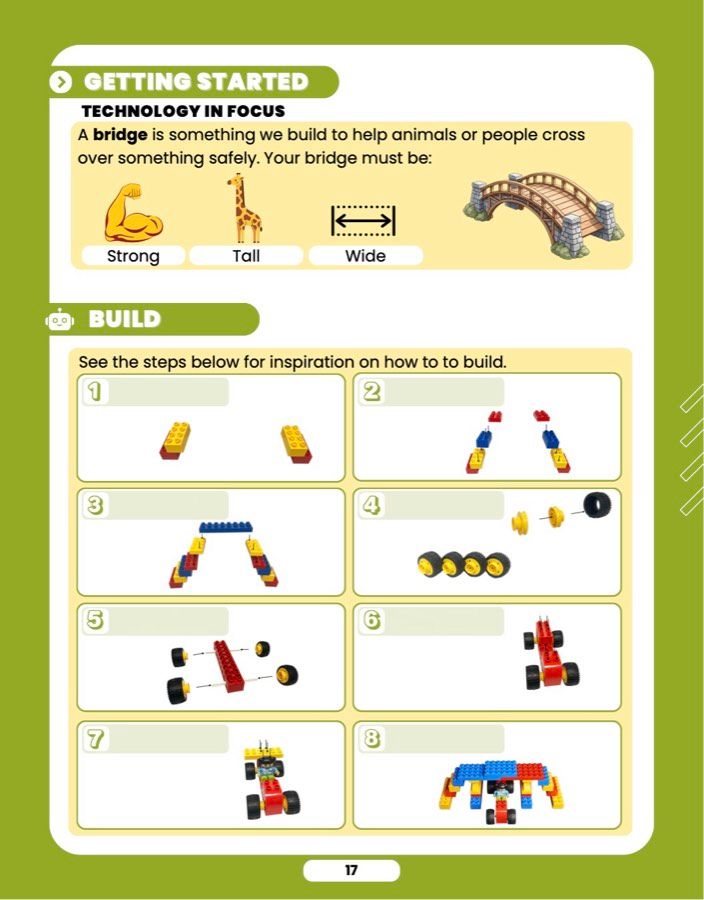
Roads go through places where elephants live. Sometimes elephants can get hurt when they cross the road. Your team will help by building a bridge so elephants can cross the road safely.The problem, as printed in the workbook.
- Goal named
- SDG 15 · Life on Land
- Careers named
- Civil Engineer, Architect
- Standards cited
- NGSS K-2-ETS1; Cambridge Science 1Bp.02; Common Core 1.NBT.A.1; Cambridge Mathematics 1Nc.01
Standards cited in Level 1, project by project
One row per project, quoted as the guidebook cites them. An empty cell means no citation for that project.
- PS4
- LS1
- LS3
- ESS1
- ETS1
- TWSp
- TWSc
- TWSa
- Bp
- Bs
- Ps
- ESs
- SIC
- Nc
- Ni
- Np
- Gg
- Gt
- Ss
| Project | SDG | NGSS | Cambridge Science | Cambridge Maths | Common Core Maths | ISTE | Careers named |
|---|---|---|---|---|---|---|---|
| 1 Design a Bridge | Life on Land | K-2-ETS1-1 | 1SIC.03 | 1Nc.01 | 1.NBT.A.1 | 1.3.d.1.4.c.1.7.c. | Civil Engineer, Architect |
| 2 Design a Pinwheel | Affordable and Clean Energy | 1-LS1-1 | 1Bs.01 | 1Gg.021Gg.08 | 1.MD.A.11.MD.A.2 | 1.3.d.1.4.c.1.7.c. | Wind Farm Developer, Wind Turbine Manufacturer |
| 3 Design a Puppet | Life on Land | 1-LS3-1 | 1Bp.011Bp.04 | 1Np.03 | 1.NBT.B.3 | 1.3.d.1.4.c.1.7.c. | Ornithologist, Ecologist, Puppet Designer |
| 4 Design a Crane | Sustainable Cities and Communities | K-2-ETS1-3 | 1TWSa.01 | 1.Ni.03 | 1.OA.A.1 | 1.3.d.1.4.c.1.7.c. | Construction Engineer, Mechanic |
| 5 Design a Cart Launcher | Climate Action | K-2-ETS1-3 | 1TWSa.01 | 1Gg.08 | 1.MD.A.2 | 1.3.d.1.4.c.1.7.c. | Mechanical Engineer, Renewable Energy Engineer |
| 6 Design a Special Effect | Climate Action | 1-PS4-3 | 1Ps.011Ps.02 | 1Ss.011Ss.03 | 1.MD.C.4 | 1.3.d.1.4.c.1.7.c. | Climate Scientist, Environmental Engineer |
| 7 Design an Elevator | Industry, Innovation and Infrastructure | K-2-ETS1-2 | 1TWSp.021TWSc.05 | 1Gg.01 | 1.G.A.1 | 1.3.d.1.4.c.1.7.c. | Elevator Mechanic, Mechanical Engineer, Safety Inspector |
| 8 Design a Call Signal | Industry, Innovation and Infrastructure | 1-PS4-4 | 1Ps.011Ps.02 | 1Ni.011Ni.051Np.03 | 1.OA.D.71.NBT.B.3 | 1.3.d.1.4.c.1.7.c. | Product Designer, Computer Programmer |
| 9 Design a Scale | Decent Work and Economic Growth | 1-ESS1-2 | 1ESs.021TWSc.05 | 1Gt.03 | 1.MD.B.3 | 1.3.d.1.4.c.1.7.c. | Farmer, Food Quality Checker |
| 10 Design a Counter | Life on Land | 1-ESS1-2 | 1ESs.021TWSc.05 | 1Gt.03 | 1.MD.B.3 | 1.3.d.1.4.c.1.7.c. | Ecologist, Mathematician |
| 11 Design a House | Affordable and Clean Energy | 1-ESS1-1 | 1ESs.021ESs.01 | 1Gg.06 | 1.G.A.2 | 1.3.d.1.4.c.1.7.c. | Architect, Civil Engineer |
| 12 Design a Smart Light | Affordable and Clean Energy | 1-ESS1-1 | 1ESs.021ESs.01 | 1Ni.021Ni.03 | 1.OA.A.1 | 1.3.d.1.4.c.1.7.c. | Electric Engineer, Civil Engineer |
| 13 Design a Smart Fan | Affordable and Clean Energy | 1-ESS1-1 | 1ESs.021ESs.01 | 1Ni.021Ni.03 | 1.OA.A.1 | 1.3.d.1.4.c.1.7.c. | Wildlife Rescuer, Architect |
| 14 Design a City | Sustainable Cities and Communities | K-2-ETS1-1 | 1TWSp.01 | 1Nc.01 | 1.NBT.A.1 | 1.3.d.1.4.c.1.7.c. | City Planner, Architect |
| 15 Design a Traffic Device | Sustainable Cities and Communities | 1-PS4-4 | 1Ps.011Ps.02 | 1Np.03 | 1.NBT.B.3 | 1.3.d.1.4.c.1.7.c. | Civil Engineer, City Planner |
| Capstone Design a Smart Device | Sustainable Cities and Communities | 1-PS4-4 | 1Ps.011Ps.02 | 1Gg.06 | 1.G.A.2 | 1.3.d.1.4.c.1.7.c. | — |
Source: SKOOL21 Level A to 12 curriculum crosswalk (2026), compiled from the teacher guides and student books. Where the two differ, the student book prevails.
Read Level 1 online
The full workbook, and the teacher guide where published, in a page-turning reader.

STEM Innovator’s Workbook, Level 1
Opens a page-turning reader from Issuu. Issuu may set its own cookies once it loads.
Teacher Guide, Level 1
Opens a page-turning reader from Issuu. Issuu may set its own cookies once it loads.
What you order
| Item | Title | ISBN or SKU |
|---|---|---|
| Student workbook | STEM Innovator’s Workbook, Level 1 | 978-981-17521-2-4 |
| Teacher guidebook | Guidebook, Level 1 | 978-981-17736-5-5 |
| Learning kit | Smart Machines Kit | STEMSIHKitKG1 |
Assessment built in
Four checkpoints a year use a seven-criterion rubric, and every other project gets a 30 second workbook check.
How assessment works →Standards mapped
The guidebook maps each project to NGSS, Cambridge and Common Core standards where they apply.
See the table for this level →