
Level 4: Robotics with MakeCode
Level 4 introduces autonomous systems. Students prototype with a Micro:bit and LED displays and program robots in MakeCode blocks.

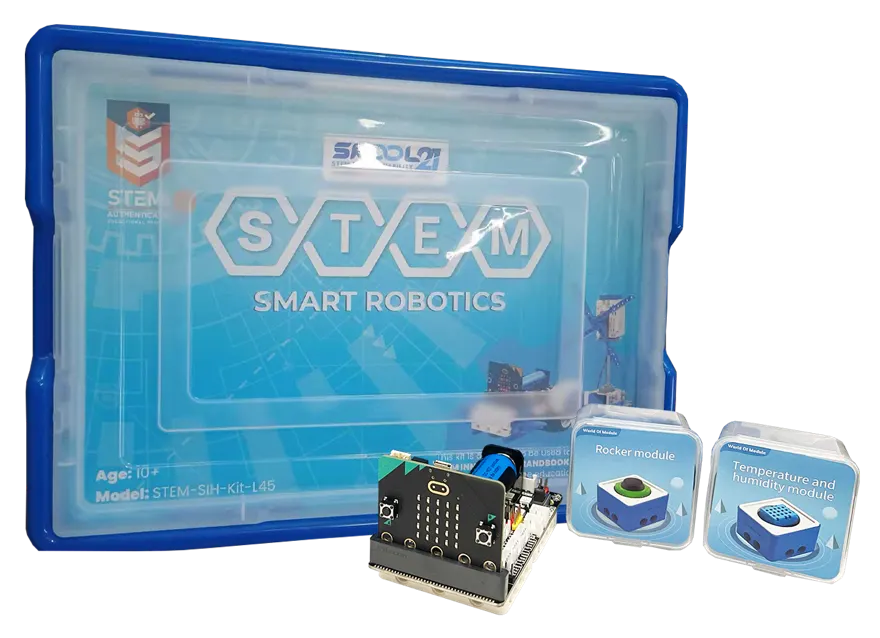
Level 4 at a glance
- Grade
- Grade 4 · Elementary
- Technology
- Robotics with MakeCode
- Tools
- MakeCode on a micro:bit
- Kit
- Smart Robotics Kit, one per group of four
- Projects
- 15 projects and a Capstone
- Weekly time
- One 45 or 90 minute session
- Pre and post challenge
- Build an Automatic Pet Feeder
- Sustainability theme
- Health and Infrastructure Safety
- Careers named
- Robotics Engineer, Biomedical Engineer, Meteorologist
 Level 4 book demo
See Level 4 in action
A short walk through the Level 4 workbook and the Smart Robotics Kit, from the SKOOL21 channel.
More videos on the SKOOL21 channel →Projects from the Smart Robotics Kit


Students can
- Program a robot in Microsoft MakeCode
- Use a Micro:bit display and sensors in a prototype
- Work in a team to solve a robotics challenge
Summarised from the SKOOL21 Level Exit Outcomes.
How they work
- Define
- Design
- Share
- Reflect

Fifteen projects and a Capstone.
Full exit outcomes and Sustainable Development Goals for Level 4
Engineering & Design
- Build and program a working robotic solution (micro:bit, motor, and sensor) that performs an automated task on a trigger condition (the "Build an Automatic Pet Feeder" pre/post challenge).
- Complete the level's first formally named Capstone project, applying the full Define, Plan, Build, Test, Improve cycle to an original problem.
- Iterate on a robotics prototype across multiple test rounds, making and explaining purposeful design improvements.
- Calibrate a sensor-triggered mechanism so it activates reliably under the intended condition.
Science
- Investigate an energy-transfer concept, such as a motor converting electrical energy to mechanical motion (NGSS PS3 Energy).
- Explore an earth-systems or human-activity theme connected to a build, such as resource use (NGSS ESS2/ESS3).
- Investigate biology and physics content together through a robotics build, reflecting this level's Biology–Physics tie (Cambridge Science Stage 4).
- Connect a build to a real-world scenario as an example of science in context (Cambridge Science Stage 4).
Mathematics
- Apply geometry and spatial reasoning to position sensors and mechanisms on a robot (Cambridge Geometry).
- Use number operations and fractions to calibrate timing or quantities, such as how much food a mechanism releases (Cambridge Number; Common Core Number & Operations — Fractions).
- Collect and represent data from repeated tests of an automated trigger (Cambridge Statistics; Common Core Measurement & Data).
Computing & Coding
- Write and debug block-based MakeCode programs on a micro:bit that read a sensor input and drive a motor output.
- Program conditional trigger logic (if sensor condition, then motor action) to automate a physical task.
- Test and revise code across multiple iterations so an autonomous sensing robot behaves reliably.
Take on and fulfill a defined team role — Leader, Material Manager, Reporter, or Testing Supervisor — while collaborating, communicating, and resolving conflict within a build team.
Recognize how this level’s robotics and health-sensing builds connect to real careers, such as Robotics Engineer, Biomedical Engineer, or Meteorologist.
Identify the Sustainable Development Goal connected to their build, themed around Health & Infrastructure Safety.
From the SKOOL21 Level Exit Outcomes. Standards named are NGSS, Common Core and Cambridge strands.
- 3 Good Health and Well-being
- 7 Affordable and Clean Energy
- 9 Industry, Innovation and Infrastructure
- 10 Reduced Inequalities
- 11 Sustainable Cities and Communities
- 13 Climate Action
- 15 Life on Land
- 16 Peace, Justice and Strong Institutions
Source: SKOOL21 Five Pillars Framework. Compare all levels
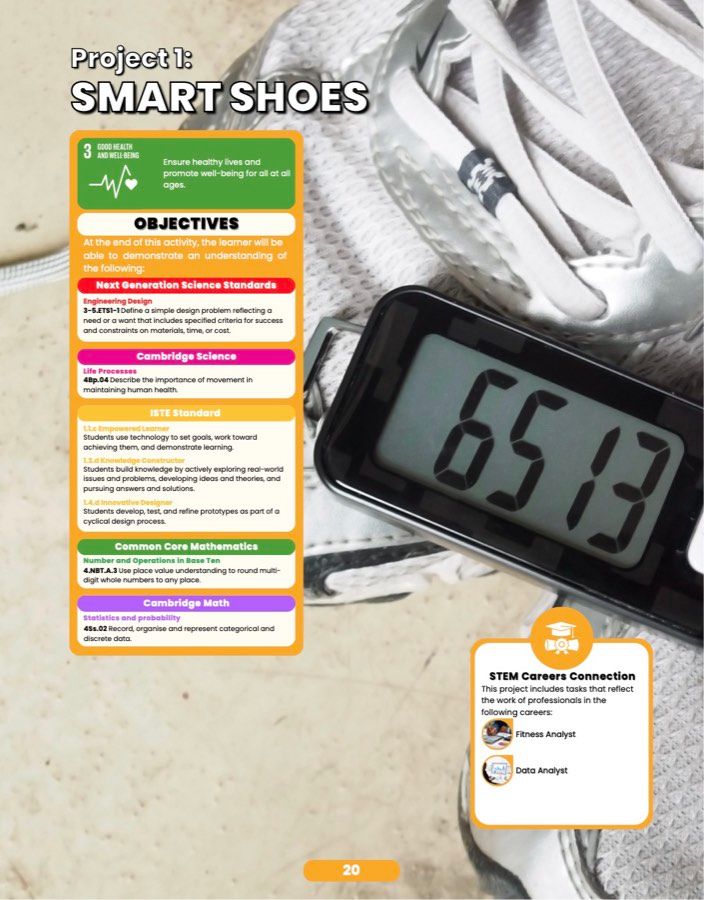
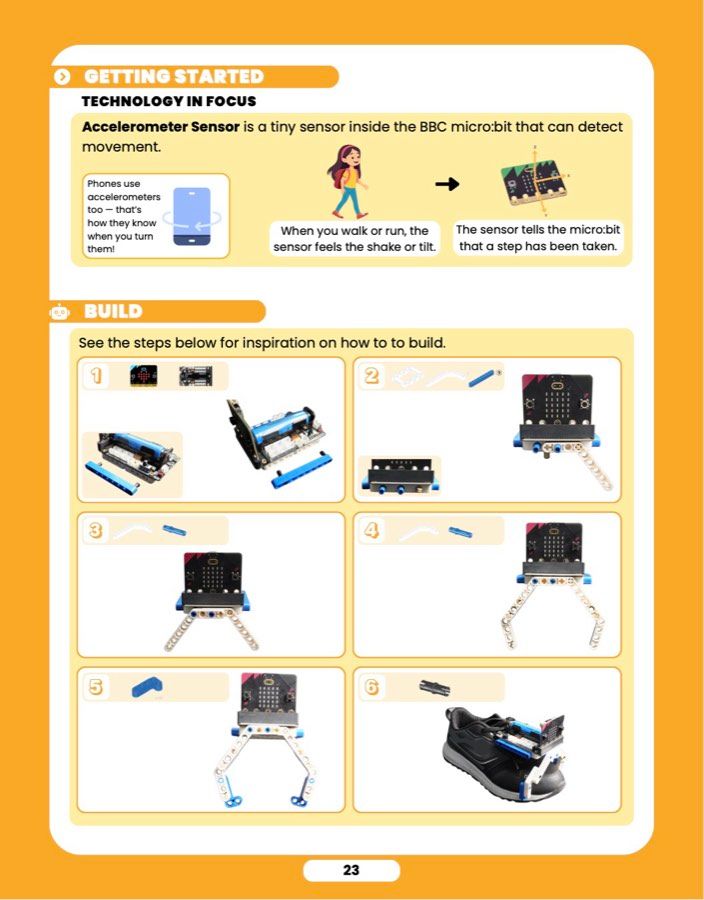
Project 1: Smart Shoes
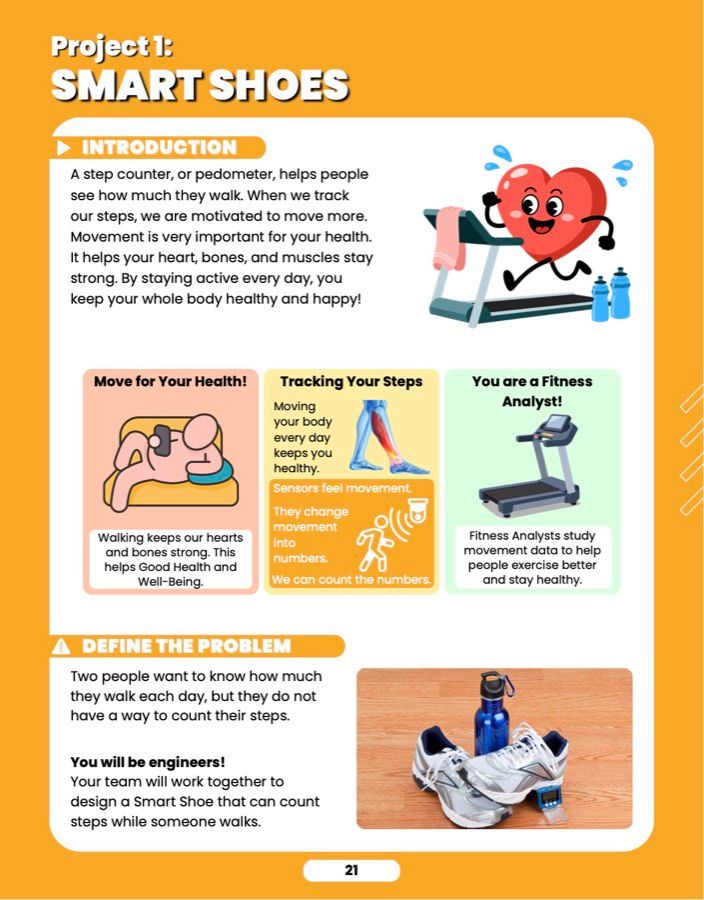
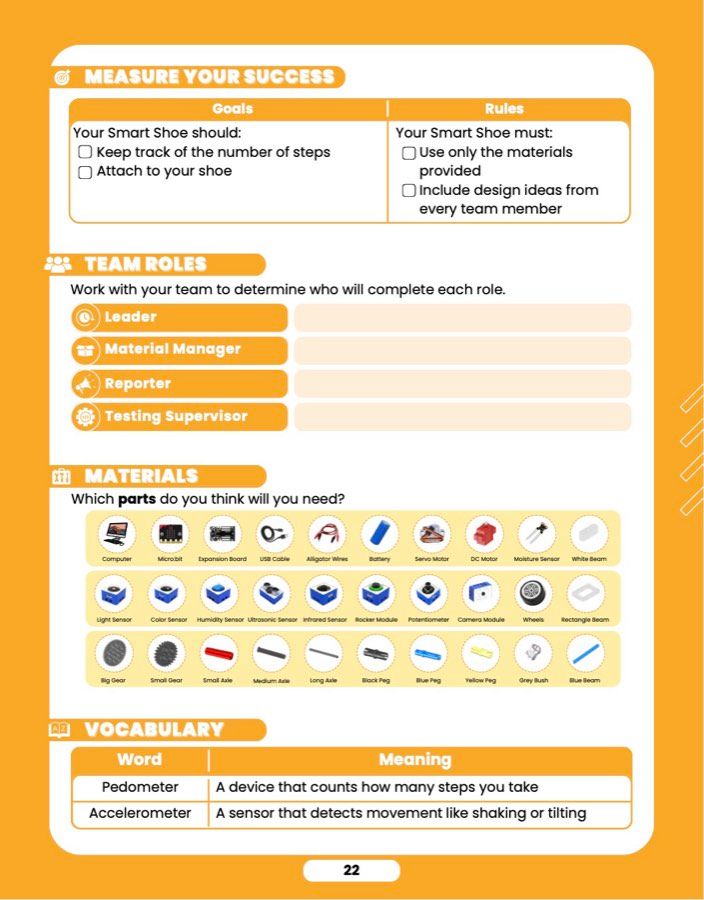
The first project of the level, as it appears in the guidebook. The full workbook is in the reader below where published.
Two people want to know how much they walk each day, but they do not have a way to count their steps. Your team will work together to design a Smart Shoe that can count steps while someone walks.The problem, as printed in the workbook.
- Goal named
- SDG 3 · Good Health and Well-being
- Careers named
- Fitness Analyst, Data Analyst
- Standards cited
- NGSS 3-5-ETS1-1; Cambridge Science 4Bp.04; Common Core 4.NBT.A.3; Cambridge Mathematics 4Ss.02
Standards cited in Level 4, project by project
One row per project, quoted as the guidebook cites them. An empty cell means no citation for that project.
- PS3
- PS4
- ESS2
- ESS3
- ETS1
- TWSc
- TWSm
- Bp
- Bs
- Be
- Pf
- Ps
- Pe
- ESp
- ESs
- SIC
- Nc
- Ni
- Nf
- Gg
- Gp
- Ss
| Project | SDG | NGSS | Cambridge Science | Cambridge Maths | Common Core Maths | ISTE | Careers named |
|---|---|---|---|---|---|---|---|
| 1 Smart Shoe | Good Health and Well-Being | 3-5-ETS1-1 | 4Bp.04 | 4Ss.02 | 4.NBT.A.3 | 1.3.d | Fitness Analyst, Data Analyst |
| 2 Soil Moisture Sensor | Life on Land | 4-ESS3-1 | 4SIC.05 | 4Ss.02 | 4.MD.A.1 | 1.7.d | Agricultural Engineer, Environmental Scientist |
| 3 Seismograph | Sustainable Cities and Communities | 4-ESS3-2 | 4ESp.03 | 4Gg.08 | 4.G.A.1 | 1.5.b | Geophysicist, Civil Engineer |
| 4 Mars Rover | Industry, Innovation and Infrastructure | 4-PS3-1 | 4TWSm.014ESs.02 | 4Gp.03 | 4.MD.A.2 | 1.4.d | Aerospace Engineer, Robotics Engineer |
| 5 Smart Parking Barrier | Sustainable Cities and Communities | 3-5-ETS1-3 | 4Pe.02 | 4Gp.01 | 4.MD.C.6 | 1.4.a | Urban Planner, Traffic Systems Engineer |
| 6 Joint Simulator | Good Health and Well-Being | 4-PS3-3 | 4Bs.02 | 4Gg.08 | 4.G.A.2 | 1.1.c | Biomechanical Engineer, Physical Therapist |
| 7 Energy-Saving Fan | Affordable and Clean Energy | 4-PS3-4 | 4Be.014Be.02 | 4Nf.02 | 4.MD.A.1 | 1.6.a | HVAC Engineer, Sustainability Engineer |
| 8 Line-Following Robot | Industry, Innovation and Infrastructure | 4-PS4-3 | 4Be.03 | 4Gp.01 | 4.NBT.B.4 | 1.5.b | Robotics Engineer, Automation Specialist |
| 9 Temperature Monitor | Life on Land | 4-ESS3-2 | 4Bp.02 | 4Ni.02 | 4.NF.C.6 | 1.1.c | Wildlife Biologist, Data Analyst |
| 10 Color Detector | Reduced Inequalities | 4-PS4-2 | 4Pe.01 | 4Gp.01 | 4.G.A.1 | 1.6.c | Optometrist, Electrical Engineer |
| 11 Weather Station | Climate Action | 4-ESS2-1 | 4Pf.04 | 4Ss.02 | 4.MD.A.2 | 1.7.a | Meteorologist, Environmental Engineer |
| 12 Automatic Night Light | Peace, Justice and Strong Institutions | 4-PS3-2 | 4Ps.02 | 4Ss.03 | 4.MD.A.2 | 1.6.c | Electrical Engineer, Software Developer |
| 13 Burglar Alarm | Industry, Innovation and Infrastructure | 3-5-ETS1-3 | 4TWSc.03 | 4Nf.06 | 4.NBT.B.4 | 1.2.d | Security Systems Engineer, Cybersecurity Analyst |
| 14 Energy Predictor | Affordable and Clean Energy | 4-PS3-2 | 4Ps.01 | 4Gp.03 | 4.G.A.1 | 1.7.d | Botanist, Biologist |
| 15 No-Touch Doorbell | Good Health and Well-Being | 3-5-ETS1-2 | 4SIC.02 | 4Nc.04 | 4.NF.C.5 | 1.4.a | Biomedical Engineer, Industrial Designer |
| Capstone Waste Reduction | Climate Action | — | — | — | — | — | — |
Source: SKOOL21 Level A to 12 curriculum crosswalk (2026), compiled from the teacher guides and student books. Where the two differ, the student book prevails.
What you order
| Item | Title | ISBN or SKU |
|---|---|---|
| Student workbook | STEM Innovator’s Workbook, Level 4 | 978-981-17494-6-9 |
| Teacher guidebook | Guidebook, Level 4 | 978-981-17736-8-6 |
| Learning kit | Smart Robotics Kit | STEMSIHKitG45 |
Levels 4 and 5 share the Smart Robotics Kit.
Assessment built in
Four checkpoints a year use a seven-criterion rubric, and every other project gets a 30 second workbook check.
How assessment works →Standards mapped
The guidebook maps each project to NGSS, Cambridge and Common Core standards where they apply.
See the table for this level →