
Level 11: Internet of Things with Python
Level 11 explores the Internet of Things with the Raspberry Pi Pico, and students build on Arduino C++ by moving to Python.

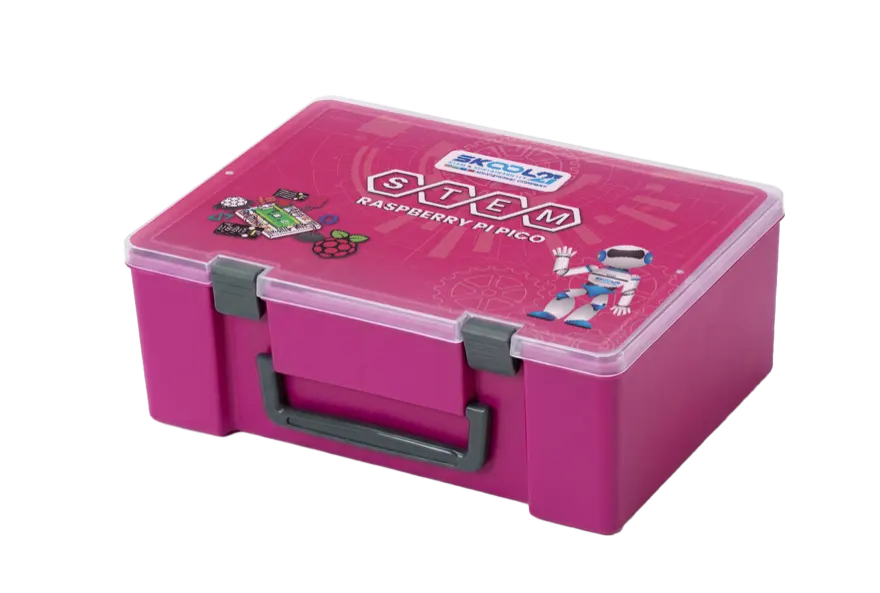
Level 11 at a glance
- Grade
- Grade 11 · High school
- Technology
- Internet of Things with Python
- Tools
- Python in Thonny
- Kit
- Raspberry Pi Pico Kit, one per group of four
- Projects
- 15 projects and a Capstone
- Weekly time
- One 45 or 90 minute session
- Pre and post challenge
- Build a Recycling Sorter Prototype
- Sustainability theme
- Industry and Climate Monitoring (IoT)
- Careers named
- Structural Engineer, Geoscientist, HVAC Engineer
 Level 11 book demo
See Level 11 in action
A short walk through the Level 11 workbook and the Raspberry Pi Pico Kit, from the SKOOL21 channel.
More videos on the SKOOL21 channel →Projects from the Raspberry Pi Pico Kit


Students can
- Program a Raspberry Pi Pico in Python
- Design an IoT system around a sensor
- Build a sorting or threshold logic solution
Summarised from the SKOOL21 Level Exit Outcomes.
How they work
- Define
- Design
- Share
- Reflect

Fifteen projects and a Capstone.
Full exit outcomes and Sustainable Development Goals for Level 11
Engineering & Design
- Sustain a self-selected engineering design problem on a second hardware platform (Raspberry Pi Pico), building on Level 9's Arduino experience.
- Build a Recycling Sorter Prototype that uses a sensor to distinguish two material types and sorts a signal accordingly (pre/post challenge).
- Write and test real Python code for a tested solution, iterating based on sensor readings.
- Work within the Project Manager/Resource Manager/Project Communicator/Project Tester team structure to deliver a sustained, self-directed project.
Science
- Investigate ecosystems and evolution content connected to a sensing/sorting project (NGSS LS2/LS4).
- Apply high-school physical science concepts — matter, motion, and energy — to a sensor-based build (NGSS HS-PS1 to HS-PS3).
- Explore an Earth-systems theme connected to responsible consumption or environmental sensing (NGSS ESS2).
- Investigate full IGCSE-style topic content spanning Biology, Chemistry, and Physics — the widest Cambridge Science stage spread of any level in the programme.
Mathematics
- Apply Pure Mathematics content, such as functions or algebraic manipulation, to a sensor-threshold or sorting-logic problem (Cambridge AS/A-Level Pure Mathematics 1&2).
- Apply Mechanics concepts where relevant to a physical sorting or build task (Cambridge AS/A-Level Mechanics).
- Use Probability & Statistics to evaluate how reliably a sensor distinguishes two material types (Cambridge AS/A-Level and IGCSE Probability & Statistics).
- Draw on the broadest spread of Common Core high-school math domains of any level in the programme (HS Number & Quantity, Algebra, Functions, Geometry) as the design task requires.
Computing & Coding
- Write and debug real Python code, via the Thonny IDE, on a Raspberry Pi Pico to read a sensor and control a sorting output.
- Apply IoT/cloud-connected sensor concepts on a new hardware platform, transferring coding skill from Level 9's Arduino C++ to Python.
Take on a project-based team role — Leader, Material Manager, Reporter, or Testing Supervisor — using more advanced collaboration and presentation skills.
Recognize real engineering careers regaining the lead through structural and climate-sensing builds, such as Structural Engineer, Geoscientist, or HVAC Engineer.
Identify the Sustainable Development Goal connected to their build, themed around Industry & Climate Monitoring (IoT).
From the SKOOL21 Level Exit Outcomes. Standards named are NGSS, Common Core and Cambridge strands.
- 3 Good Health and Well-being
- 7 Affordable and Clean Energy
- 9 Industry, Innovation and Infrastructure
- 11 Sustainable Cities and Communities
- 13 Climate Action
- 15 Life on Land
Source: SKOOL21 Five Pillars Framework. Compare all levels
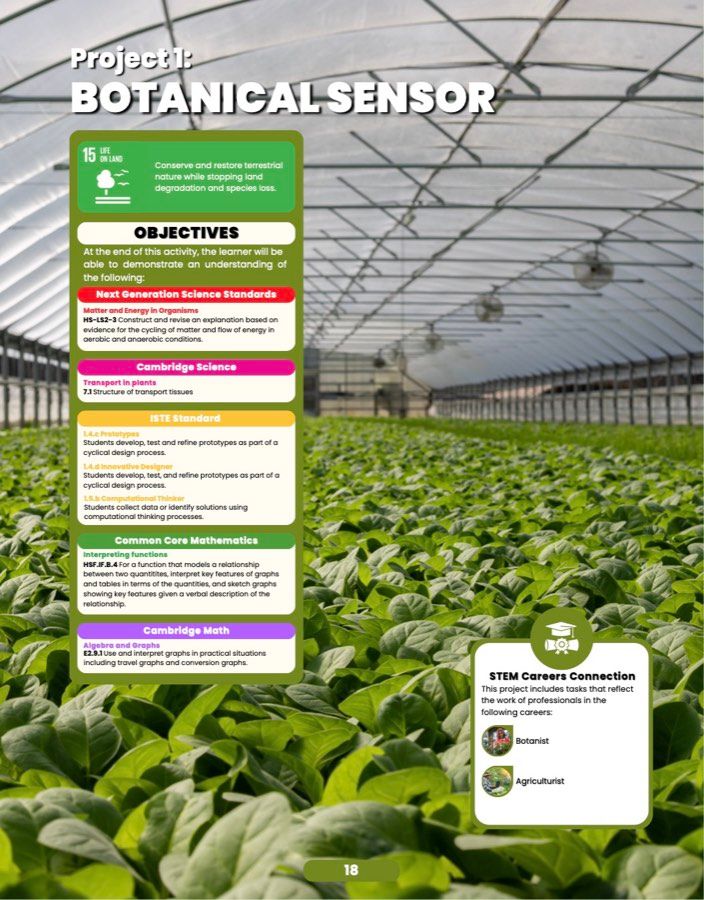
Project 1: Botanical Sensor
The first project of the level, as it appears in the guidebook. The full workbook is in the reader below where published.
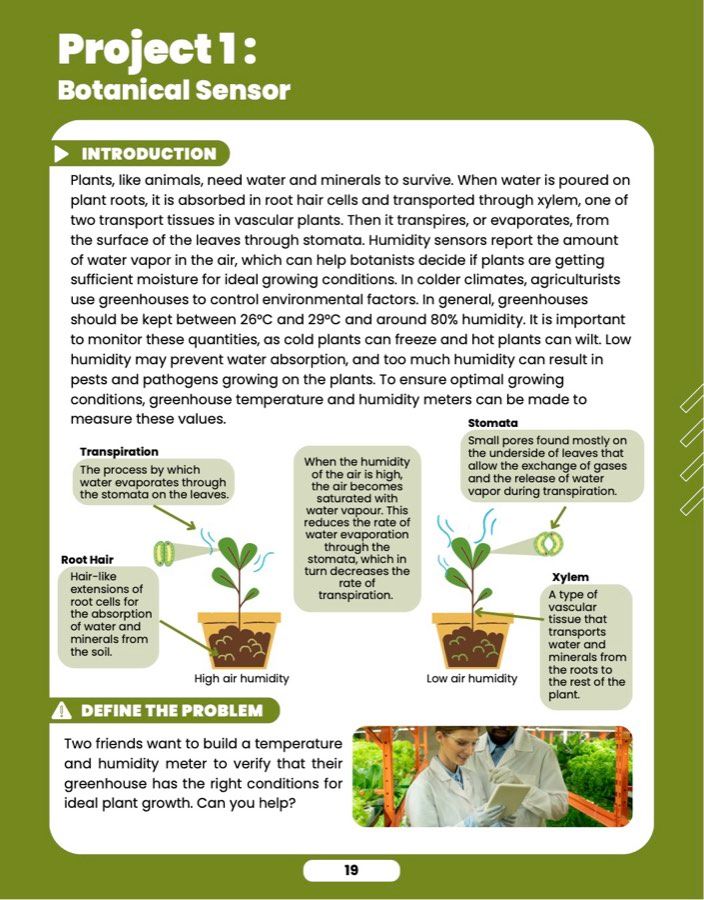
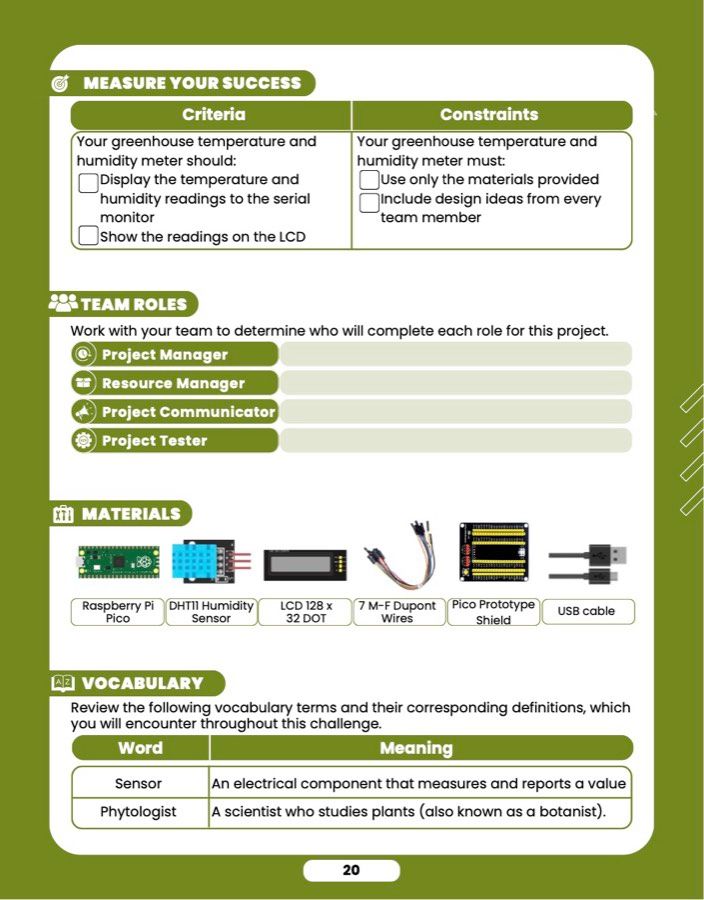
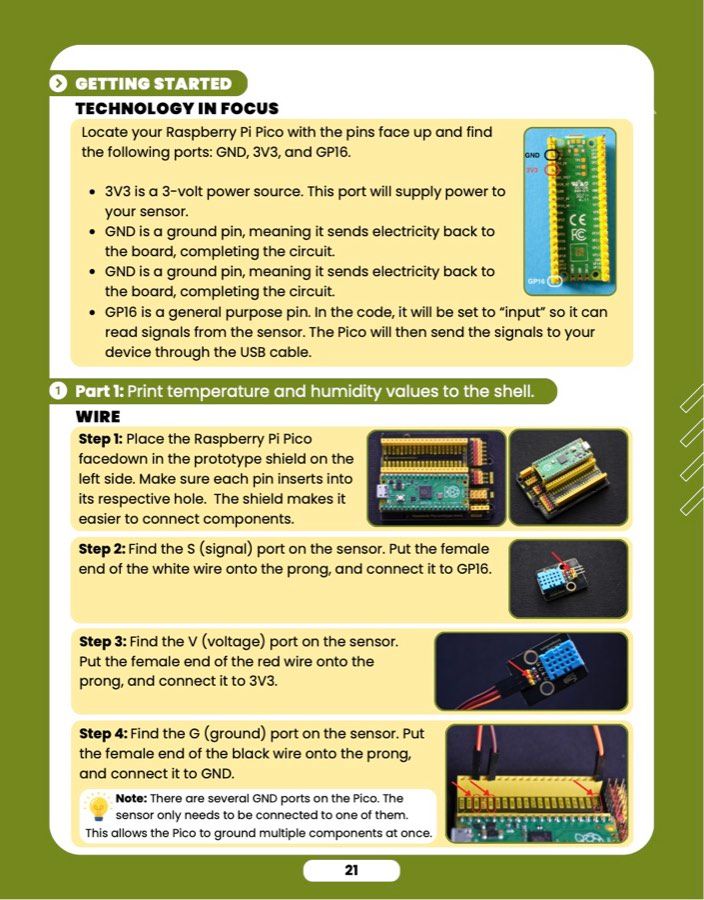
Two friends want to build a temperature and humidity meter to verify that their greenhouse has the right conditions for ideal plant growth.The problem, as printed in the workbook.
- Goal named
- SDG 15 · Life on Land
- Careers named
- Botanist, Agriculturist
- Standards cited
- NGSS HS-LS2-3; Cambridge Biology 7.1; Common Core HSF.IF.B.4; Cambridge IGCSE Mathematics E2.9.1
Standards cited in Level 11, project by project
One row per project, quoted as the guidebook cites them. An empty cell means no citation for that project.
- PS1
- PS2
- PS3
- PS4
- LS1
- LS2
- LS4
- ESS1
- ESS2
- ESS3
- Biology (IGCSE 0610 / A-Level topics)
- Chemistry (IGCSE 0620 / A-Level topics)
- Physics (IGCSE 0625 / A-Level topics)
- Earth, Space & Environment
- Number (IGCSE 0580 topic 1)
- Algebra and Graphs (IGCSE 0580 topic 2)
- Geometry (IGCSE 0580 topic 4)
- Mensuration (IGCSE 0580 topic 5)
- Transformations and Vectors (IGCSE 0580 topic 7)
- Statistics (IGCSE 0580 topic 9)
- Pure Mathematics 1 (AS & A Level 9709)
- Pure Mathematics 2 (AS & A Level 9709)
- Mechanics (AS & A Level 9709)
- Probability & Statistics (AS & A Level 9709)
| Project | SDG | NGSS | Cambridge Science | Cambridge Maths | Common Core Maths | ISTE | Careers named |
|---|---|---|---|---|---|---|---|
| 1 Botanical Sensor | (15) Life on Land | HS-LS2-3 | Transport in plants — Structure of transport tissues | E2.9.1 | HSF.IF.B.4 | 1.4.c1.4.d1.5.b | Botanist, Agriculturist |
| 2 Predator Detector | (15) Life on Land | HS-LS4-2HS-LS4-3 | Selection and Evolution — VariationNatural and artificial selection | E2.10.3 | HSA.SSE.A.1 | 1.4.c1.4.d1.5.b | Wildlife Biologist, Zoologist |
| 3 Nutrition Tracker | (3) Good Health and Well-Being | LS1.C | Biological Molecules — 2.2 Carbohydrates and lipids2.3 Proteins | 5.2 (Permutations and combinations) | HSN.VM.C.6 | 1.4.c1.4.d1.5.b | Nutritionist, Food Scientist |
| 4 Adaptive Brightness | (9) Industry, Innovation and Infrastructure | HS-LS1-5 | Photosynthesis — 13.1 Photosynthesis as an energy transfer process | C5.3 (Circlesarcs and sectors) | HSG.C.B.5 | 1.4.c1.4.d1.5.b | Electrical Engineer, Light Technician |
| 5 Temperature Alarm | (13) Climate Action | HS-LS4-6 | ClassificationBiodiversity and Conservation — 18.2 Biodiversity | Pure Mathematics 2 — 1. Algebra | HSA.REI.B.3 | 1.4.c1.4.d1.5.b | Zoologist, Environmental Scientist |
| 6 Bonding Matrix | (9) Industry, Innovation and Infrastructure | HS-PS1-8 | AtomsElements and Compounds — Ions and ionic bondsSimple molecules and covalent bondsGiant covalent structures | C2.6 (Inequalities) | HSN.VM.C.6 | 1.4.c1.4.d1.5.b | Chemical Engineer, Material Scientist |
| 7 Density Calculator | (12) Responsible Consumption and Production | HS-PS2-6 | Metals — Properties/Uses of metalsMotionForces and Energy — Mass and weightDensity | C5.4 (Surface area and volumes) | HSG.GMD.A.3 | 1.4.c1.4.d1.5.b | Product Designer, Material Scientist |
| 8 Reaction Stirrer | (9) Industry, Innovation and Infrastructure | HS-PS1-7 | Chemical Reactions — 6.2 Rate of reaction | Pure Mathematics 1 — 1. Trigonometry | HSF.TF.B.5 | 1.4.c1.4.d1.5.b | Chemist, Chemical Engineer |
| 9 Flame Monitor | (12) Responsible Consumption and Production | HS-PS3-4 | MotionForces and Energy — 1.7.1 Energy | Transformations and Vectors C7.1 (Transformations) | HSG.CO.A.2 | 1.4.c1.4.d1.5.b | Communications Technology Specialist, Food Scientist |
| 10 Convection Fan | (11) Sustainable Cities and Communities | HS-PS3-4 | Thermal Physics — 2.3.2 Convection2.3.4 Consequences of thermal energy transfer | Number C1.12 (Rates)Geometry C4.7 (Circle theorems) | HSG.C.A.2 | 1.4.c1.4.d1.5.b | HVAC Engineer, Aerospace Engineer |
| 11 Collision Warning System | (11) Sustainable Cities and Communities | HS-PS4-1 | Waves — General properties of wavesLightElectromagnetic spectrum | Algebra and Graphs E2.9 (Graphs in practical situations) | HSG.GPE.A.3 | 1.4.c1.4.d1.5.b | Mechanical Engineer, Software Engineer |
| 12 Series and Parallel Circuits | (7) Affordable and Clean Energy | HS-PS3-3 | Electricity and Magnetism — Circuit diagrams and circuit componentsSeries and parallel circuits | Pure Mathematics 2 — 1. Logarithmic and exponential functions | HSN.RN.A2 | 1.4.c1.4.d1.5.b | Electrical Engineer, Electrician |
| 13 Earthquake Brace | (13) Climate Action | HS-ESS3-1 | Natural Hazards — impacts of tectonic eventsmanagement strategies before/during/after | Transformations and Vectors E7.2 (Vectors) | HSG.MG.A.3 | 1.4.c1.4.d1.5.b | Geoscientist, Structural Engineer |
| 14 Water Level Detector | (13) Climate Action | HS-ESS2-6 | Ecosystems — 5.1.9 Describe the carbon cycle | Statistics C9.3 (Averages) | HSS.ID.A.2 | 1.4.c1.4.d1.5.b | Environmental Engineer, Geoscientist |
| 15 Asteroid Distance Sensor | (9) Industry, Innovation and Infrastructure | HS-ESS1-6 | Earth and the Solar System — The EarthThe solar system | Mechanics 4.2 (Kinematics of motion) | HSG.MG.A.3 | 1.4.c1.4.d1.5.b | Aerospace Engineer, Astronomer |
| Capstone Pico "Superpower" | — | — | — | — | — | — | — |
Source: SKOOL21 Level A to 12 curriculum crosswalk (2026), compiled from the teacher guides and student books. Where the two differ, the student book prevails.
What you order
| Item | Title | ISBN or SKU |
|---|---|---|
| Student workbook | STEM Innovator’s Workbook, Level 11 | 978-981-17736-0-0 |
| Teacher guidebook | Guidebook, Level 11 | 978-981-17737-5-4 |
| Learning kit | Raspberry Pi Pico Kit | STEMSIHKitG11 |
Assessment built in
Four checkpoints a year use a seven-criterion rubric, and every other project gets a 30 second workbook check.
How assessment works →Standards mapped
The guidebook maps each project to NGSS, Cambridge and Common Core standards where they apply.
See the table for this level →