
Level 9: Text-based programming
Level 9 moves students from block coding to text-based programming with an Arduino-compatible board and intelligent components.

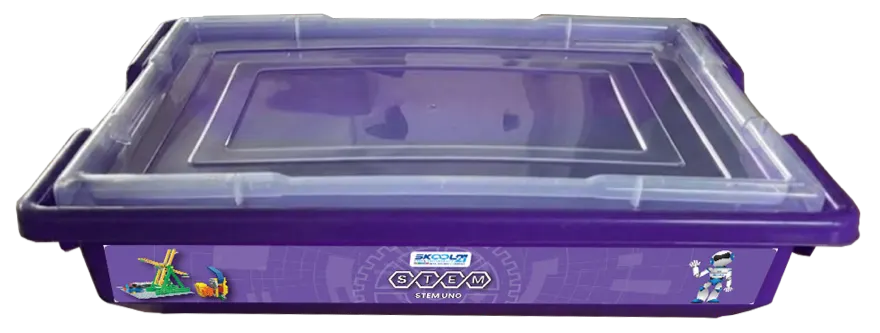
Level 9 at a glance
- Grade
- Grade 9 · High school
- Technology
- Text-based programming
- Tools
- C++ in the Arduino IDE
- Kit
- STEM Uno Kit, one per group of four
- Projects
- 15 projects and a Capstone
- Weekly time
- One 45 or 90 minute session
- Pre and post challenge
- Build a Plant Growth Monitor
- Sustainability theme
- Industrial Systems and Health
- Careers named
- Particle Physicist, Climatologist, Wind Turbine Technician
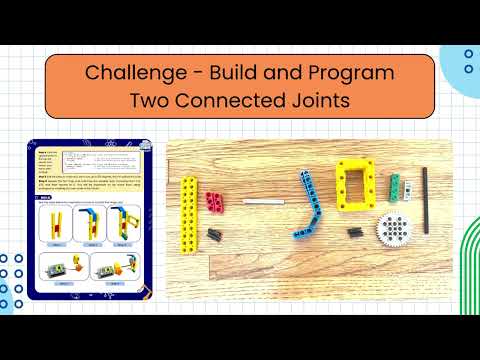 Level 9 book demo
See Level 9 in action
A short walk through the Level 9 workbook and the STEM Uno Kit, from the SKOOL21 channel.
More videos on the SKOOL21 channel →Projects from the STEM Uno Kit


Students can
- Write text-based code for a microcontroller
- Wire intelligent components to a board
- Debug a program using test results
Summarised from the SKOOL21 Level Exit Outcomes.
How they work
- Define
- Design
- Share
- Reflect

Fifteen projects and a Capstone.
Full exit outcomes and Sustainable Development Goals for Level 9
Engineering & Design
- Sustain a self-selected engineering design problem from definition through a tested solution, executed in industry-standard code.
- Build a Plant Growth Monitor that logs temperature and light data over time and flags when conditions fall outside a healthy range (pre/post challenge).
- Write, upload, and test Arduino code against real sensor data, iterating when logged conditions reveal a problem.
- Apply the full Engineering Design Process independently to a biology-, chemistry-, physics-, or Earth-science-linked problem of the student's choosing.
Science
- Apply high-school physical science concepts such as Newton's Second Law (F=ma) or energy release to a sensor-based investigation (NGSS HS-PS1/HS-PS2).
- Investigate an Earth's-Place-in-the-Universe or Earth systems topic tied to environmental sensor data (NGSS ESS1/ESS3).
- Investigate an ecosystems theme, such as plant-health conditions, using logged data (NGSS LS2).
- Work across this level's transition point in Cambridge Science content, from Lower-Secondary strand letters into IGCSE-style numbered topics spanning Biology, Physics, and Earth Science.
Mathematics
- Apply high-school Number & Quantity and Geometry concepts — this level's heaviest math domains — to a data-logging design problem (Common Core HS Number & Quantity, HS Geometry).
- Use algebra to define numeric thresholds or ranges in code, such as a "healthy range" condition (Cambridge Algebra; Common Core HS Algebra).
- Interpret logged data using statistics concepts as the curriculum transitions toward IGCSE Core/Extended numbering (Cambridge Statistics; Common Core HS Statistics & Probability).
Computing & Coding
- Write, compile, and upload text-based C++ code in the Arduino IDE — the programme's first fully text-based (non-block) programming language.
- Program a sensor-logging routine with conditional logic, flagging when a value falls outside a defined range, on professional-grade industrial hardware.
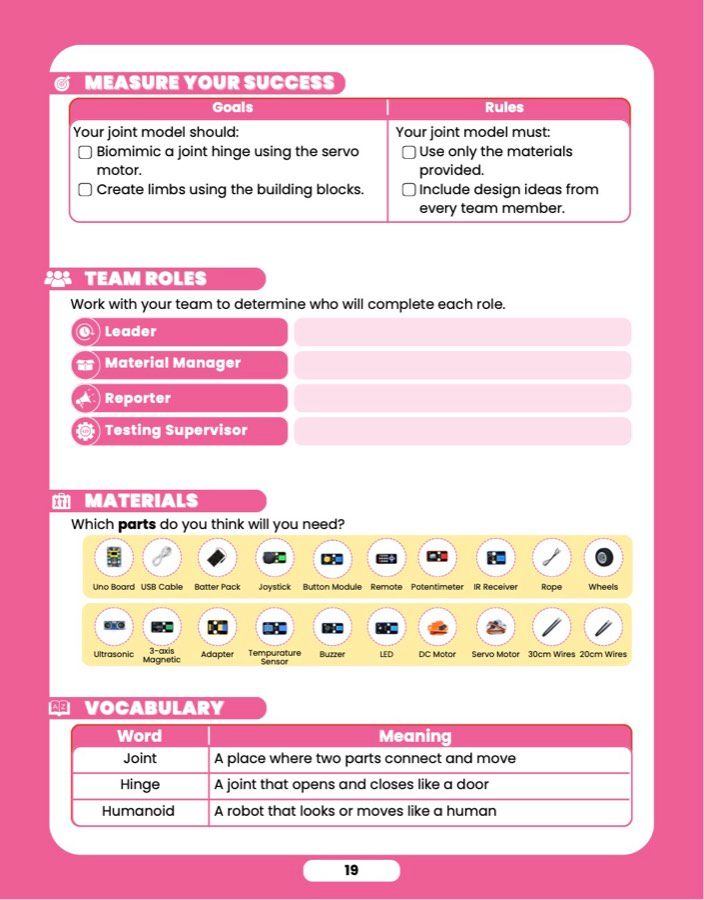
Take on a project-based team role — Leader, Material Manager, Reporter, or Testing Supervisor — using more advanced collaboration and presentation skills.
Recognize real physical-science careers at their peak alongside engineering and environmental roles, such as Particle Physicist or Wind Turbine Technician.
Identify the Sustainable Development Goal connected to their build, themed around Industrial Systems & Health.
From the SKOOL21 Level Exit Outcomes. Standards named are NGSS, Common Core and Cambridge strands.
- 3 Good Health and Well-being
- 6 Clean Water and Sanitation
- 7 Affordable and Clean Energy
- 8 Decent Work and Economic Growth
- 9 Industry, Innovation and Infrastructure
- 12 Responsible Consumption and Production
- 13 Climate Action
- 15 Life on Land
Source: SKOOL21 Five Pillars Framework. Compare all levels
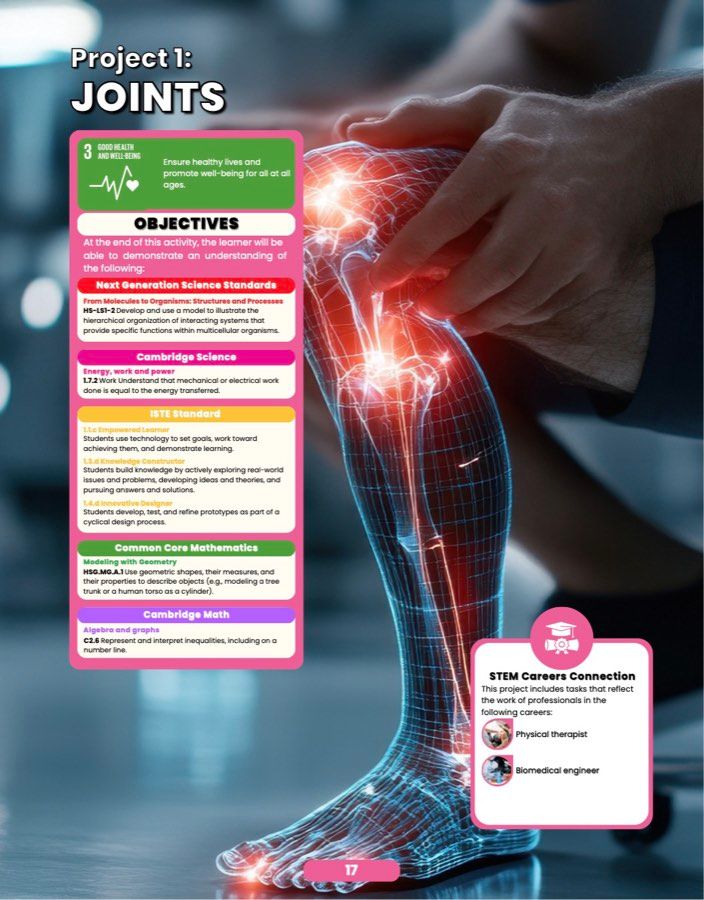
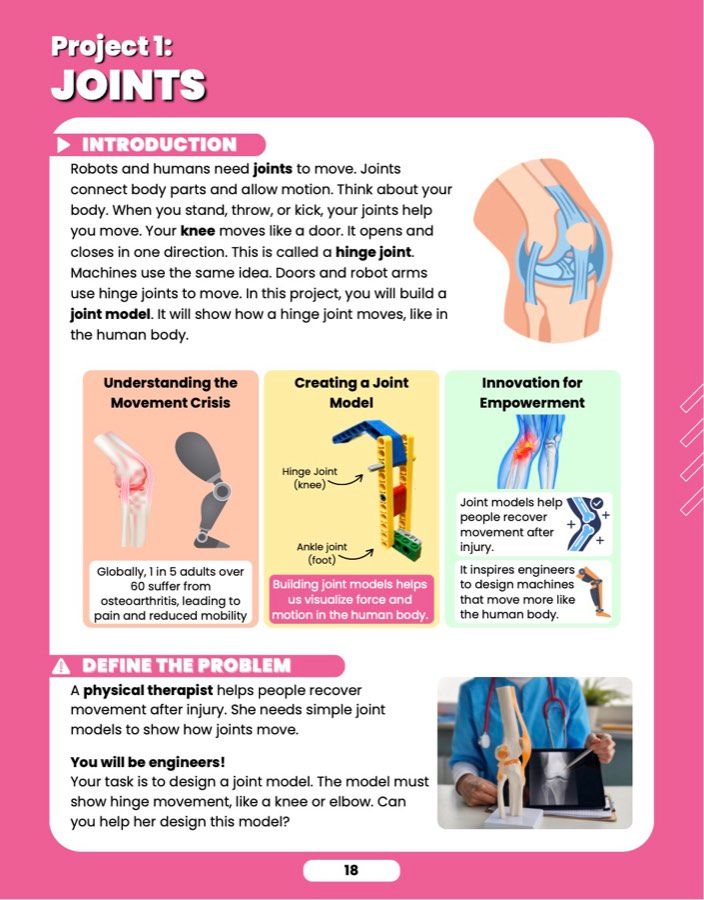
Project 1: Joints
The first project of the level, as it appears in the guidebook. The full workbook is in the reader below where published.
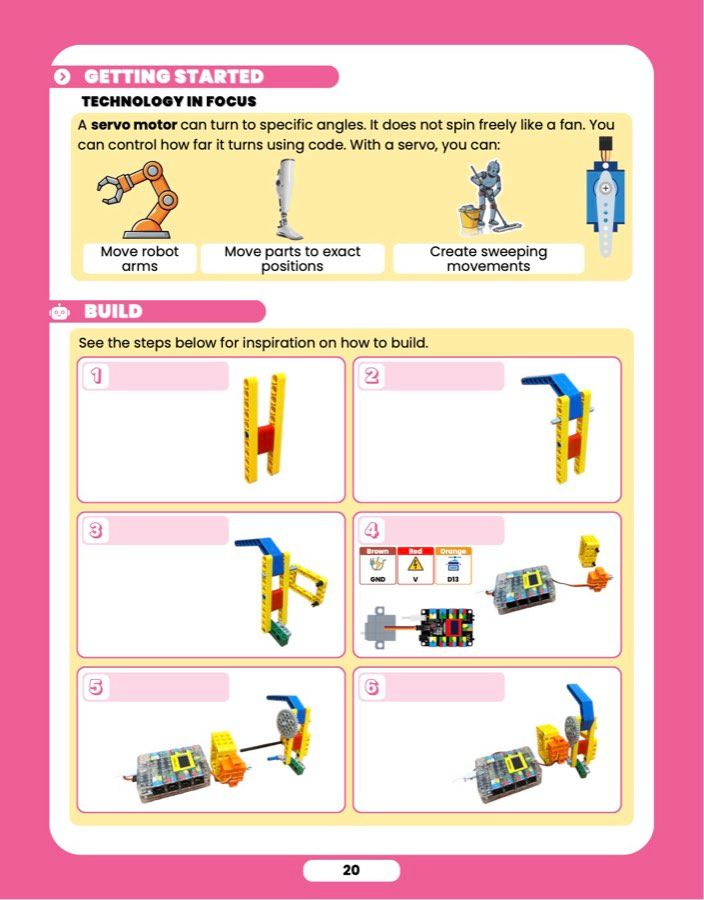
A physical therapist helps people recover movement after injury. She needs simple joint models to show how joints move. Your task is to design a joint model. The model must show hinge movement, like a knee or elbow.The problem, as printed in the workbook.
- Goal named
- SDG 3 · Good Health and Well-being
- Careers named
- Physical Therapist, Biomedical Engineer
- Standards cited
- NGSS HS-LS1-2; Cambridge IGCSE Physics 1.7.2; Common Core HSG.MG.A.1; Cambridge IGCSE Mathematics C2.6
Standards cited in Level 9, project by project
One row per project, quoted as the guidebook cites them. An empty cell means no citation for that project.
- PS1
- PS2
- PS3
- PS4
- LS1
- LS2
- ESS1
- ESS2
- TWSa
- Cc
- Ps
- Pe
- ESp
- ESs
- ESc
- SIC
- Biology (IGCSE 0610 / A-Level topics)
- Chemistry (IGCSE 0620 / A-Level topics)
- Physics (IGCSE 0625 / A-Level topics)
- Gg
- Gp
- Ss
- As
- Algebra and Graphs (IGCSE 0580 topic 2)
- Mensuration (IGCSE 0580 topic 5)
- Transformations and Vectors (IGCSE 0580 topic 7)
| Project | SDG | NGSS | Cambridge Science | Cambridge Maths | Common Core Maths | ISTE | Careers named |
|---|---|---|---|---|---|---|---|
| 1 Joints | Good Health and Well-Being | HS-LS1-2 | 1.7.2 (Energywork and power) | C2.6 | HSG.MG.A.1 | Multiple codes incl. 1.3.d1.4.d | Physical Therapist, Biomedical Engineer |
| 2 Weight Machine | Good Health and Well-Being | HS-PS3-3 | 11.1.5 (Gas exchange in humans) | E5.1 | HSF.LE.B.5 | — | Physical Therapist, Personal Trainer |
| 3 Energy Wheel | Life on Land | HS-LS2-4 | 19.2 (Organisms and their environment) | E7.1 | HSF.BF.B.3 | — | Ecologist, Environmental Engineer |
| 4 Gold Foil Experiment | Industry, Innovation and Infrastructure | HS-PS1-8 | 2.2.1 (Atomselements and compounds) | E2.2 | HSN.RN.A.2 | — | Particle Physicist, Manufacturing Engineer |
| 5 Chromatography | Good Health and Well-Being | HS-PS4-1 | 12.3.1 (Chromatography) | E2.5 | HSA.CED.A.2 | — | Analytical Chemist, Chemist |
| 6 Endothermic or Exothermic? | Industry, Innovation and Infrastructure | HS-PS1-5 | 5.1.4 (Exothermic and endothermic reactions) | 9Ss.05 | HSS.ID.B.6.c | — | Chemist, Chemical Engineer |
| 7 Solubility Predictor | Clean Water and Sanitation | HS-PS1-6 | 9Cc.04 (Changes to Materials) | 9As.06 | HSS.ID.C.7 | — | Environmental Chemist, Environmental Engineer |
| 8 Moments | Responsible Consumption and Production | HS-PS2-1 | 9TWSa.04 (Thinking and Working Scientifically) | 9Gg.04 | HSG.GMD.A.3 | — | Mechanical Engineer, Food Scientist |
| 9 Particle Model | Responsible Consumption and Production | HS-PS3-2 | 9Cc.04 (Changes to Materials) | 9Gg.10 | HS.G-SRT.C.8 | — | Physicist, Atmospheric Scientist |
| 10 Reflection | Industry, Innovation and Infrastructure | HS-PS4-5 | 8Ps.01 (Light and Sound) | 9Gp.02 | HSG.SRT.C.8 | — | Electrical Engineer, Physicist |
| 11 Magnetometer | Decent Work and Economic Growth | HS-PS2-5 | 8Pe.01 (Electricity and Magnetism) | 9Gp.03 | HSG-GMD.B.4 | — | Electrical Engineer, Hardware Engineer |
| 12 Wind Turbines | Affordable and Clean Energy | HS-PS3-3 | 8ESp.02 (Earth and Space) | 9Gp.05 | HSG.CO.A.2 | — | Renewable Energy Engineer, Wind Turbine Technician |
| 13 Weather Seesaw | Climate Action | HS-ESS2-4 | 8ESc.01 (Cycles on Earth) | 9As.04 | HSF.IF.C.9 | — | Climatologist, Environmental Engineer |
| 14 Asteroids | Climate Action | HS-ESS1-4 | 9ESs.01 (Earth in Space) | 9Ss.03 | HSS-ID.B.5 | — | Astronomer, Aerospace Engineer |
| 15 Global Science Impact | Industry, Innovation and Infrastructure | HS-PS4-5 | 9SIC.05 (Science in Context) | 9Ss.05 | HSS.CP.A.5 | — | Data Scientist, Electrical Engineer |
| Capstone Classroom Efficiency | — | — | — | — | — | — | — |
Source: SKOOL21 Level A to 12 curriculum crosswalk (2026), compiled from the teacher guides and student books. Where the two differ, the student book prevails.
What you order
| Item | Title | ISBN or SKU |
|---|---|---|
| Student workbook | STEM Innovator’s Workbook, Level 9 | 978-981-17494-1-4 |
| Teacher guidebook | Guidebook, Level 9 | 978-981-17737-3-0 |
| Learning kit | STEM Uno Kit | STEMSIHKitG9 |
Assessment built in
Four checkpoints a year use a seven-criterion rubric, and every other project gets a 30 second workbook check.
How assessment works →Standards mapped
The guidebook maps each project to NGSS, Cambridge and Common Core standards where they apply.
See the table for this level →