
Level 5: Beginner AI
Level 5 introduces beginner AI. Learners build systems that react to their surroundings and process data.

Level 5 at a glance
- Grade
- Grade 5 · Elementary
- Technology
- Beginner AI
- Tools
- MakeCode on a micro:bit
- Kit
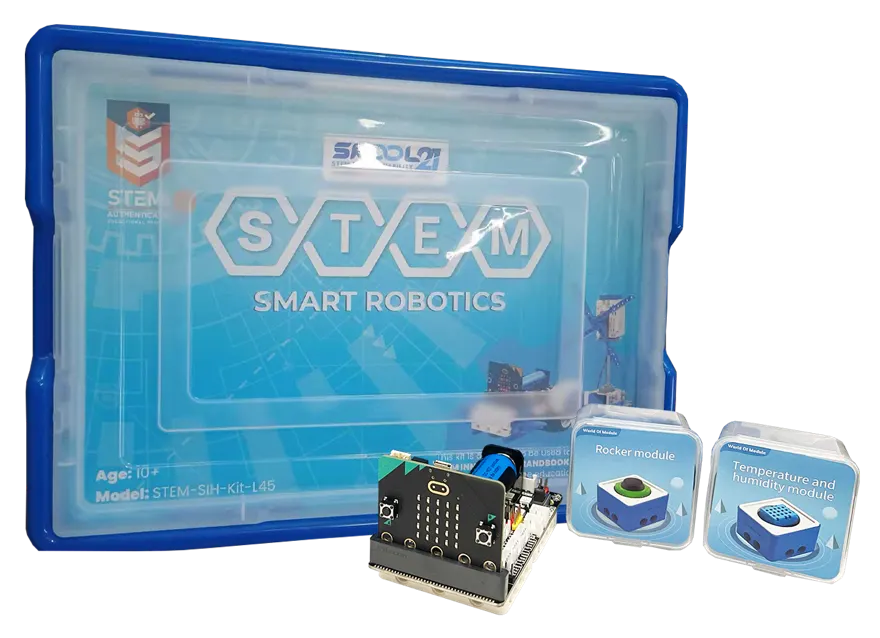
- Smart Robotics Kit, one per group of four
- Projects
- 15 projects and a Capstone
- Weekly time
- One 45 or 90 minute session
- Pre and post challenge
- Build a Plant Watering Alert
- Sustainability theme
- The broadest spread of goals of any level so far
- Careers named
- Water Quality Technician, Acoustic Engineer, Nutritionist
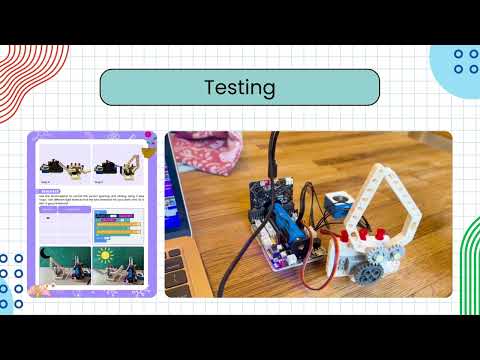 Level 5 book demo
See Level 5 in action
A short walk through the Level 5 workbook and the Smart Robotics Kit, from the SKOOL21 channel.
More videos on the SKOOL21 channel →Projects from the Smart Robotics Kit


Students can
- Build a system that reacts to sensor data
- Explain a simple AI-driven decision
- Extend Level 4 robotics skills to a new problem
Summarised from the SKOOL21 Level Exit Outcomes.
How they work
- Define
- Design
- Share
- Reflect

Fifteen projects and a Capstone.
Full exit outcomes and Sustainable Development Goals for Level 5
Engineering & Design
- Build a moisture-sensing device using the kit's advanced sensor array that signals — by light or sound — when a plant's soil is too dry (the "Build a Plant Watering Alert" pre/post challenge).
- Apply a sensor-based engineering solution to a life-science or environmental problem, extending Level 4's robotics skills to a new domain.
- Program simple conditional (if/then) logic to translate a sensor reading into an alert output — an early introduction to AI-style decision logic.
- Test a sensor-based build against a real threshold condition and adjust the trigger point as needed.
Science
- Apply matter and motion concepts, such as moisture in soil or movement of water, to an environmental sensing problem (NGSS PS1/PS2).
- Investigate an earth-systems or human-activity theme connected to plant or environmental health (NGSS ESS2/ESS3).
- Investigate a biology topic, such as plant needs, as this level's leading science strand (Cambridge Science Stage 5 — Biology).
- Encounter beginning particle-model chemistry concepts, introduced for the first time at this level (Cambridge Science Stage 5 — Chemistry).
Mathematics
- Apply geometry and spatial reasoning to sensor placement in a device build (Cambridge Geometry).
- Use number concepts to define and test a numeric threshold, such as a moisture level (Cambridge Number; Common Core Number & Operations — Fractions/Base Ten).
- Apply operations and algebraic thinking to a conditional rule (if X, then Y) underlying sensor logic (Common Core Operations & Algebraic Thinking).
Computing & Coding
- Write MakeCode programs on a micro:bit that read an advanced sensor (e.g., moisture) and evaluate it against a threshold.
- Apply beginner conditional/branching logic — an early introduction to AI-style decision-making — to trigger an output.
Take on and fulfill a defined team role — Leader, Material Manager, Reporter, or Testing Supervisor — while collaborating, communicating, and resolving conflict within a build team.
Recognize how this level’s environmental and life-science builds connect to real careers, such as Water Quality Technician, Acoustic Engineer, or Nutritionist.
Identify the Sustainable Development Goal connected to their build, with the broadest multi-goal exposure of any level so far.
From the SKOOL21 Level Exit Outcomes. Standards named are NGSS, Common Core and Cambridge strands.
- 2 Zero Hunger
- 3 Good Health and Well-being
- 4 Quality Education
- 6 Clean Water and Sanitation
- 7 Affordable and Clean Energy
- 8 Decent Work and Economic Growth
- 9 Industry, Innovation and Infrastructure
- 12 Responsible Consumption and Production
- 13 Climate Action
Source: SKOOL21 Five Pillars Framework. Compare all levels
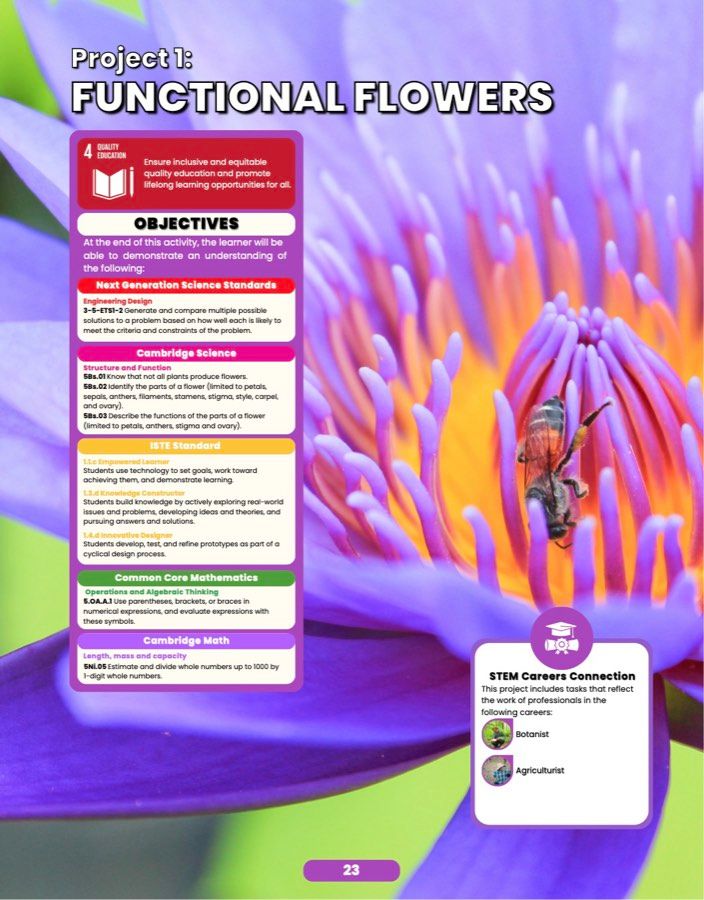
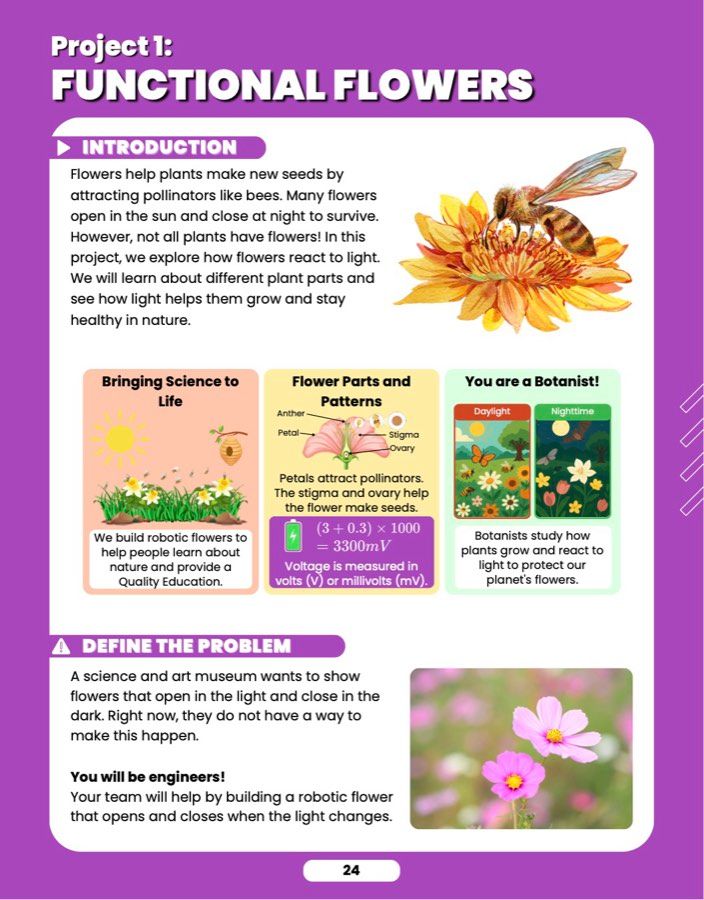
Project 1: Functional Flowers
The first project of the level, as it appears in the guidebook. The full workbook is in the reader below where published.
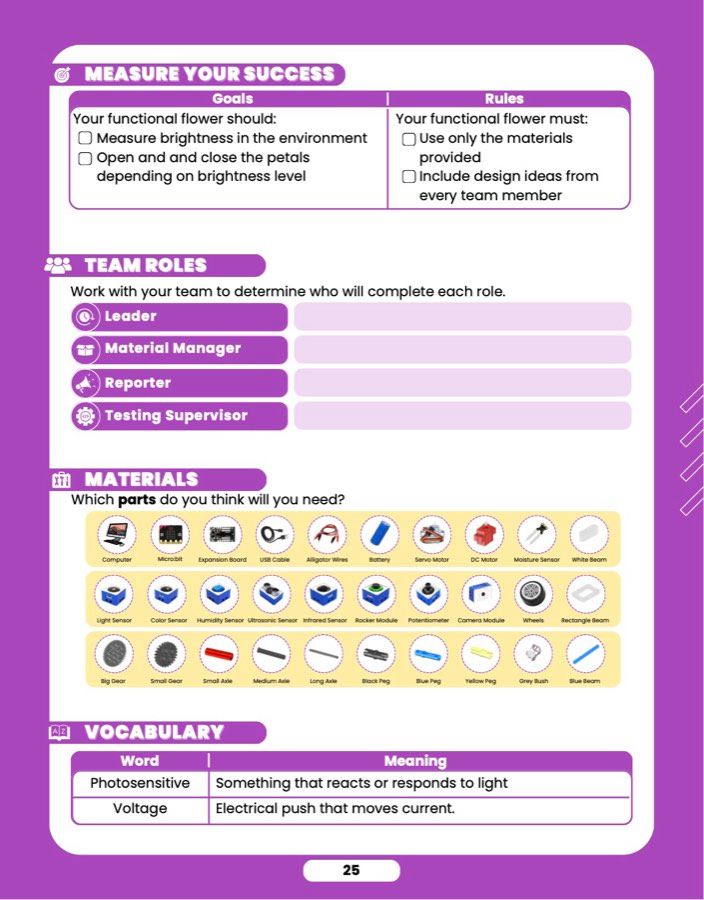
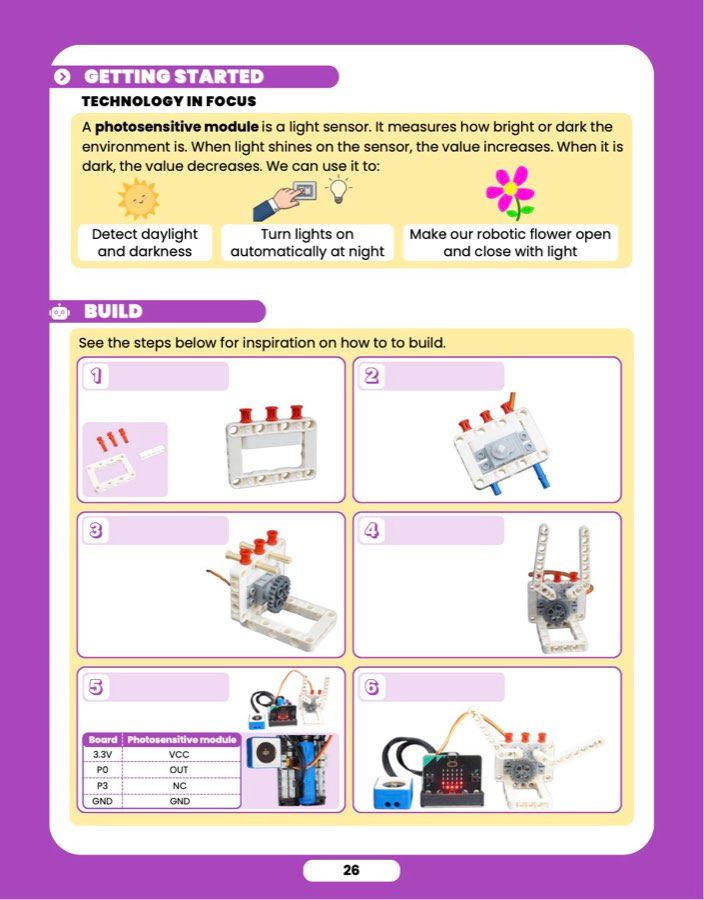
A science and art museum wants to show flowers that open in the light and close in the dark. Right now, they do not have a way to make this happen. Your team will help by building a robotic flower that opens and closes when the light changes.The problem, as printed in the workbook.
- Goal named
- SDG 4 · Quality Education
- Careers named
- Botanist, Agriculturist
- Standards cited
- NGSS 3-5-ETS1-2; Cambridge Science 5Bs.01, 5Bs.02, 5Bs.03; Common Core 5.OA.A.1; Cambridge Mathematics 5Ni.05
Standards cited in Level 5, project by project
One row per project, quoted as the guidebook cites them. An empty cell means no citation for that project.
- PS1
- PS2
- ESS2
- ESS3
- ETS1
- Bp
- Bs
- Be
- Cm
- Cp
- Cc
- Pf
- Ps
- Pe
- ESp
- ESs
- ESc
- Ni
- Np
- Nf
- Gg
- Gp
| Project | SDG | NGSS | Cambridge Science | Cambridge Maths | Common Core Maths | ISTE | Careers named |
|---|---|---|---|---|---|---|---|
| 1 Functional Flowers | Quality Education | 3-5-ETS1-2 | 5Bs.015Bs.025Bs.03 | 5Ni.05 | 5.OA.A.1 | 1.4.c | Botanist, Agriculturist |
| 2 Digestive System | Good Health and Well-Being | 3-5-ETS1-2 | 5Bs.04 | 5Nf.08 | 5.NBT.B.7 | 1.7.c | Doctor, Nurse Practitioner |
| 3 Ripeness Checker | Zero Hunger | MS-ETS1-2 | 5Bp.01 | 5Nf.10 | 5.NBT.B.5 | 1.3.d | Nutritionist, Nurse Practitioner |
| 4 Seed Dispersal | Zero Hunger | 5-ESS3-1 | 5Bp.03 | 5Np.01 | 5.NBT.A.1 | 1.3.d | Agriculturist, Mechanical Engineer |
| 5 Environmental Adaptation | Climate Action | 3-5-ETS1-2 | 5Be.01 | 5Nf.10 | 5.MD.A.1 | 1.3.d | Zoologist, Environmental Scientist |
| 6 Spider Adaptations | Industry, Innovation and Infrastructure | 3-5-ETS1-3 | 5Be.03 | 5Nf.05 | 5.NF.A.2 | 1.4.c1.7.c | Biomedical Engineer, Zoologist |
| 7 Particle Model | Quality Education | 5-PS1-1 | 5Cm.01 | 5Nf.06 | 5.NF.B.4 | 1.7.c | Chemical Engineer, Physicist |
| 8 Water Treatment Mixer | Clean Water and Sanitation | 5-PS1-4 | 5Cp.015Cp.02 | 5Nf.06 | 5.NF.B.4 | 1.3.d | Water Quality Technician, Environmental Engineer |
| 9 Rain Predictor | Climate Action | 5-ESS2-2 | 5Cc.01 | 5Nf.06 | 5.NF.B.4 | 1.4.c1.7.c | Meteorologist, Environmental Engineer |
| 10 Lift Mechanism | Industry, Innovation and Infrastructure | 5-PS2-1 | 5Pf.015Pf.02 | 5Nf.10 | 5.MD.A.1 | 1.3.d | Construction Engineer, Civil Engineer |
| 11 Sound Muffler | Decent Work and Economic Growth | 3-5-ETS1-2 | 5Ps.015Ps.025Ps.03 | 5Gp.01 | 5.MD.B.2 | 1.3.d1.7.c | Acoustic Engineer, Electrical Engineer |
| 12 Electromagnetism | Affordable and Clean Energy | 3-5-ETS1-3 | 5Pe.015Pe.025Pe.03 | 5Gg.03 | 5.MD.C.5.b | 1.7.c | Electrical Engineer, Mechanical Engineer |
| 13 Tire Pollution | Good Health and Well-Being | 5-ESS3-1 | 5ESp.01 | 5Nf.05 | 5.NF.A.2 | 1.4.c1.7.c | Air Quality Monitor, Environmental Scientist |
| 14 Evaporation Fan | Responsible Consumption and Production | 3-5-ETS1-2 | 5ESc.01 | 5Gp.03 | 5.G | 1.3.d1.7.c | Meteorologist, Mechanical Engineer |
| 15 The Earth's Tilt | Quality Education | 3-5-ETS1-2 | 5ESs.015ESs.02 | 5Nf.06 | 5.NBT.B.7 | 1.4.c | Astronomer, Climate Scientist |
| Capstone Animal Care | — | — | — | — | — | — | — |
Source: SKOOL21 Level A to 12 curriculum crosswalk (2026), compiled from the teacher guides and student books. Where the two differ, the student book prevails.
What you order
| Item | Title | ISBN or SKU |
|---|---|---|
| Student workbook | STEM Innovator’s Workbook, Level 5 | 978-981-17494-5-2 |
| Teacher guidebook | Guidebook, Level 5 | 978-981-17736-9-3 |
| Learning kit | Smart Robotics Kit | STEMSIHKitG45 |
Levels 4 and 5 share the Smart Robotics Kit.
Assessment built in
Four checkpoints a year use a seven-criterion rubric, and every other project gets a 30 second workbook check.
How assessment works →Standards mapped
The guidebook maps each project to NGSS, Cambridge and Common Core standards where they apply.
See the table for this level →