
Level 3: Block coding with Scratch
Level 3 opens the computer revolution. Students program microcontrollers and motors in Scratch and master input, process, output logic.

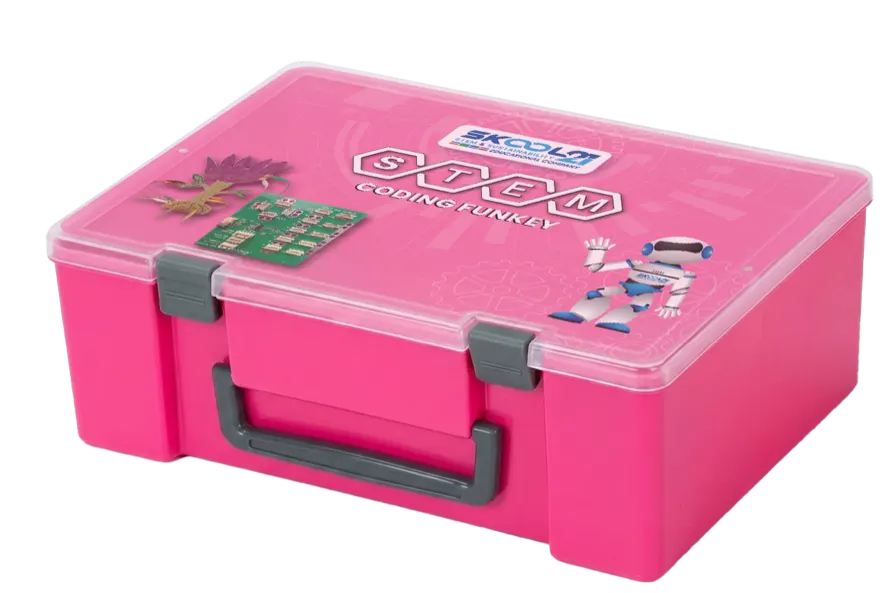
Level 3 at a glance
- Grade
- Grade 3 · Primary
- Technology
- Block coding with Scratch
- Tools
- Scratch-style block coding
- Kit
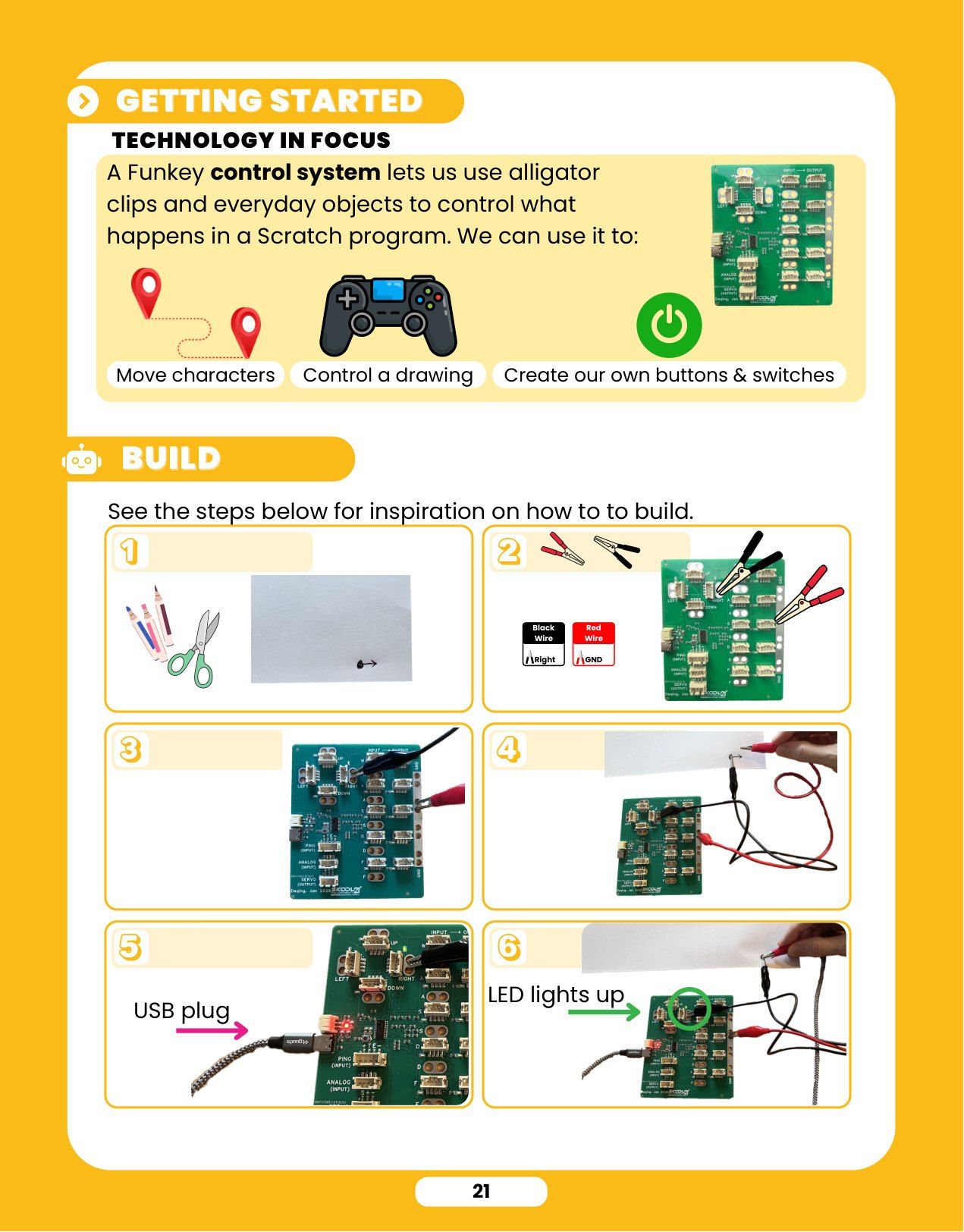
- Coding FunKey Kit, one per group of four
- Projects
- 15 projects and a Capstone
- Weekly time
- One 45 or 90 minute session
- Pre and post challenge
- Program a Crossing Signal
- Sustainability theme
- Cities, Ecosystems and Hazard Response
- Careers named
- Cartographer, Paleontologist, Veterinarian
 Level 3 book demo
See Level 3 in action
A short walk through the Level 3 workbook and the Coding FunKey Kit, from the SKOOL21 channel.
More videos on the SKOOL21 channel →Projects from the Coding FunKey Kit


Students can
- Write block programs in Scratch
- Connect a program to motors and a microcontroller
- Describe a system as input, process and output
Summarised from the SKOOL21 Level Exit Outcomes.
How they work
- Define
- Design
- Share
- Reflect

Fifteen projects and a Capstone.
Full exit outcomes and Sustainable Development Goals for Level 3
Engineering & Design
- Learn and apply the Coding FunKey Kit's block-coding tool through a dedicated "learn the tool" phase before tackling an open-ended problem.
- Write and test block-based code that controls a real-world-styled sequence, such as a repeating red-wait-green crossing signal triggered by a button (the "Program a Crossing Signal" pre/post challenge).
- Apply the engineering design process (NGSS 3-5-ETS1) across a first multi-session design cycle: define, build, test, and refine over more than one session.
- Use knowledge of code blocks to purposefully control a physical outcome, even where this "learn the tool" phase leaves limited room for a fully original solution.
Science
- Investigate biological evolution or diversity of living things through a project (NGSS LS4; Cambridge Science Stage 3 Biology).
- Explore an earth-systems concept, such as weather or natural resources, connected to a build (NGSS ESS2/ESS3; Cambridge Science Stage 3 Earth & Space).
- Investigate motion, forces, or energy transfer through a coded and mechanical build (NGSS PS2/PS3; Cambridge Science Stage 3 Physics).
- Apply Thinking & Working Scientifically as the level's dominant mode — predicting, testing, and revising across multi-session builds (Cambridge Science Stage 3).
Mathematics
- Apply geometry and mensuration concepts, such as measuring timing or distance for a signal sequence (Cambridge Geometry incl. Mensuration).
- Use number and fraction concepts in a build, such as timing intervals or part quantities (Cambridge Number; Common Core Number & Operations — Fractions).
- Collect and interpret data, including simple probability, from repeated tests of a coded sequence (Cambridge Statistics incl. Probability; Common Core Measurement & Data).
Computing & Coding
- Write and debug block-based, Scratch-style code on the Coding FunKey Kit's microcontroller board — the programme's first true visual/block programming language.
- Use sequencing, loops (repetition), and a button-triggered input to control LED outputs (input-process-output logic).
- Iterate on a coded program by testing it against a real-world-styled specification and correcting errors.
Take on and fulfill a defined team role — Leader, Material Manager, Reporter, or Testing Supervisor — while collaborating, communicating, and resolving conflict within a build team.
Recognize a wide span of real STEM careers — the widest single-level spread in the programme — such as Cartographer, Paleontologist, or Veterinarian.
Identify the Sustainable Development Goal connected to their build, themed around Cities, Ecosystems & Hazard Response — and, at Capstone, choose their own goal.
From the SKOOL21 Level Exit Outcomes. Standards named are NGSS, Common Core and Cambridge strands.
- 3 Good Health and Well-being
- 4 Quality Education
- 9 Industry, Innovation and Infrastructure
- 11 Sustainable Cities and Communities
- 12 Responsible Consumption and Production
- 13 Climate Action
- 15 Life on Land
Source: SKOOL21 Five Pillars Framework. Compare all levels
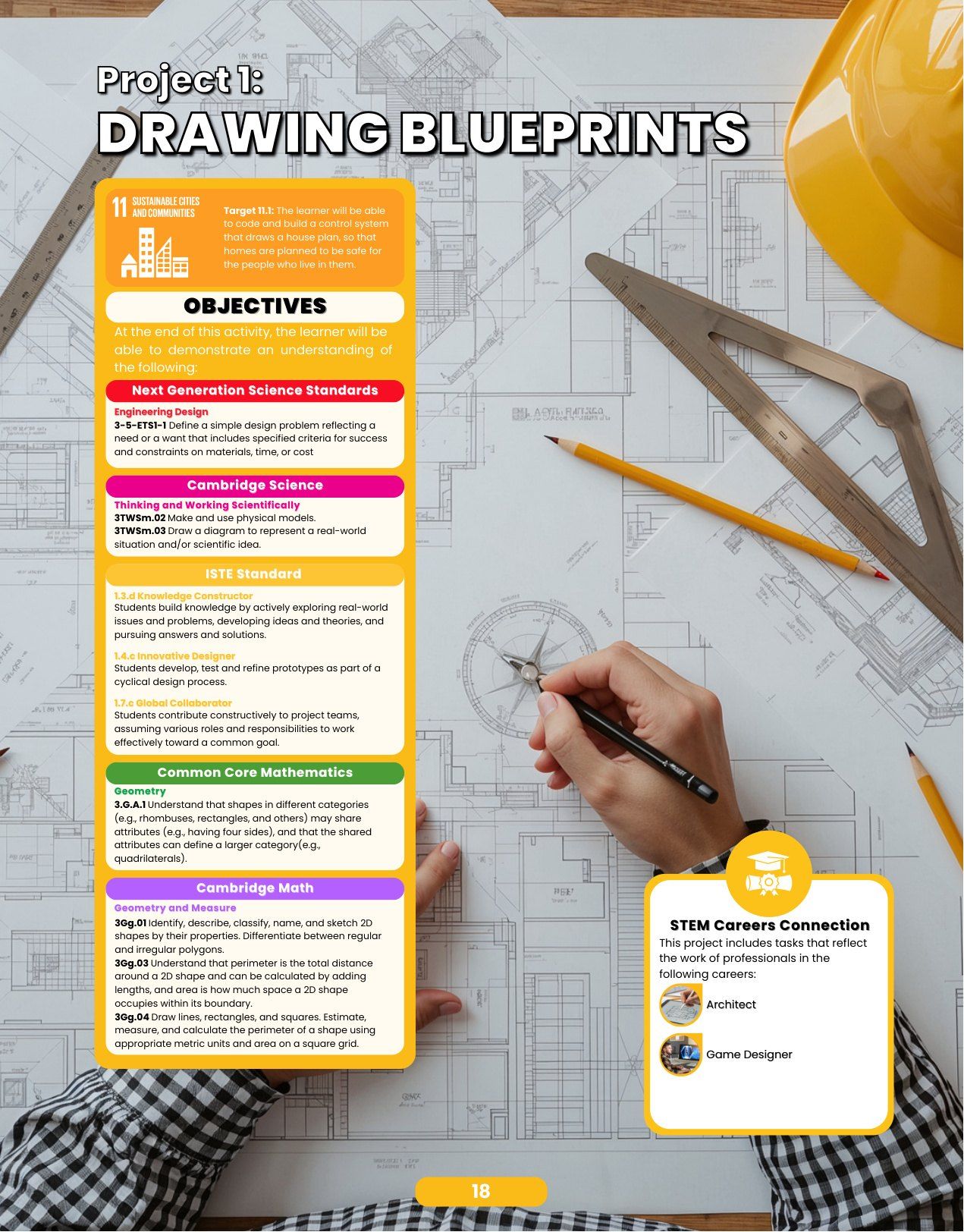
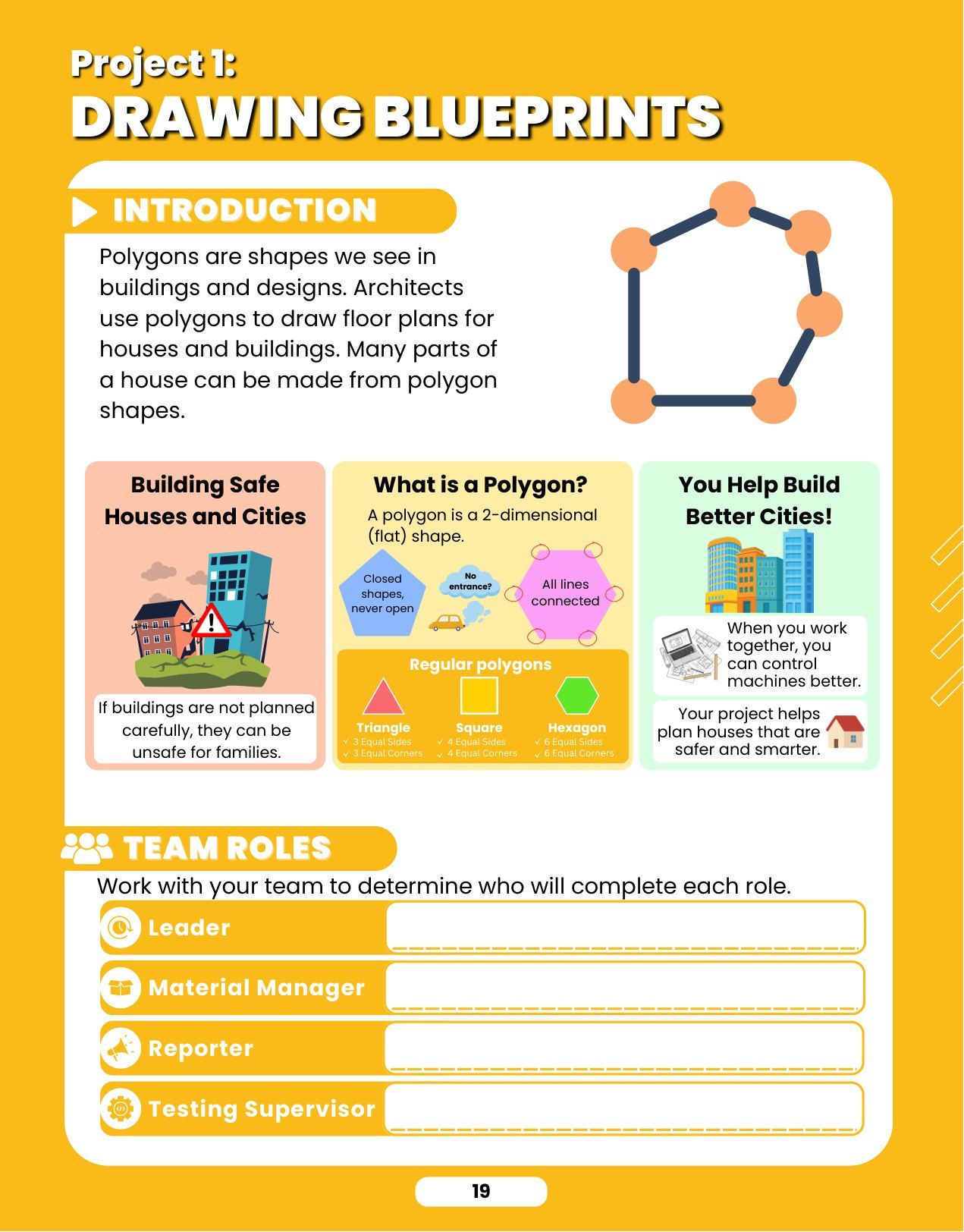
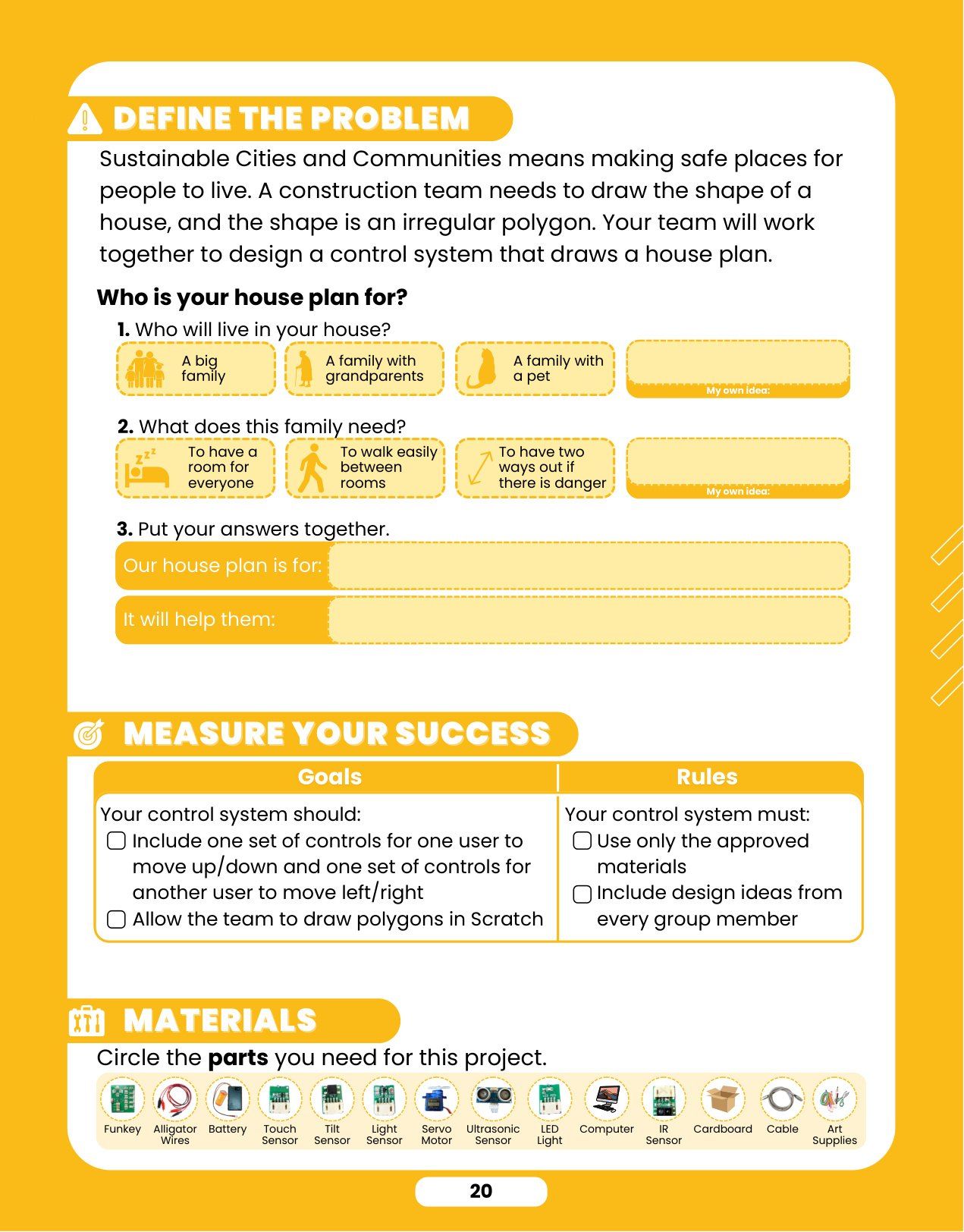
Project 1: Drawing Blueprints
The first project of the level, as it appears in the guidebook. The full workbook is in the reader below where published.
A construction team wants to draw the shape of a house. The house has an irregular polygon shape. Your team will work together to control a concrete machine and draw the shape correctly.The problem, as printed in the workbook.
- Goal named
- SDG 11 · Sustainable Cities and Communities
- Careers named
- Architect, Game Designer
- Standards cited
- NGSS 3-5-ETS1-1; Cambridge Science 3TWSm.02, 3TWSm.03; Common Core 3.G.A.1; Cambridge Mathematics 3Gg.01
Standards cited in Level 3, project by project
One row per project, quoted as the guidebook cites them. An empty cell means no citation for that project.
- PS2
- PS4
- LS1
- LS4
- ESS2
- ESS3
- ETS1
- TWSc
- TWSm
- Bs
- Be
- Cm
- Cp
- Cc
- Pf
- Ps
- Pe
- ESp
- SIC
- Np
- Nf
- Nm
- Gg
- Gp
- Gt
- Ss
- Sp
- 2 codes excluded from the grid above
| Project | SDG | NGSS | Cambridge Science | Cambridge Maths | Common Core Maths | ISTE | Careers named |
|---|---|---|---|---|---|---|---|
| 1 Drawing Blueprints | Sustainable Cities and Communities | 3-5-ETS1-1 | 3TWSm.023TWSm.03 | 3Gg.013Gg.033Gg.04 | 3.G.A.1 | 1.1.c1.4.d1.5.b | Architect, Game Designer |
| 2 Food Maze Game | (15) Life on Land | 3-LS4-33-LS4-4 | 3Be.01 | 3Gp.01 | 3.MD.B.3 | 1.4.d1.6.a | Zoologist, Marine Biologist |
| 3 Trickiest Multiplication | (4) Quality Education | 3-5-ETS1-1 | 3TWSm.02 | 3Nn.054Nn.04 | 3.NBT.A.33.MD.A.13.OA.B.5 | 1.1.c1.4.d1.5.b | Data Scientist, Mathematician |
| 4 Flowering Plants | (15) Life on Land | 3-PS2-3 | 3Bs.013TWSm.01 | 3Gg.093Nf.01 | 3.Nf.A.1 | 1.4.d1.5.b | Agricultural Engineer, Museum Exhibit Designer |
| 5 Identifying Animals | (15) Life on Land | 3-LS4-2 | 3Bs.023TWSc.03 | 3Np.043Np.05 | 3.NBT.A.1 | 1.4.d1.6.a | Veterinarian, Ornithologist |
| 6 Traveling Around the World | Quality Education | 3-PS2-3 | 3Pe.013Pe.023Pe.03 | 3Gg.033Gg.04 | 3.MD.C.6 | 1.4.d1.5.b | Ethnographer, Cartographer |
| 7 Sunlight and Shadows | (11) Sustainable Cities and Communities | 3-PS2-23-PS4-2 | 3Ps.023Ps.033TWSm.02 | 3Gt.013Gt.02 | 3.MD.A.1 | 1.4.d1.5.b | Scientist, City Planner |
| 8 Organ Match | (3) Good Health and Well-being | 3-LS1-13-PS2-3 | 3Bs.033TWSm.02 | 3Gm.02 | 3.G.A.1 | 1.4.d1.5.b | Medical Scientist, Physiotherapist |
| 9 Redirecting a Flood | (11) Sustainable Cities and Communities | 3-ESS3-1 | 3TWSc.02 | 3Ss.023Ss.03 | 3.MD.B.3 | 1.4.d1.5.b | Environmental Engineer, Civil Engineer |
| 10 Liquid & Solid Simulator | (13) Climate Action | 3-LS1-1 | 3Cm.013Cp.013Cc.01 | 3Gp.01 | 3.G.A.1 | 1.4.d1.5.b | Chemist, Metallurgist |
| 11 Mini Golf - Gravity | (9) Industry, Innovation and Infrastructure | 3-PS2-13-PS2-2 | 3Pf.02 | 3Ss.023Nf.01 | 3.NF.A.13.NF.A.3 | 1.4.d1.5.b | Roadway Engineer, Amusement Park Designer |
| 12 Fossil Evidence | (9) Industry, Innovation and Infrastructure | 3-LS4-1 | 3ESp.013ESp.023TWSm.03 | 3Gg.02 | 3.MD.B.4 | 1.4.d1.5.b | Paleontologist, Geologist |
| 13 Probability Machine - Drop Ball | (9) Industry, Innovation and Infrastructure | 3-PS2-1 | 3Pf.013Pf.02 | 3Sp.02 | 3.NF.A.1 | 1.4.d1.5.b | Game Designer, Data Scientist |
| 14 Shadow Puppet Show - Part 1 | (4) Quality Education | 3-5-ETS1-2 | 3Ps.013Ps.023Ps.03 | 3Gp.01 | 4.MD.A.44.G.A.3 | 1.1.c1.6.a | Scientist, Theater Technicians |
| 15 Shadow Puppet Show - Part 2 | (4) Quality Education | 3-5-ETS1-3 | 3Ps.013Ps.023Ps.03 | 3Nm.013Nm.02 | 4.MD.A.44.G.A.3 | 1.1.c1.6.a | Art and Design Engineer, Theater Technicians |
| Capstone Reducing Impacts of Natural Hazards | Choice of Goals (student-selected: drought, wildfire, flooding, or disease) | 3-ESS2-13-ESS2-2 | 3TWSc.023SIC.033SIC.04 | — | — | 1.4.c | — |
Source: SKOOL21 Level A to 12 curriculum crosswalk (2026), compiled from the teacher guides and student books. Where the two differ, the student book prevails.
Read Level 3 online
The full workbook, and the teacher guide where published, in a page-turning reader.

STEM Innovator’s Workbook, Level 3
Opens a page-turning reader from Issuu. Issuu may set its own cookies once it loads.
What you order
| Item | Title | ISBN or SKU |
|---|---|---|
| Student workbook | STEM Innovator’s Workbook, Level 3 | 978-981-17521-0-0 |
| Teacher guidebook | Guidebook, Level 3 | 978-981-17736-7-9 |
| Learning kit | Coding FunKey Kit | STEMSIHKitG3 |
Assessment built in
Four checkpoints a year use a seven-criterion rubric, and every other project gets a 30 second workbook check.
How assessment works →Standards mapped
The guidebook maps each project to NGSS, Cambridge and Common Core standards where they apply.
See the table for this level →