
Level 8: Data science
Level 8 brings data science into the classroom with a 16-in-1 DataBot. Students handle data, probability and statistics.


Level 8 at a glance
- Grade
- Grade 8 · Middle school
- Technology
- Data science
- Tools
- DataBot sensor logging
- Kit
- Data Science Kit, one per group of four
- Projects
- 15 projects and a Capstone
- Weekly time
- One 45 or 90 minute session
- Pre and post challenge
- Investigate Your Classroom
- Sustainability theme
- 13 of the 17 SDGs in a single level
- Careers named
- Human-Robot Interface Designer, Indoor Air Quality Specialist, Biomechanical Engineer
 Level 8 book demo
See Level 8 in action
A short walk through the Level 8 workbook and the Data Science Kit, from the SKOOL21 channel.
More videos on the SKOOL21 channel →Projects from the Data Science Kit


Students can
- Collect data with the DataBot
- Use probability and statistics to interpret results
- Present a conclusion supported by data
Summarised from the SKOOL21 Level Exit Outcomes.
How they work
- Define
- Design
- Share
- Reflect
Fifteen projects and a Capstone.
Full exit outcomes and Sustainable Development Goals for Level 8
Engineering & Design
- Select and define a personal or environmental problem independently — the programme's first fully self-selected Capstone problem.
- Use the DataBot to collect real sensor data (light, sound, or temperature) on a chosen classroom factor (the "Investigate Your Classroom" pre/post challenge).
- Analyze collected sensor data and present a specific, evidence-based finding.
- Persist with a self-selected focus across a full data-collection-and-analysis cycle.
Science
- Investigate energy and waves concepts using sensor data, such as light or sound readings (NGSS PS3; Cambridge Science Stage 8 — Physics, the level's leading strand).
- Investigate a life-science topic (molecules to organisms) connected to a data-driven project (NGSS LS1).
- Explore a human-activity/earth-systems theme through environmental data collection (NGSS ESS3).
- Apply middle-school engineering design (NGSS MS-ETS1) and Thinking & Working Scientifically to a self-directed investigation (Cambridge Science Stage 8).
Mathematics
- Collect, organize, and interpret quantitative sensor data using statistics concepts (Cambridge Statistics; Common Core Statistics & Probability).
- Apply algebra or functions to describe a relationship found in collected data (Cambridge Algebra; Common Core Functions, Expressions & Equations).
- Use number-system and geometry concepts as needed to process and present data (Common Core The Number System; Geometry).
Computing & Coding
- Use the DataBot's sensor-logging interface to capture, log, and export multi-sensor data (light, sound, temperature, and more).
- Apply basic data-handling and probability/statistics workflows to interpret logged sensor data and draw a conclusion.
Take on a project-based team role — Leader, Material Manager, Reporter, or Testing Supervisor — using more advanced collaboration and presentation skills.
Recognize real engineering and data-adjacent careers built around sensor data, such as Human-Robot Interface Designer or Indoor Air Quality Specialist.
Identify the Sustainable Development Goal connected to their build, drawing on real sensor data to span 13 of 17 SDGs in a single level.
From the SKOOL21 Level Exit Outcomes. Standards named are NGSS, Common Core and Cambridge strands.
- 1 No Poverty
- 2 Zero Hunger
- 3 Good Health and Well-being
- 4 Quality Education
- 7 Affordable and Clean Energy
- 8 Decent Work and Economic Growth
- 9 Industry, Innovation and Infrastructure
- 10 Reduced Inequalities
- 11 Sustainable Cities and Communities
- 12 Responsible Consumption and Production
- 13 Climate Action
- 15 Life on Land
Source: SKOOL21 Five Pillars Framework. Compare all levels
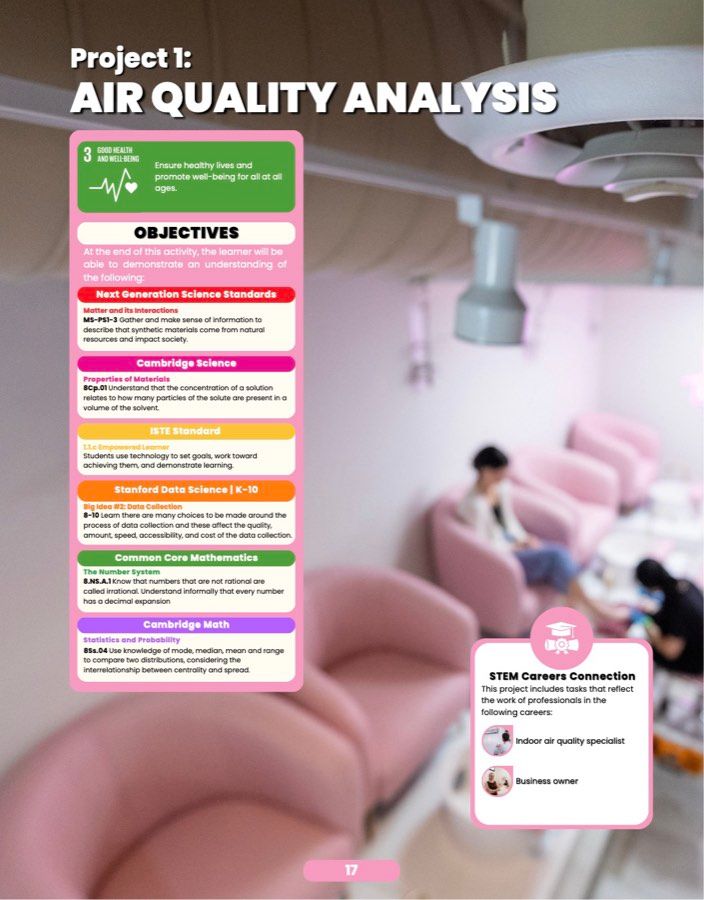
Project 1: Air Quality Analysis
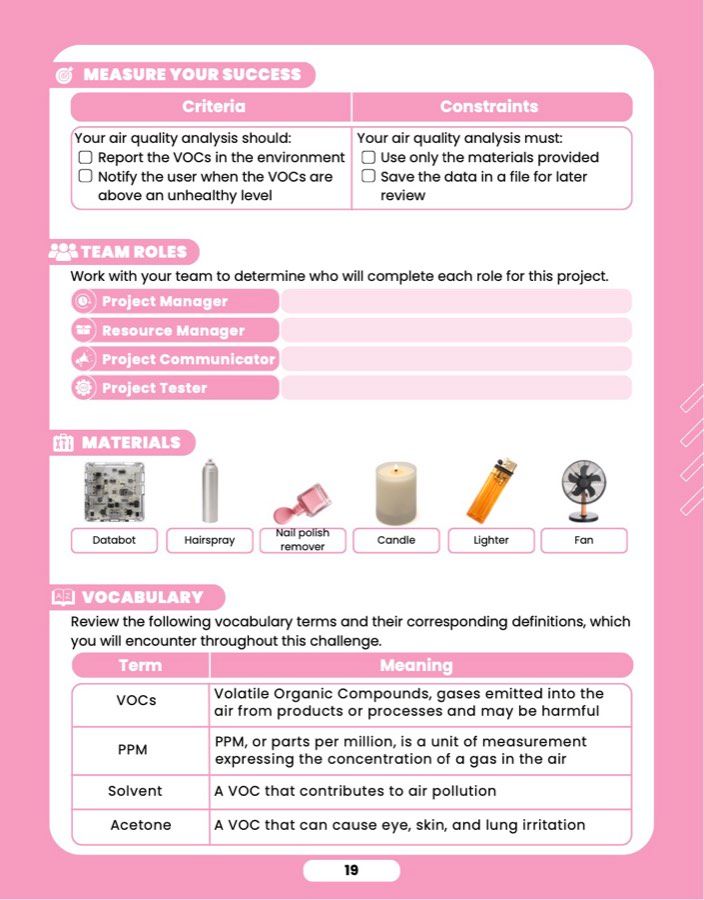
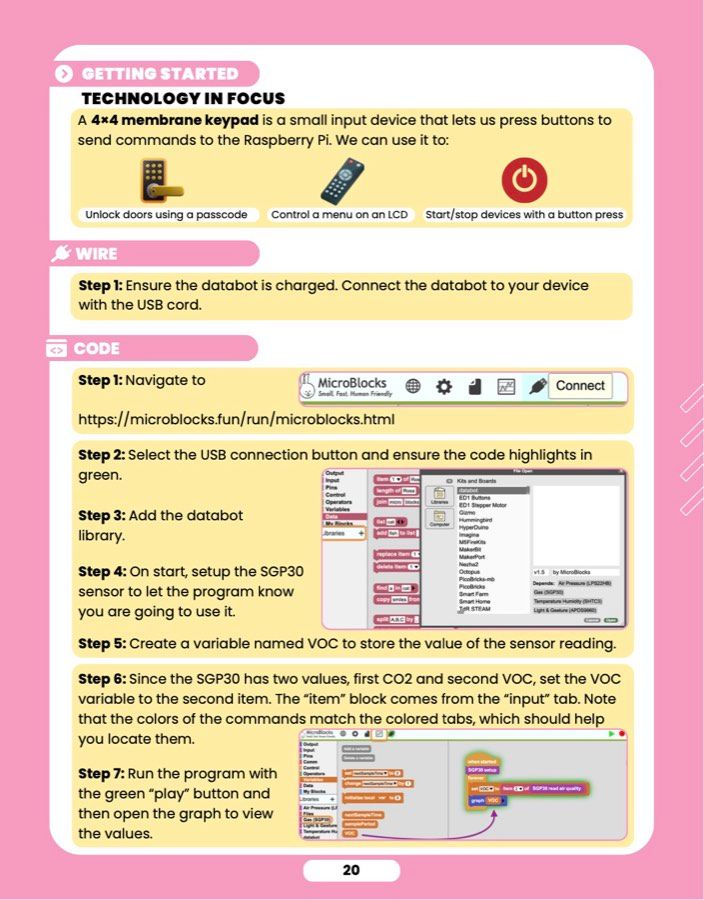
The first project of the level, as it appears in the guidebook. The full workbook is in the reader below where published.
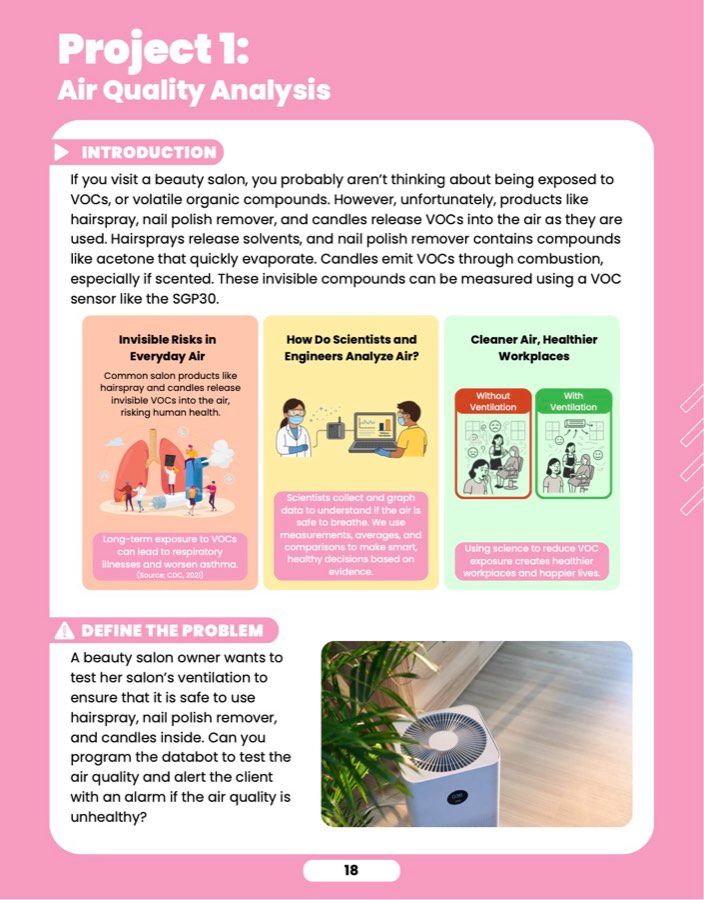
A beauty salon owner wants to test her salon’s ventilation to ensure that it is safe to use hairspray, nail polish remover and candles inside. Can you program the databot to test the air quality and alert the client with an alarm if the air quality is unhealthy?The problem, as printed in the workbook.
- Goal named
- SDG 3 · Good Health and Well-being
- Careers named
- Indoor Air Quality Specialist, Business Owner
- Standards cited
- NGSS MS-PS1-3; Cambridge Science 8Cp.01; Common Core 8.NS.A.1; Cambridge Mathematics 8Ss.04
Standards cited in Level 8, project by project
One row per project, quoted as the guidebook cites them. An empty cell means no citation for that project.
- PS1
- PS2
- PS3
- PS4
- LS1
- ESS3
- ETS1
- TWSc
- TWSa
- Bp
- Bs
- Cp
- Pf
- Ps
- Pe
- ESc
- SIC
- Gg
- Gp
- Ss
- Ae
- As
| Project | SDG | NGSS | Cambridge Science | Cambridge Maths | Common Core Maths | ISTE | Careers named |
|---|---|---|---|---|---|---|---|
| 1 Air Quality Analysis | (3) Good Health and Well-being | MS-PS1-3 | 8Cp.01 | 8Ss.04 | 8.NS.A.1 | 1.1.c (Empowered Learner) | Indoor Air Quality Specialist, Business Owner |
| 2 UV-Protection Product Testing | (12) Responsible Consumption and Production | MS-PS4-2 | 8Ps.04 | 8Ae.04 | 8.EE.C.7 | 1.1.c (Empowered Learner) | Quality Control Technician, Researcher |
| 3 Jump Counter | (3) Good Health and Well-being | MS-LS1-5 | 8Bp.03 | 8As.07 | 8.F.B.5 | 1.1.c (Empowered Learner) | Physical Therapist, Kinesiologist |
| 4 Soundproof Walls | (1) No Poverty | MS-PS4-2 | 8TWSc.07 | 8As.04 | 8.F.B.4 | 1.1.c (Empowered Learner) | Audio Engineer, Data Analyst |
| 5 Greenhouse Effect | (13) Climate Action | MS-ESS3-5 | 8ESc.02 | 8Ae.04 | 8.F.A.3 | 1.1.c (Empowered Learner) | Climate Scientist, Environmental Scientist |
| 6 Landslide Prevention | (9) Industry, Innovation and Infrastructure | MS-ESS3-2 | 8SIC.02 | 8Gg.11 | 8.G.A.5 | 1.1.c (Empowered Learner) | Civil Engineer, Environmental Scientist |
| 7 Blackout Curtains | (5) Gender Equality | MS-PS4-2 | 8Ps.04 | 8Ss.05 | 8.SP.A.1 | 1.1.c (Empowered Learner) | Materials Scientist, Health Professional |
| 8 Package Parachute | (2) Zero Hunger | MS-PS2-2 | 8Pf.03 | 8As.03 | 8.EE.B.5 | 1.1.c (Empowered Learner) | Aerospace Engineer, Aeronautical Engineer |
| 9 Split Thermal Lunchbox | (4) Quality Education | MS-PS3-3 | 8TWSa.04 | 8Ae.06 | 8.EE.C.8.c | 1.1.c (Empowered Learner) | Product Designer, Materials Scientist |
| 10 Maglev Trains | (7) Affordable and Clean Energy | MS-PS3-2 | 8Pe.01 | 8As.04 | 8.EE.C.7 | 1.1.c (Empowered Learner) | Civil Engineer, Transport Engineer |
| 11 Blind Spot Sensor | (9) Industry, Innovation and Infrastructure | MS-ETS1-1 | 8SIC.02 | 8Ss.05 | 8.SP.A.4 | 1.1.c (Empowered Learner) | Electrical Engineer, Transport Engineer |
| 12 Conductor Converter | (10) Reduced Inequalities | MS-PS4-3 | 8TWSa.02 | 8As.07 | 8.F.B.5 | 1.1.c (Empowered Learner) | Human-Robot Interface Designer, Sound Engineer |
| 13 Balance Ball Chair | (8) Decent Work and Economic Growth | MS-ETS1-1 | 8Pf.05 | 8As.04 | 8.F.B.4 | 1.1.c (Empowered Learner) | Biomechanical Engineer, Ergonomic Designer |
| 14 Altitude Sickness Alarm | (15) Life on Land | MS-LS1-7 | 8Bs.04 | 8As.04 | 8.F.B.4 | 1.1.c (Empowered Learner) | Biomechanical Engineer, Physician |
| 15 Bike Stability Monitor | (11) Sustainable Cities and Communities | MS-PS2-2 | 8Pf.03 | 8Gp.01 | 8.G.B.8 | 1.1.c (Empowered Learner) | Biomechanical Engineer, Physician |
| Capstone Personal Trainer | (3) Good Health and Well-being | MS-ETS1-1 | 8Bp.03 | — | — | 1.1.c (Empowered Learner) | — |
Source: SKOOL21 Level A to 12 curriculum crosswalk (2026), compiled from the teacher guides and student books. Where the two differ, the student book prevails.
What you order
| Item | Title | ISBN or SKU |
|---|---|---|
| Student workbook | STEM Innovator’s Workbook, Level 8 | 978-981-17494-2-1 |
| Teacher guidebook | Guidebook, Level 8 | 978-981-17737-2-3 |
| Learning kit | Data Science Kit | STEMSIHKitG8 |
Assessment built in
Four checkpoints a year use a seven-criterion rubric, and every other project gets a 30 second workbook check.
How assessment works →Standards mapped
The guidebook maps each project to NGSS, Cambridge and Common Core standards where they apply.
See the table for this level →