
Level 2: Electronics
Students snap together circuit modules and reason about how hardware logic makes a system work, alongside science-rich content.

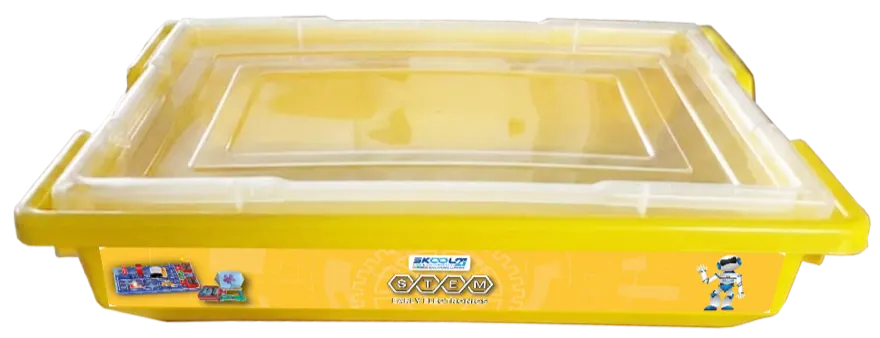
Level 2 at a glance
- Grade
- Grade 2 · Primary
- Technology
- Electronics
- Tools
- Snap circuit modules
- Kit
- Early Electronics Kit, one per group of four
- Projects
- 15 projects and a Capstone
- Weekly time
- One 45 or 90 minute session
- Pre and post challenge
- Design a Silent Doorbell
- Sustainability theme
- Infrastructure and Education Access
- Careers named
- Circuit Design Engineer, Sound Engineer, Laser Technician
 Level 2 book demo
See Level 2 in action
A short walk through the Level 2 workbook and the Early Electronics Kit, from the SKOOL21 channel.
More videos on the SKOOL21 channel →Projects from the Early Electronics Kit


Students can
- Assemble working circuits from snap modules
- Explain what each module does in a circuit
- Predict and test how a change alters the result
Summarised from the SKOOL21 Level Exit Outcomes.
How they work
- Define
- Design
- Share
- Reflect

Fifteen projects and a Capstone.
Full exit outcomes and Sustainable Development Goals for Level 2
Engineering & Design
- Build a working electrical circuit (battery, wires, switch/button, LED) that solves a stated real-world problem (the "Design a Silent Doorbell" pre/post challenge).
- Apply the define-build-test process specifically to circuit design, testing whether the circuit lights up on a button press.
- Test and troubleshoot a circuit that does not work as intended through direct hands-on testing (14 of this level's 16 projects are purely engineering-design tasks).
- Design an accessible/adaptive solution for a stated user need (e.g., a visual alert in place of an audio one).
Science
- Describe and select the properties of matter used in a circuit build, such as conductive versus non-conductive materials (NGSS Physical Science — Matter, PS1).
- Explain how a simple circuit produces light through an electrical connection (Cambridge Science Stage 2 Physics — Electricity, the level's dominant strand).
- Apply Thinking & Working Scientifically skills to test and refine a circuit build (Cambridge Science Stage 2).
- Connect a build to an Earth & Space or Chemistry topic encountered this level (Cambridge Science Stage 2).
Mathematics
- Count and organize circuit components, and describe simple likelihood/probability ideas from repeated testing outcomes (Cambridge Primary Statistics incl. Probability).
- Identify and use 2D/3D shapes and spatial layout when arranging circuit components (Cambridge Primary Geometry; Common Core Geometry).
- Apply number operations to compare quantities, such as wire lengths or battery counts (Cambridge Primary Number; Common Core Number & Operations in Base Ten).
- Apply a mathematical practice such as perseverance while troubleshooting a non-working circuit (Common Core Standards for Mathematical Practice).
Computing & Coding
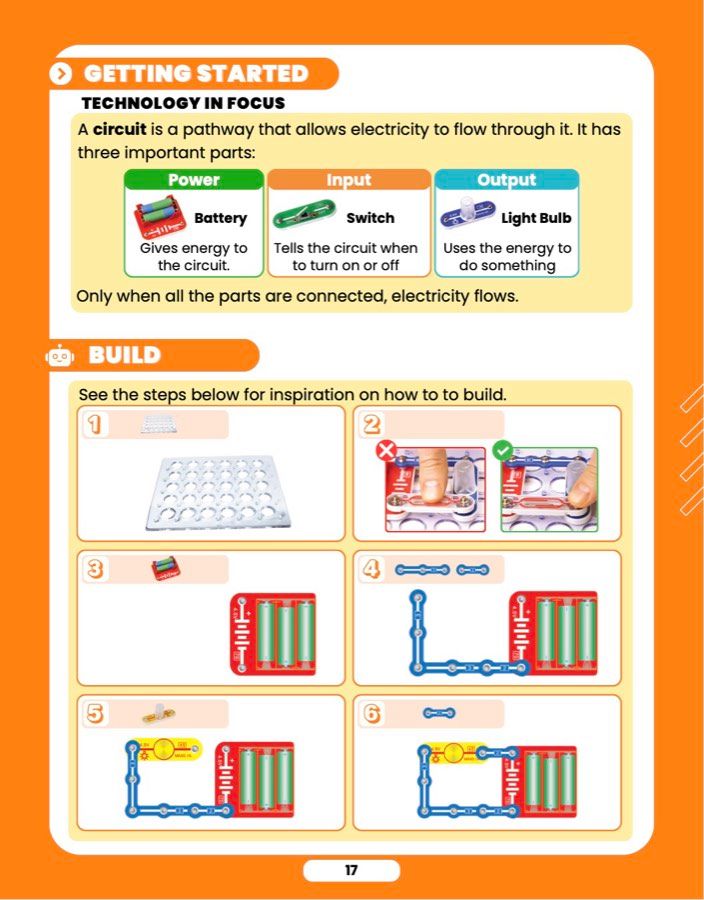
- Build and test a functioning electrical circuit with a trigger (switch/button) and an output (LED) — an electronics-based precursor to input-process-output logic.
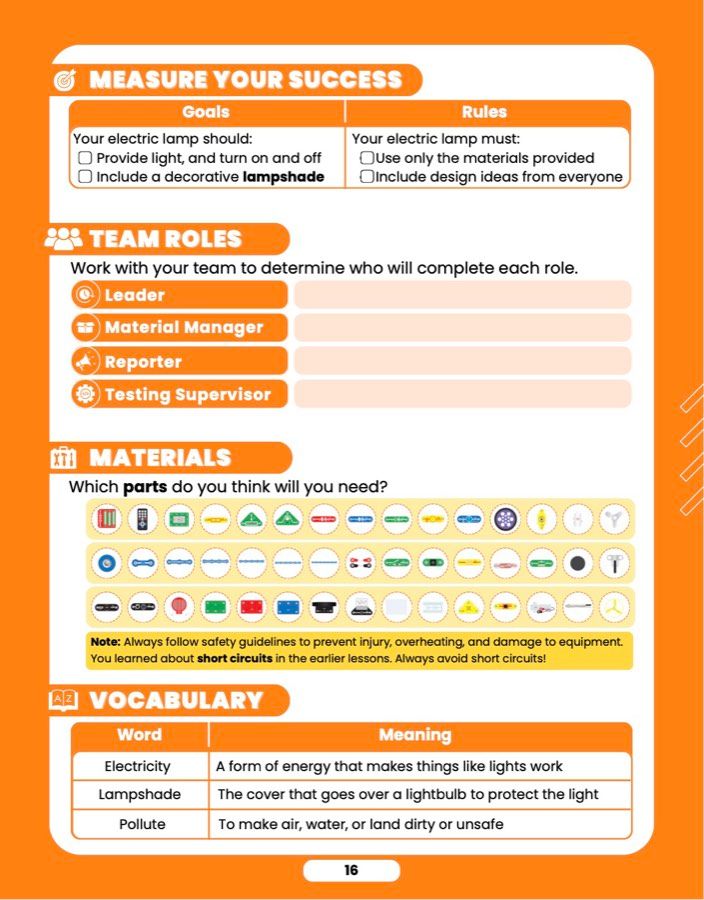
Take on and fulfill a defined team role — Leader, Material Manager, Reporter, or Testing Supervisor — while collaborating, communicating, and resolving conflict within a build team.
Recognize how this level’s builds connect to real electronics-engineering careers, such as Circuit Design Engineer, Sound Engineer, or Laser Technician.
Identify the Sustainable Development Goal connected to their build, themed around Infrastructure & Education Access — and, at Capstone, choose their own goal.
From the SKOOL21 Level Exit Outcomes. Standards named are NGSS, Common Core and Cambridge strands.
- 2 Zero Hunger
- 3 Good Health and Well-being
- 4 Quality Education
- 7 Affordable and Clean Energy
- 9 Industry, Innovation and Infrastructure
- 11 Sustainable Cities and Communities
- 12 Responsible Consumption and Production
- 13 Climate Action
Source: SKOOL21 Five Pillars Framework. Compare all levels
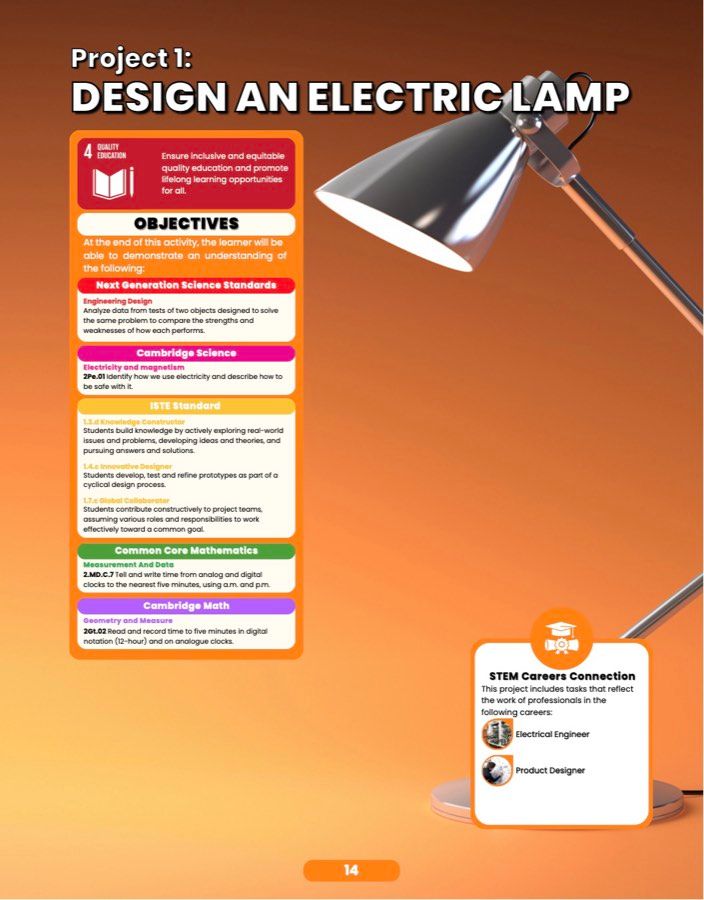
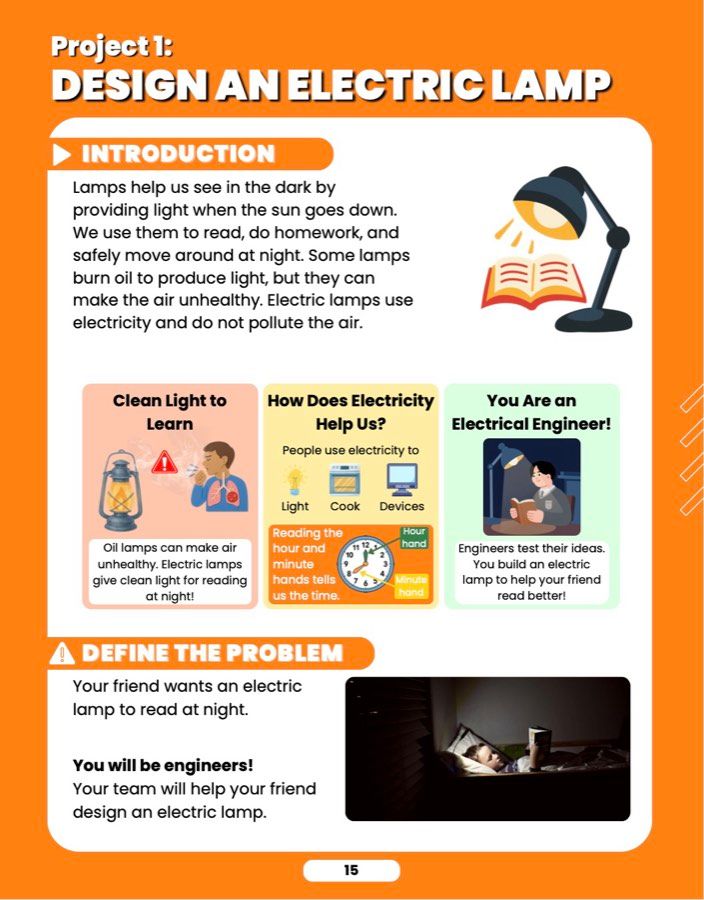
Project 1: Design an Electric Lamp
The first project of the level, as it appears in the guidebook. The full workbook is in the reader below where published.
Your friend wants an electric lamp to read at night. Your team will help your friend design an electric lamp.The problem, as printed in the workbook.
- Goal named
- SDG 4 · Quality Education
- Careers named
- Electrical Engineer, Product Designer
- Standards cited
- NGSS K-2 Engineering Design; Cambridge Science 2Pe.01; Common Core 2.MD.C.7; Cambridge Mathematics 2Gt.02
Standards cited in Level 2, project by project
One row per project, quoted as the guidebook cites them. An empty cell means no citation for that project.
- PS1
- ETS1
- TWSc
- TWSm
- Cp
- Pf
- Pe
- ESp
- Nc
- Ni
- Np
- Nf
- Gg
- Gt
- Ss
- Sp
- TWM
| Project | SDG | NGSS | Cambridge Science | Cambridge Maths | Common Core Maths | ISTE | Careers named |
|---|---|---|---|---|---|---|---|
| 1 Design an Electric Lamp | Quality Education | K-2-ETS1-1 | 2TWSc.022TWSc.04 | 2Gt.02 | 2.MD.C.7 | 1.3.d.1.4.c.1.7.c. | Electrical Engineer, Product Designer |
| 2 Design a Switch | Responsible Consumption and Production | 2-PS1-22-PS1-1 | 2Cp.012Cp.022Cp.03 | 2Ss.012Ss.02 | 2.MD.D.92.MD.D.10 | 1.3.d.1.4.c.1.7.c. | Safety Engineer, Materials Scientist |
| 3 Design a Doorbell | Industry, Innovation and Infrastructure | K-2-ETS1-1 | 2Pe.022Pe.03 | 2Gg.01 | 2.G.A.1 | 1.3.d.1.4.c.1.7.c. | Electrical Engineer, Civil Engineer |
| 4 Design a Lodestone Detector | Quality Education | 2-PS1-22-PS1-1 | 2Cp.032ESp.01 | 2Ss.012Ss.02 | 2.MD.D.92.MD.D.10 | 1.3.d.1.4.c.1.7.c. | Geologist, Materials Scientist |
| 5 Design a Communicator | Industry, Innovation and Infrastructure | K-2-ETS1-1 | 2Pe.022TWSm.02 | 2Sp.01 | MP6 | 1.3.d.1.4.c.1.7.c. | Communication Engineer, Marine Engineer |
| 6 Design a Fan | Climate Action | K-2-ETS1-1 | 2Pe.032Pf.03 | 2Nf.01 | 2.G.A.3 | 1.3.d.1.4.c.1.7.c. | Mechanical Engineer, Electrical Engineer |
| 7 Design a Circuit | Industry, Innovation and Infrastructure | K-2-ETS1-1 | 2Pe.022Pe.03 | 2Np.01 | 2.NBT.A.1 | 1.3.d.1.4.c.1.7.c. | Lighting Designer, Laser Technician |
| 8 Design a Motion Detector | Zero Hunger | K-2-ETS1-1 | 2Pe.022Pe.03 | 2Gg.032Gg.04 | 2.MD.A.1 | 1.3.d.1.4.c.1.7.c. | Safety Engineer, Electrical Engineer |
| 9 Design a Motion Alarm | Sustainable Cities and Communities | K-2-ETS1-1 | 2Pe.022Pe.03 | 2Np.03 | 2.NBT.A.4 | 1.3.d.1.4.c.1.7.c. | Security Technician, Electrical Engineer |
| 10 Design a Light Show | Affordable and Clean Energy | K-2-ETS1-1 | 2Pe.022Pe.03 | 3Ni.04 | 2.NBT.B.7 | 1.3.d.1.4.c.1.7.c. | Electrical Engineer, Laser Technician |
| 11 Design an Asteroid Game | Quality Education | K-2-ETS1-1 | 2Pe.022Pe.03 | 2Np.01 | 2.NBT.A.1 | 1.3.d.1.4.c.1.7.c. | Game Electronics Engineer, Electrical Engineer |
| 12 Design a Birthday Surprise | Good Health and Well-being | K-2-ETS1-1 | 2Pe.022Pe.03 | 2Ni.01 | 2.NBT.A.3 | 1.3.d.1.4.c.1.7.c. | Circuit Design Engineer, Sound Engineer |
| 13 Design a Night Light | Affordable and Clean Energy | K-2-ETS1-1 | 2Pe.022Pe.03 | 2Nc.052Ni.04 | 2.OA.C.4 | 1.3.d.1.4.c.1.7.c. | Sensor Systems Engineer, Electrical Engineer |
| 14 Design an Electric Car | Sustainable Cities and Communities | K-2-ETS1-1 | 2Pe.022Pe.03 | 2Ss.01 | 2.OA.A.1 | 1.3.d.1.4.c.1.7.c. | Electric Vehicle Engineer, Electrical Engineer |
| 15 Design a Highway | Industry, Innovation and Infrastructure | K-2-ETS1-1 | 2Pe.022Pe.03 | TWM.01TWM.08 | MP1 | 1.3.d.1.4.c.1.7.c. | Civil Engineer, Urban Planner |
| Capstone STEM Challenge | Choice of Goals (student-selected) | K-2-ETS1-1 | 2Pe.022Pe.03 | TWM.01TWM.08 | MP1 | 1.3.d.1.4.c.1.7.c. | — |
Source: SKOOL21 Level A to 12 curriculum crosswalk (2026), compiled from the teacher guides and student books. Where the two differ, the student book prevails.
Read Level 2 online
The full workbook, and the teacher guide where published, in a page-turning reader.

STEM Innovator’s Workbook, Level 2
Opens a page-turning reader from Issuu. Issuu may set its own cookies once it loads.
Teacher Guide, Level 2
Opens a page-turning reader from Issuu. Issuu may set its own cookies once it loads.
What you order
| Item | Title | ISBN or SKU |
|---|---|---|
| Student workbook | STEM Innovator’s Workbook, Level 2 | 978-981-17521-1-7 |
| Teacher guidebook | Guidebook, Level 2 | 978-981-17736-6-2 |
| Learning kit | Early Electronics Kit | STEMSIHKitG2 |
Assessment built in
Four checkpoints a year use a seven-criterion rubric, and every other project gets a 30 second workbook check.
How assessment works →Standards mapped
The guidebook maps each project to NGSS, Cambridge and Common Core standards where they apply.
See the table for this level →