
Level B: Simple machines
Kindergarten builders explore pulleys, wind blades and levers, and meet early science, the SDGs and careers.

Level B at a glance
- Grade
- Kindergarten · Foundation
- Technology
- Simple machines
- Tools
- Pre-code, simple machines
- Kit
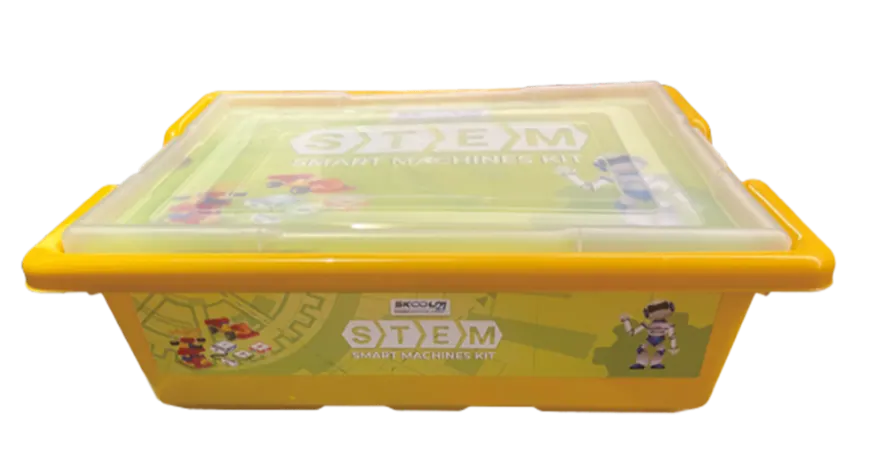
- Smart Machines Kit, one per group of four
- Projects
- 15 projects and a Capstone
- Weekly time
- One 45 or 90 minute session
- Pre and post challenge
- Build a Moving Toy
- Sustainability theme
- 10 of the 17 SDGs across the level, such as Life on Land, Sustainable Cities and Communities, and Climate Action
 Level B book demo
See Level B in action
A short walk through the Level B workbook and the Smart Machines Kit, from the SKOOL21 channel.
More videos on the SKOOL21 channel →Projects from the Smart Machines Kit


Students can
- Build with pulleys, wind blades and levers
- Describe how a simple machine changes a push or a pull
- Talk about people who solve problems in their community
Summarised from the SKOOL21 Level Exit Outcomes.
How they work
- Plan
- Do
- Improve
- Review

Fifteen projects and a Capstone.
Full exit outcomes for Level B
Engineering & Design
- Build a simple machine (e.g., a pulley or basic mechanism) from the Smart Machine Kit that performs a specified real-world-inspired function.
- Build a device that moves independently across a surface when pushed, and describe how it works (the "Build a Moving Toy" pre/post challenge).
- Test whether a built object performs its intended action, adjusting the build with teacher or peer guidance.
- Collaborate in a small group to build and test a solution to a simple, real-world-framed scenario, ahead of formally assigned team roles (which begin at Level 1).
Science
- Explore and describe basic forces and motion (push, pull, roll) through a moving-machine build (NGSS K-2-ETS1 / Physical Science — Forces & Energy).
- Describe a simple human impact on the local environment (e.g., keeping a park clean) in connection with a build (NGSS Earth & Human Activity).
- Make simple first-hand observations across biology, chemistry, physics, and earth/space topics through guided investigation (Cambridge Science Stage 1 — Thinking & Working Scientifically, the leading strand).
- Apply the Engineering Design Process at a K-2 level to a simple, real-world-framed problem (NGSS K-2-ETS1).
Mathematics
- Count and compare quantities of pieces used in a build (Cambridge Primary Number; Common Core Counting & Cardinality).
- Identify and describe simple 2D/3D shapes in kit components (Cambridge Primary Geometry; Common Core Kindergarten Geometry).
- Collect and represent simple classroom data, such as tallying how many builds moved successfully (Cambridge Primary Statistics; Common Core Measurement & Data).
- Use early operations/algebraic thinking, such as combining pieces to reach a target count (Common Core Operations & Algebraic Thinking).
Computing & Coding
- Sequence and assemble mechanical components (pulleys, levers) in a specified order to achieve a moving function — an early, non-digital precursor to procedural thinking.
Collaborate in an informal, teacher-guided small group to build, test, and share a solution — the first step toward the formal team roles introduced at Level 1.
Not yet introduced — SKOOL21 begins explicitly naming real STEM careers from Level 1 on.
Identify the Sustainable Development Goal connected to their build — spanning 10 of 17 SDGs across the level, e.g. Life on Land, Sustainable Cities & Communities, Climate Action.
From the SKOOL21 Level Exit Outcomes. Standards named are NGSS, Common Core and Cambridge strands.
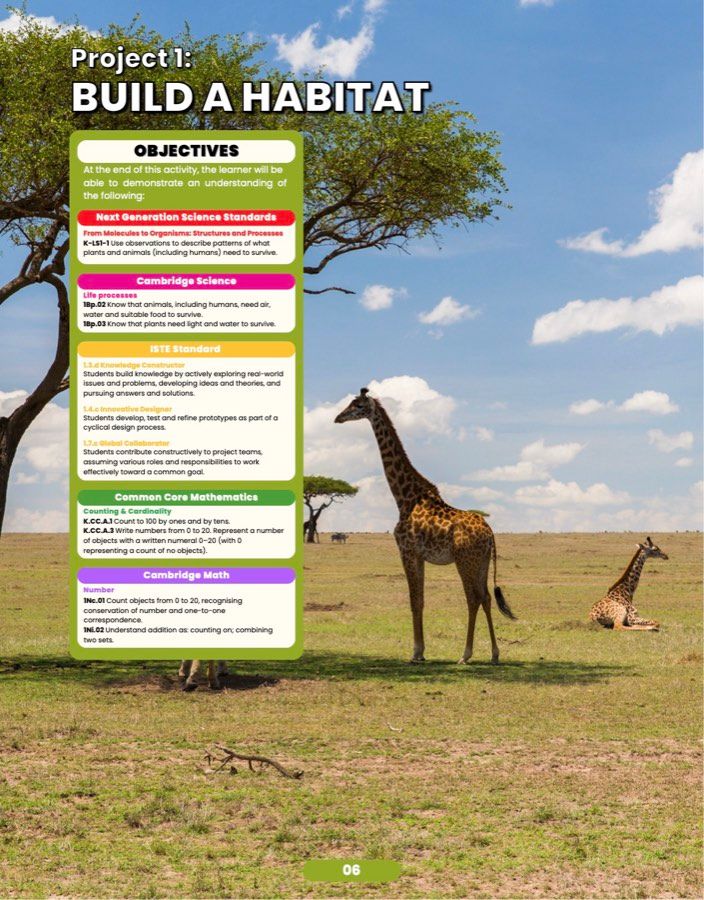
Project 1: Build a Habitat
The first project of the level, as it appears in the guidebook. The full workbook is in the reader below where published.
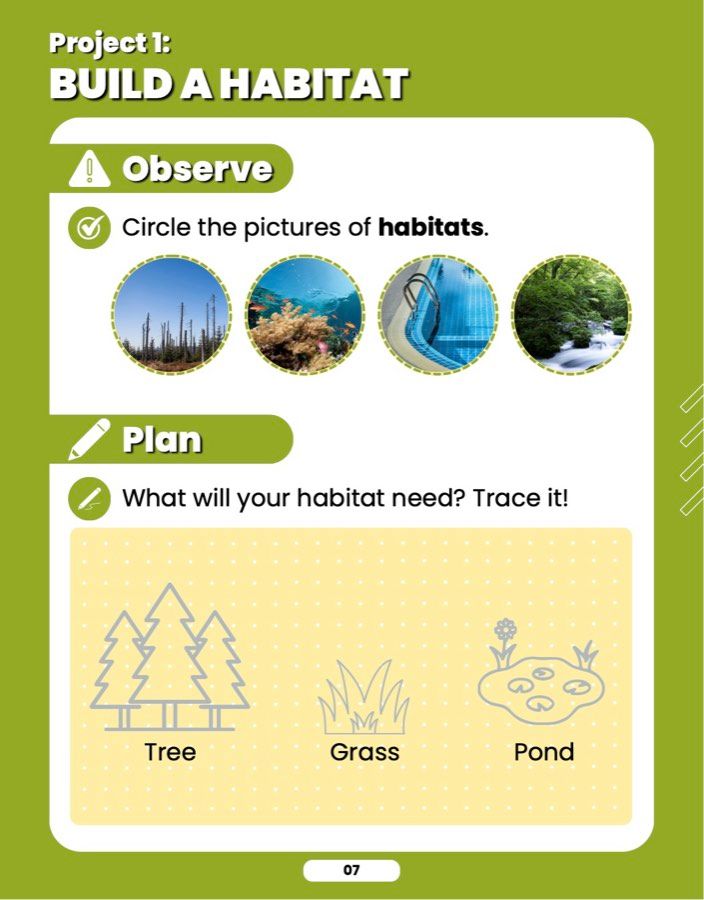
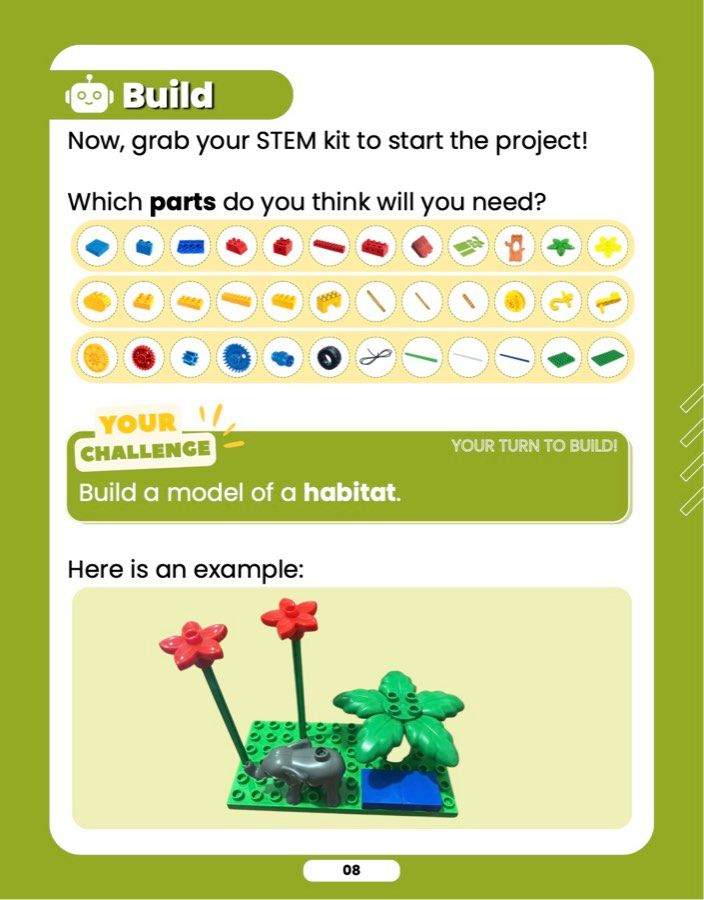
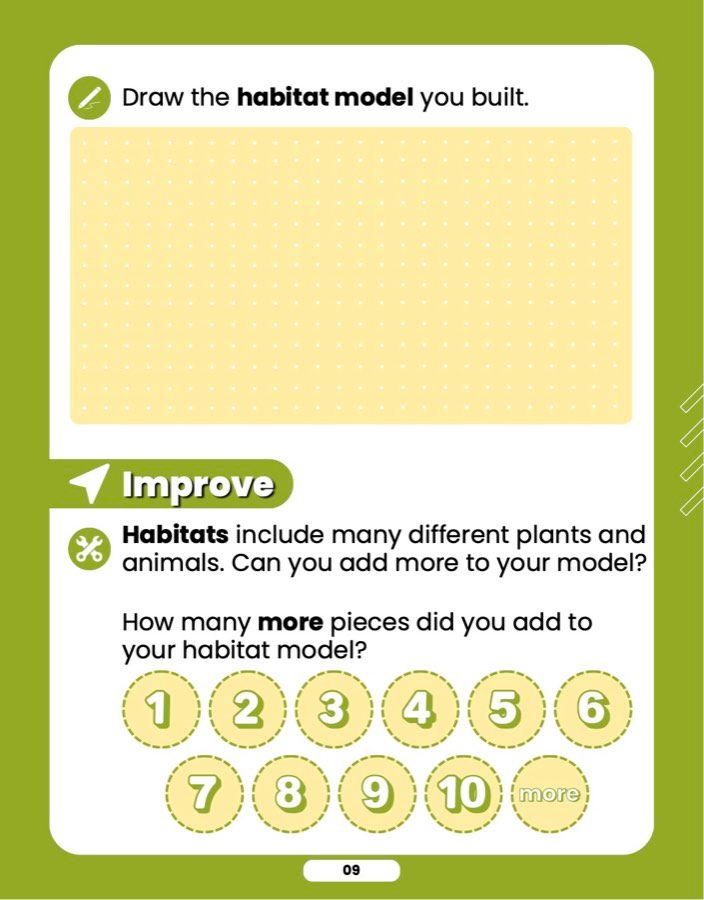
Children circle the pictures that show a habitat, trace what theirs will need (a tree, grass and a pond), then build a model of it with the kit.
- Standards cited
- NGSS K-LS1-1; Cambridge Science 1Bp.02, 1Bp.03; Common Core K.CC.A.1, K.CC.A.3; Cambridge Mathematics 1Nc.01
Standards cited in Level B, project by project
One row per project, quoted as the guidebook cites them. An empty cell means no citation for that project.
- PS2
- PS3
- LS1
- ESS2
- ESS3
- ETS1
- TWSp
- TWSc
- Bp
- Cc
- Pf
- ESp
- ESs
- SIC
- Nc
- Ni
- Gg
- Ss
| Project | SDG | NGSS | Cambridge Science | Cambridge Maths | Common Core Maths | ISTE |
|---|---|---|---|---|---|---|
| 1 Build a Habitat | Life on Land | K-LS1-1 | 1Bp.021Bp.03 | 1Nc.011Ni.02 | K.CC.A.1K.CC.A.3 | 1.3.d.1.4.c.1.7.c. |
| 2 Build a Boat | Sustainable Cities and Communities | K-ESS3-2 | 1Pf.031TWSp.02 | 1Nc.011Gg.02 | K.CC.B.5K.CC.C.7 | 1.3.d.1.4.c.1.7.c. |
| 3 Build a Playground | Good Health and Well Being | K-PS3-2 | 1ESs.021TWSp.01 | 1Gg.011Gg.02 | K.G.B.4K.G.B.5 | 1.3.d.1.4.c.1.7.c. |
| 4 Build a Truck | Life on Land | K-ESS3-3 | 1SIC.041TWSc.03 | 1Ss.031Nc.03 | K.MD.A.1K.CC.A.3 | 1.3.d.1.4.c.1.7.c. |
| 5 Build a Farm Tool | Zero Hunger | K-ESS3-1K-2-ETS1-1 | 1Bp.021TWSc.02 | 1Gg.04 | K.MD.A.1 | 1.3.d.1.4.c.1.7.c. |
| 6 Build a Wind Meter | Climate Action | K-ESS2-1 | 1SIC.03 | 1Nc.011Gg.02 | K.CC.A.1K.MD.A.1 | 1.3.d.1.4.c.1.7.c. |
| 7 Build a Spin Dryer | Responsible Consumption and Production | K-PS2-1 | 1Pf.011Pf.02 | 1Gg.05 | K.G.A.2 | 1.3.d.1.4.c.1.7.c. |
| 8 Build a Box Mover | Industry, Innovation and Infrastructure | K-PS2-1 | 1Pf.011Pf.02 | 1Gg.041Ni.01 | K.MD.A.1K.MD.A.2 | 1.3.d.1.4.c.1.7.c. |
| 9 Build a Sailboat | Life Below Water | K-PS2-2 | 1Pf.011Pf.02 | 1Nc.011Ss.03 | K.MD.A.2 | 1.3.d.1.4.c.1.7.c. |
| 10 Build a Bicycle | Climate Action | K-PS3-1 | 1ESp.021ESs.01 | 1Nc.011Ss.03 | K.MD.A.2 | 1.3.d.1.4.c.1.7.c. |
| 11 Build a Machine | Sustainable Cities and Communities | K-2-ETS1-2 | 1Cc.011TWSc.02 | 1Ni.021Ni.05 | K.OA.A.3 | 1.3.d.1.4.c.1.7.c. |
| 12 Build a Well | Clean Water and Sanitation | K-2-ETS1-3 | 1TWSc.05 | 1Ni.021Ni.05 | K.OA.A.3 | 1.3.d.1.4.c.1.7.c. |
| 13 Build a Robot | — | — | — | — | — | 1.3.d.1.4.c.1.7.c. |
| 14 Build a Spinning Toy | Quality Education | K-PS2-1K-2-ETS1-1 | 1TWSp.02 | 1Gg.05 | K.G.A.2 | 1.3.d.1.4.c.1.7.c. |
| 15 Build a Catapult | Industry, Innovation and Infrastructure | K-PS2-2 | 1Pf.02 | 1Ni.03 | K.OA.A.2 | 1.3.d.1.4.c.1.7.c. |
| Capstone Build the Future | Industry, Innovation and Infrastructure | K-2-ETS1-2 | 1TWSp.02 | 1Ni.03 | K.OA.A.2 | 1.3.d.1.4.c.1.7.c. |
Source: SKOOL21 Level A to 12 curriculum crosswalk (2026), compiled from the teacher guides and student books. Where the two differ, the student book prevails.
Read Level B online
The full workbook, and the teacher guide where published, in a page-turning reader.

STEM Innovator’s Workbook, Level B
Opens a page-turning reader from Issuu. Issuu may set its own cookies once it loads.
Teacher Guide, Level B
Opens a page-turning reader from Issuu. Issuu may set its own cookies once it loads.
What you order
| Item | Title | ISBN or SKU |
|---|---|---|
| Student workbook | STEM Innovator’s Workbook, Level B | 978-981-17521-3-1 |
| Teacher guidebook | Guidebook, Level B | 978-981-17736-4-8 |
| Learning kit | Smart Machines Kit | STEMSIHKitKG1 |
Assessment built in
Four checkpoints a year use a seven-criterion rubric, and every other project gets a 30 second workbook check.
How assessment works →Standards mapped
The guidebook maps each project to NGSS, Cambridge and Common Core standards where they apply.
See the table for this level →