
Level 7: Smart AI systems
Level 7 develops smart AI systems, and students solve complex missions with connected, programmable hardware.

Level 7 at a glance
- Grade
- Grade 7 · Middle school
- Technology
- Smart AI systems
- Tools
- MakeCode with AI blocks
- Kit
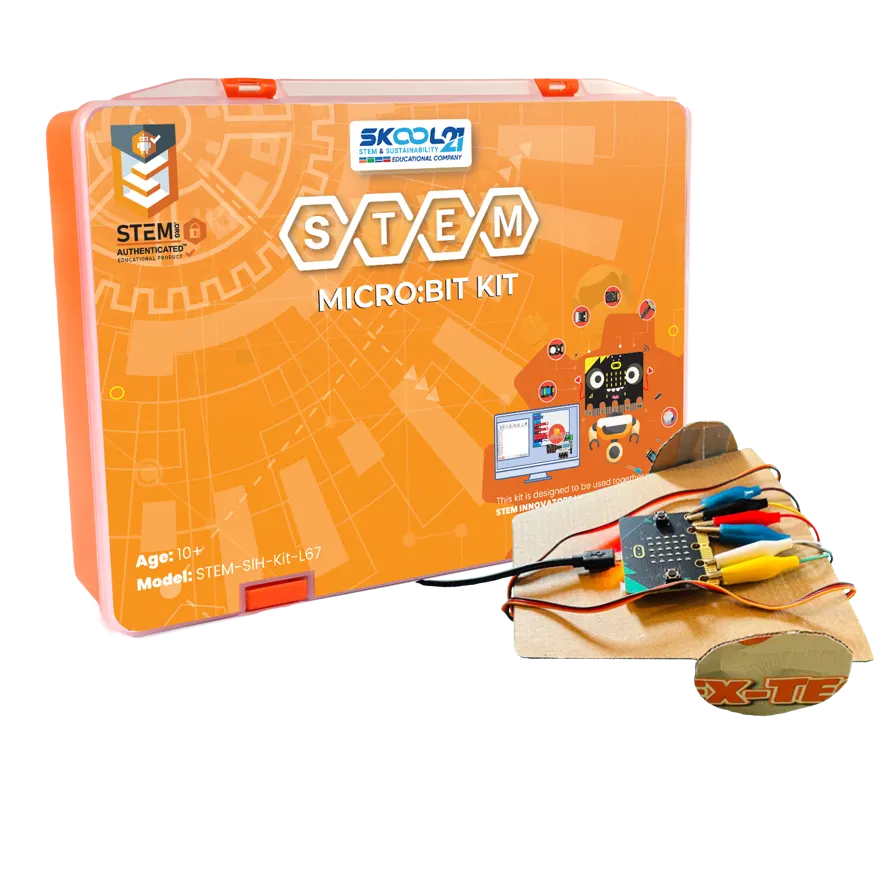
- STEM Micro:bit Kit, one per group of four
- Projects
- 15 projects and a Capstone
- Weekly time
- One 45 or 90 minute session
- Pre and post challenge
- Build a Story Light Show
- Sustainability theme
- Land, Industry and Climate
- Careers named
- Oceanographer, Microbiologist, First Responder
 Level 7 book demo
See Level 7 in action
A short walk through the Level 7 workbook and the STEM Micro:bit Kit, from the SKOOL21 channel.
More videos on the SKOOL21 channel →Projects from the STEM Micro:bit Kit


Students can
- Build a smart system that senses and responds
- Solve a multi-step mission with a program
- Explain how the system uses data
Summarised from the SKOOL21 Level Exit Outcomes.
How they work
- Define
- Design
- Share
- Reflect

Fifteen projects and a Capstone.
Full exit outcomes and Sustainable Development Goals for Level 7
Engineering & Design
- Respond to the programme's first open-ended, audience-facing design brief, defining a creative problem and building a solution for a real audience.
- Combine micro:bit code with simple AI-style pattern logic to create an audience-facing light-and-sound presentation (the "Build a Story Light Show" pre/post challenge).
- Work within the relabeled 4-role team structure for older students (Project Manager, Resource Manager, Project Communicator, Project Tester).
- Present a finished build to another team, explaining design choices and answering audience questions.
Science
- Investigate ecosystems and evolution themes through a project (NGSS LS2).
- Explore earth-systems content connected to a build (NGSS ESS2).
- Apply middle-school engineering design (NGSS MS-ETS1) to define and solve a stated problem.
- Investigate matter-related physical science content, drawing on this level's widest spread of biology, chemistry, physics, and earth/space content of any level so far (NGSS PS1; Cambridge Science Stage 7–9).
Mathematics
- Apply algebra, introduced for the first time in the programme, to a project task (Cambridge Algebra).
- Use ratio/proportional relationships and number-system concepts in a build (Common Core Ratios & Proportional Relationships; The Number System).
- Apply geometry and early expressions / equations concepts to a design task (Cambridge Geometry; Common Core Expressions & Equations).
Computing & Coding
- Write AI-integrated block programs on a micro:bit that apply simple AI/ML-style pattern or decision logic (e.g., a light-and-sound sequence that responds to a condition).
- Combine multiple coded behaviors into one audience-facing program and debug it for a live presentation.
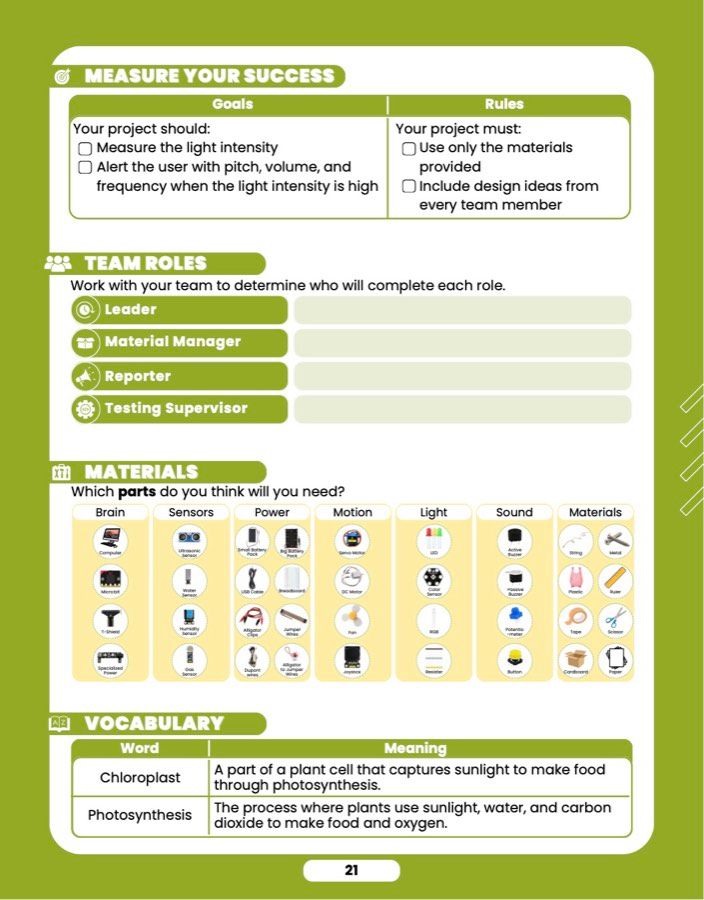
Take on a project-based team role — Leader, Material Manager, Reporter, or Testing Supervisor — using more advanced collaboration and presentation skills.
Recognize real health, environmental, and — for the first time — AI-titled careers, such as Oceanographer, Microbiologist, or First Responder.
Identify the Sustainable Development Goal connected to their build, themed around Land, Industry & Climate.
From the SKOOL21 Level Exit Outcomes. Standards named are NGSS, Common Core and Cambridge strands.
- 3 Good Health and Well-being
- 4 Quality Education
- 7 Affordable and Clean Energy
- 8 Decent Work and Economic Growth
- 9 Industry, Innovation and Infrastructure
- 13 Climate Action
- 14 Life Below Water
- 15 Life on Land
Source: SKOOL21 Five Pillars Framework. Compare all levels
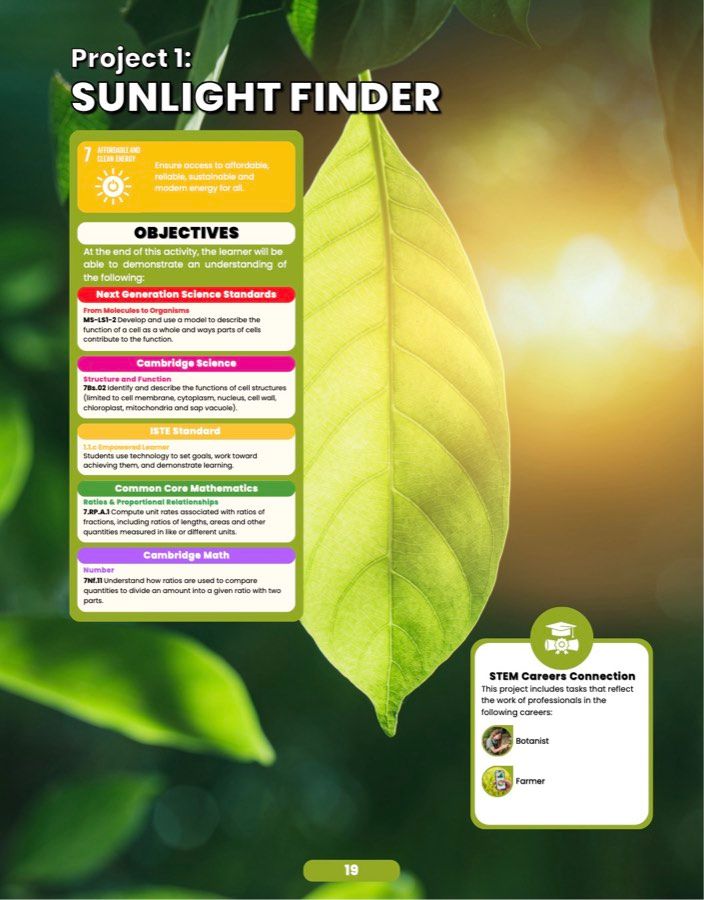
Project 1: Sunlight Finder
The first project of the level, as it appears in the guidebook. The full workbook is in the reader below where published.
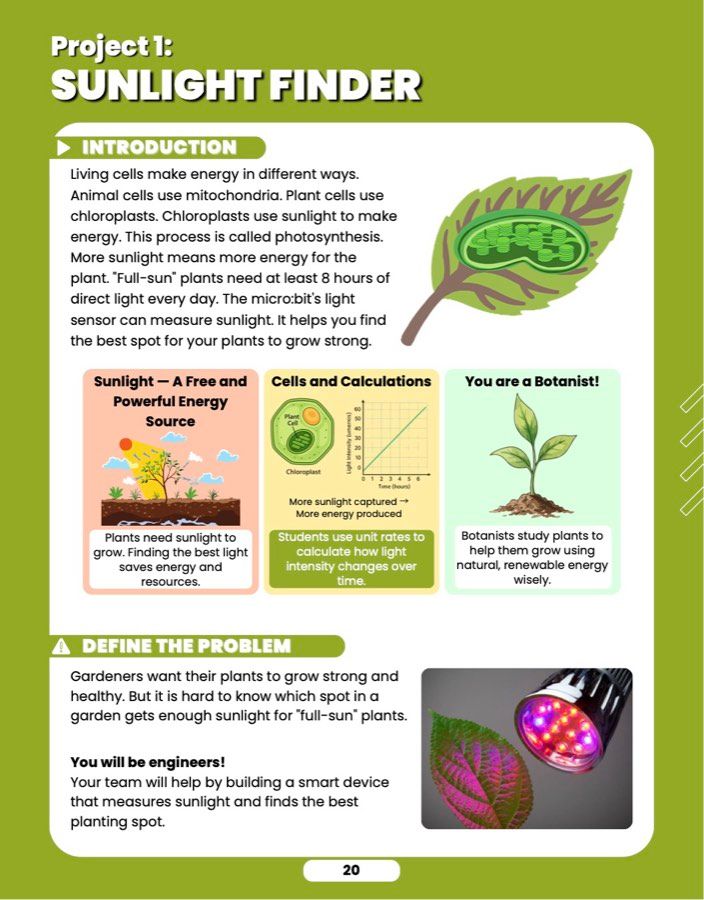
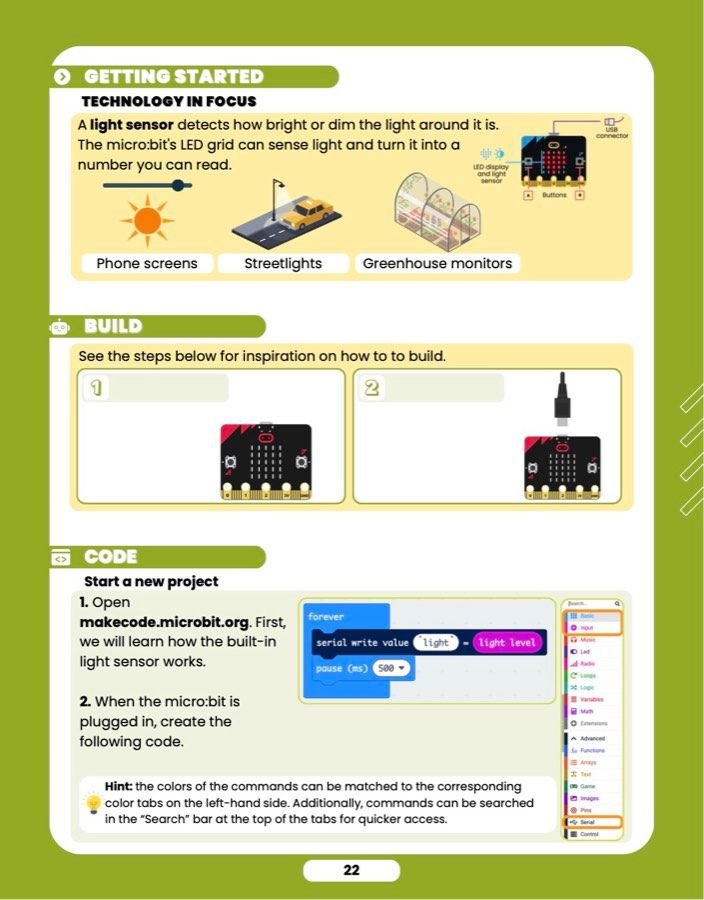
Gardeners want their plants to grow strong and healthy. But it is hard to know which spot in a garden gets enough sunlight for “full-sun” plants. Your team will help by building a smart device that measures sunlight and finds the best planting spot.The problem, as printed in the workbook.
- Goal named
- SDG 7 · Affordable and Clean Energy
- Careers named
- Botanist, Farmer
- Standards cited
- NGSS MS-LS1-2; Cambridge Science 7Bs.02; Common Core 7.RP.A.1; Cambridge Mathematics 7Nf.11
Standards cited in Level 7, project by project
One row per project, quoted as the guidebook cites them. An empty cell means no citation for that project.
- PS1
- LS1
- LS2
- LS4
- ESS1
- ESS2
- ETS1
- TWSc
- TWSm
- TWSa
- Bp
- Bs
- Be
- Cm
- Cp
- Pf
- Pe
- ESp
- ESs
- ESc
- SIC
- Ni
- Nf
- Gg
- Ae
- As
| Project | SDG | NGSS | Cambridge Science | Cambridge Maths | Common Core Maths | ISTE | Careers named |
|---|---|---|---|---|---|---|---|
| 1 Sunlight Finder | Affordable and Clean Energy | MS-LS1-2 | 7Bs.02 | 7Nf.11 | 7.RP.A.1 | 1.4.a1.4.c | Botanist, Farmer |
| 2 AI Fitness Timer | Good Health and Well-Being | MS-ETS1-4 | 7TWSc.037TWSa.017TWSa.02 | 7.Ae.03 | 7.EE.A.1 | 1.4.a1.4.c | Medical Professional, Fitness Instructor |
| 3 Key Classification | Life on Land | MS-LS2-1 | 7Bp.04 | 7Nf.01 | 7.RP.A.2 | 1.3.d | Wildlife Biologist, Paleontologist |
| 4 Decomposer Population Analysis | Life Below Water | MS-LS2-2 | 7Be.017Be.02 | 7Nf.09 | 7.RP.A.3 | 1.3.d | Microbiologist, Waste Management |
| 5 Metal or Nonmetal? | Industry, Innovation and Infrastructure | MS-PS1-1 | 7Cm.03 | 7Ni.01 | 7.NS.A.1 | 1.7.c | Materials Scientist, Electrical Engineer |
| 6 Thermal Particle Model | Decent Work and Economic Growth | MS-PS1-4 | 7Cm.067Cm.07 | 7Nf.03 | 7.NS.A.2 | 1.6.c | Materials Scientist, Chemist |
| 7 Acids and Bases | Quality Education | MS-PS1-3 | 7Cp.027Cp.03 | 7Nf.01 | 7.NS.A.3 | 1.3.d | Materials Scientist, Chemist |
| 8 AI Animal Recognition System | Life on Land | LS2.C | 8Be.03 | 7Ae.04 | 7.EE.A.2 | 1.3.d | Biologist, AI Engineer |
| 9 Smoke Alarm | Life on Land | LS4.D | 7SIC.059Be.01 | 7Gg.01 | 6.G.A.3 | 1.3.d1.4.a | Environmental Engineer, First Responder |
| 10 Humidity Monitor | Climate Action | MS-ESS2-4 | 7ESc.01 | 9Gg.01 | 7.G.B.4 | 1.3.d | Environmental Engineer, Meteorologist |
| 11 Tides | Climate Action | MS-ESS1-2 | 7ESs.03 | 8.Gg.11 | 7.G.B.5 | 1.3.d | Weather Analyst, Oceanographer |
| 12 Circuit Current Control | Decent Work and Economic Growth | MS-ETS1-3 | 7Pe.04 | 7.Gg.01 | 7.G.A.1 | 1.7.c | Electrical Engineer, Electrician |
| 13 AI Storytelling Device | Quality Education | MS-ETS1-4 | 7TWSc.037TWSa.017TWSa.02 | 7.Ae.03 | 7.EE.A.1 | 1.4.a1.4.c | AI Product Manager, Reading Specialist |
| 14 Earthquake Alarm | Climate Action | MS-ESS2-3 | 7ESp.017ESp.02 | 7.Gg.01 | 7.G.A.2 | 1.7.c | Geologist, First Responder |
| 15 Simple Machines | Industry, Innovation and Infrastructure | MS-ETS1-3 | 7Pf.017SIC.02 | 7As.04 | 6.EE.C.9 | 1.3.d1.4.a | Mechanical Engineer |
| Capstone AI Magic Show | Industry, Innovation and Infrastructure | MS-ETS1-4 | 7TWSm.01 | — | — | 1.3.d1.4.a | — |
Source: SKOOL21 Level A to 12 curriculum crosswalk (2026), compiled from the teacher guides and student books. Where the two differ, the student book prevails.
What you order
| Item | Title | ISBN or SKU |
|---|---|---|
| Student workbook | STEM Innovator’s Workbook, Level 7 | 978-981-17494-3-8 |
| Teacher guidebook | Guidebook, Level 7 | 978-981-17737-1-6 |
| Learning kit | STEM Micro:bit Kit | STEMSIHKitG67 |
Levels 6 and 7 share the STEM Micro:bit Kit.
Assessment built in
Four checkpoints a year use a seven-criterion rubric, and every other project gets a 30 second workbook check.
How assessment works →Standards mapped
The guidebook maps each project to NGSS, Cambridge and Common Core standards where they apply.
See the table for this level →